Passing your driving test does not put you in the clear. Under the Road Traffic (New Drivers) Act 1995, your licence is cancelled (revoked) if you reach 6 or more penalty points within 2 years of passing your first driving test in Great Britain, and points you picked up on your provisional licence count too. Lose it, and you are back to square one: a new provisional licence and both the theory and practical tests again. This guide explains what the rule means while you are still learning, on test day and through your first two years, and how to avoid ever sitting the tests twice.
The rule in five points
The limit: 6 points within 2 years of passing your first test (experienced drivers get a ban at 12 points within 3 years).
Provisional points count: unexpired points on your provisional licence carry over to your full licence.
Revocation is automatic. It still applies if you accept a fixed penalty rather than going to court.
Getting your licence back: apply and pay for a new provisional licence, then pass the theory and practical tests again.
No second probation: passing a test for another category, such as a lorry, does not start a new 2-year period.
The rules apply for 2 years after you pass your first driving test, if you passed it in:
Great Britain or Northern Ireland
the Isle of Man, the Channel Islands or Gibraltar
an EU or EEA country
They also apply if you exchanged a foreign licence for a British one and then passed a further driving test in Great Britain. If you already hold a full licence for one type of vehicle from one of the countries listed above, passing a test for another type does not put you back under the rules.
Before you pass: why learner points matter
Alex gets 3 points for speeding while learning, with a supervisor in the car. Alex passes the test a few months later. Those 3 points carry over. Any further offence carrying 3 or more points within 2 years of passing takes Alex to 6, and the licence is cancelled.
The lesson for learners: drive to test standard on every practice drive, not just on test day. A phone offence counts for supervisors too. The law on holding a phone applies to anyone supervising a learner. See phones and sat navs: the law.
Revoked: retaking both tests
DVLA cancels your full licence. You cannot drive unsupervised.
Apply and pay for a new provisional licence.
Drive only as a learner: supervised, with L plates.
Pass the theory test again, including hazard perception.
Pass the practical driving test again, to the same standard: no more than 15 driving faults and no serious or dangerous faults.
If you passed but hadn’t sent off for your full licence yet: you must still retake both tests, but you can use your current provisional licence to take them.
Revocation is different from a ban. A court ban (for example for drink-driving) is separate and can be added on top.
Your first two years: the safety code for new drivers (Highway Code Annex 8)
The Highway Code says as many as one new driver in five has some kind of collision in their first year. Annex 8 gives this advice for the first 12 months:
Avoid driving between midnight and 6 am unless it’s really necessary. It is a high-risk time for new drivers.
You are responsible for your passengers. Don’t let them distract you or push you into taking risks.
Never show off or compete with other drivers.
Don’t drive after any alcohol or drugs. Check the labels on over-the-counter medicines.
Make sure everyone wears a seat belt for the whole journey.
Keep your speed down, especially on bends, where many serious collisions happen because a driver loses control.
Get plenty of solo experience before driving a high-powered car.
Never drive uninsured.
Annex 8 also suggests further training such as Pass Plus, which could reduce your insurance costs.
Common questions
Does the 2 years start on test day or when my licence arrives?
It runs from the date you pass your first driving test.
Do points from before my test count?
Yes. Unexpired provisional licence points carry over and count towards the 6.
Can I avoid revocation by paying a fixed penalty?
No. The Highway Code says the rule applies even if you pay by fixed penalty.
Does it matter if I pass a lorry or motorcycle test later?
No. There is no new 2-year period when you pass a test for another category of vehicle.
After I re-pass, do I get another 2-year probation?
The official guidance doesn’t say so. Check with DVLA if this affects you.
Does Northern Ireland have the same rule?
Tests passed in Northern Ireland are covered by the rule described here. Northern Ireland also has its own new-driver rules and R plates. See the Northern Ireland guide.
Looking for lessons or an instructor? Our sister site Compare Driving Instructors covers lesson prices and choosing an instructor.
In Great Britain, a motoring conviction can put penalty points on your driving record, from 1 to 11 depending on the offence. The points are recorded with an endorsement code such as SP30 for speeding or CU80 for using a phone. Reach 12 points within 3 years and you can be banned for at least 6 months. For drivers in their first 2 years after passing, the limit is 6 points. This guide covers fixed penalty amounts, the most common codes, how long points last and when a ban becomes automatic.
Key facts
Points range from 1 to 11 per offence.
12 or more points within 3 years: disqualification for at least 6 months (“totting up”, code TT99).
New drivers: 6 or more points within 2 years of passing and your licence is cancelled.
Endorsements stay on your record for 4 or 11 years, depending on the offence.
Dangerous driving and drink-driving carry a compulsory ban of at least 12 months.
Common fixed penalties (as of November 2026)
Offence
Fixed penalty
Points
Code
Speeding (minimum penalty)
£100
3
SP30 (SP50 on a motorway)
Holding and using a phone or other device while driving
£200
6
CU80
Driving a car you are not insured to drive
£300
6
IN10
Speeding: you may be offered a speed awareness course instead of the fine and points, if the police think it is appropriate and you haven’t been on one in the past 3 years. If you plead not guilty and lose in court, the fine is usually a percentage of your weekly income, up to £1,000 (£2,500 on a motorway).
Fixed penalties for other offences vary, so check the amount on the notice you receive.
Maximum court penalties (Highway Code Annex 5)
Offence
Maximum penalty
Points
Dangerous driving
2 years’ prison, unlimited fine, compulsory ban
3 to 11
Careless and inconsiderate driving
Unlimited fine, possible ban
3 to 9
Drink or drug driving, or failing to provide a specimen
6 months’ prison, unlimited fine, compulsory ban
3 to 11
Failing to stop after, or report, an accident
6 months’ prison, unlimited fine, possible ban
5 to 10
Driving while disqualified
6 months’ prison (12 in Scotland), unlimited fine, possible ban
6
Driving without insurance
Unlimited fine, possible ban
6 to 8
Using a hand-held mobile phone
£1,000 fine, possible ban
6
Speeding
£1,000 fine (£2,500 on motorways), possible ban
3 to 6, or 3 by fixed penalty
Traffic light offences
£1,000 fine, possible ban
3
Driving otherwise than in accordance with a licence
£1,000 fine, possible ban
3 to 6
Failing to identify the driver of a vehicle
£1,000 fine, possible ban
6
No MOT certificate
£1,000 fine
None
Seat belt offences
£500 fine
None
Endorsement codes learners should know
Code
Offence
Points
AC10 / AC20
Failing to stop after an accident / failing to give details or report within 24 hours
5 to 10
CD10
Driving without due care and attention
3 to 9
CU10 / CU30 / CU40
Defective brakes / tyres / steering
3
CU50
Danger from load or passengers
3
CU80
Breach of requirements as to control of the vehicle, such as using a mobile phone
3 to 6
DD40
Dangerous driving
3 to 11
DR10
Driving or attempting to drive with alcohol above the limit
3 to 11
DG10
Driving or attempting to drive with a drug level above the specified limit
3 to 11
IN10
Using a vehicle uninsured against third party risks
6 to 8
LC20
Driving otherwise than in accordance with a licence
3 to 6
MS70
Driving with uncorrected defective eyesight
3
MS90
Failing to give information about the identity of the driver
6
MW10
Breaking motorway regulations (not speed limits)
3
PC20
Pedestrian crossing offence with a moving vehicle
3
SP30
Exceeding the statutory speed limit on a public road
3 to 6
TS10 / TS20 / TS30
Ignoring traffic lights / double white lines / a stop sign
3
Code variants: a 0 changed to 2 means you aided or abetted the offence (LC20 becomes LC22). Changed to 4 means you caused or permitted it (LC24). Changed to 6 means you encouraged it (DD46). The points are the same. That matters for supervisors: helping a learner break the law can put points on your licence too.
How long do penalty points stay on your licence?
Type of offence
Stays on record
Counts towards totting up
Most offences (speeding, phone, careless driving, insurance)
4 years from the offence date
First 3 years
Dangerous driving (DD40, DD60, DD80) or any offence resulting in a ban
4 years from conviction
First 3 years
Drink or drug driving (DR10, DR20, DR30, DR31, DR61, DR80) and causing death while under the influence (CD40, CD50, CD60, CD70)
11 years from conviction
First 10 years
Insurers and employers may be able to see a 4-year endorsement for the whole 4 years, and an 11-year endorsement for its first 5 years (30 months if you were under 18). You can view your points on your driving licence record on GOV.UK.
Totting up: when you get banned
12 or more points within 3 years: 6-month ban.
Second ban within 3 years: 12 months.
Third ban within 3 years: 2 years.
For any offence with points, a court can also ban you for whatever period it thinks fit, usually a week to a few months.
Dangerous driving and drink-driving carry a compulsory ban of at least 12 months. A second drink-drive offence within 10 years means at least 3 years.
Banned for 56 days or more? You must apply for a new licence before driving again, and the court may order a retest or extended test.
Worked example: how quickly a new driver loses their licence
Sam passed six months ago. A speed camera catches Sam speeding: £100 and 3 points. Four months later, Sam gets another speeding fixed penalty: 3 more points. That makes 6 points within 2 years of passing, so the licence is cancelled. Paying by fixed penalty makes no difference. Sam must apply for a new provisional licence and pass both the theory and practical tests again. One phone offence (6 points) would have done the same. See the New Drivers Act.
Common questions
How many points can you have before a ban?
12 within 3 years for experienced drivers. If you passed within the last 2 years, 6 points cancels your licence.
Can learners get points?
Yes. Points on a provisional licence that have not expired carry over to your full licence and count towards the new-driver limit of 6.
When can I do a speed awareness course instead of taking points?
Only if the police offer it. They must decide it suits the offence, and you must not have been on a course in the past 3 years. If you take the course, it replaces the £100 fixed penalty and 3 points.
Do I have to tell my insurer about points?
Insurers can find out about a 4-year endorsement at any point while it is on your record. Annex 5 warns that insurance is likely to rise considerably after a conviction for a serious driving offence.
What is code TT99?
It shows a ban for totting up 12 or more points within 3 years. It stays on your record for 4 years from conviction.
Are codes different in Northern Ireland?
Yes, Northern Ireland has its own endorsement codes and processes. A ban in Great Britain also applies in Northern Ireland and the Isle of Man.
Department for Transport, “The Highway Code: Annex 5. Penalties” (gov.uk)
GOV.UK, “Penalty points (endorsements)” (Overview, Endorsement codes and penalty points, How long endorsements stay on your driving record, New drivers) (gov.uk)
GOV.UK, “Speeding penalties” (gov.uk)
GOV.UK, “Using a phone, sat nav or other device when driving” (gov.uk)
GOV.UK, “Vehicle insurance: Driving without insurance” (gov.uk)
To drive a car legally in Great Britain you need four things in place: the right driving licence, at least third-party insurance that covers you, vehicle tax, and a current MOT if the car is over three years old. The car must also be registered with DVLA, with the V5C logbook in the keeper’s name. This guide explains each document, the penalties for missing one, and the points a new driver can least afford. It is based on Annex 3 of the Highway Code and DVLA and DVSA guidance on GOV.UK.
Car documents checklist
Document
Who needs it
Penalty if missing (as of November 2026)
Driving licence for the right category
Every driver
Code LC20: 3 to 6 points
Insurance (third party minimum)
Every driver, for the car they are driving
£300 fixed penalty and 6 points, or in court an unlimited fine and possible ban
MOT certificate
Cars from the third anniversary of registration
Fine of up to £1,000
Vehicle tax (VED)
Every car used or kept on a public road, even if it is exempt
Offence; the car cannot be taxed without a valid MOT
V5C registration certificate (logbook)
The registered keeper
Must tell DVLA about a sale, purchase, or name or address change
Insurance: what is the legal minimum?
You MUST have an insurance policy that at least covers injury or damage to a third party while you use the car (Annex 3). Check the policy covers you in that car before you drive it. If the car is insured but you are not, you can still be penalised.
Type of cover
What it covers
Third party
The legal minimum. Covers anyone you injure or whose property you damage. Does not cover your own car or your own injuries.
Third party, fire and theft
As above, plus your car if it is stolen or damaged by fire.
Comprehensive
As above, plus damage to your own car up to its market value and personal injury to you.
Penalties for no insurance
Police can give a fixed penalty of £300 and 6 points (code IN10 carries 6 to 8 points).
In court: an unlimited fine and disqualification.
Police can seize the car and, in some cases, destroy it. Roadside cameras can detect uninsured cars.
New drivers: 6 points within two years of passing cancels your licence, so one no-insurance offence is enough. See the New Drivers Act.
Continuous insurance enforcement
A registered keeper must keep the car insured unless it has been declared off the road (SORN). If an uninsured car is not SORN, the keeper can get a £100 fine, have the car clamped, impounded or destroyed, and face a court fine of up to £1,000. You can check whether a car is insured on askMID.
By the third anniversary of its registration, then every year after that. Some vehicles need testing at one year old.
An MOT lasts a year. You can take it up to a month (minus a day) before it runs out and keep the same renewal date. For example, if it runs out on 15 May, the earliest test date that keeps the renewal date is 16 April.
Cars made or first registered over 40 years ago are exempt, unless they have been substantially changed in the last 30 years.
If the MOT has run out
You cannot drive or park the car on the road. The only exceptions are driving it to a pre-arranged MOT test, or to or from somewhere for repairs. The fine is up to £1,000. Driving an unroadworthy car may also invalidate your insurance. You can check a car’s MOT history and expiry date online on GOV.UK.
Vehicle tax (VED) and SORN
Vehicle Excise Duty MUST be paid on every vehicle used or kept on a public road. You must tax it even if nothing is due because it is exempt.
Tax does not transfer when you buy a car. You must tax it before you drive it, or declare it off the road.
You cannot renew tax if the MOT has expired. MOT records can take up to 2 days to update after a pass.
Tax online with the reference from a DVLA reminder, the V5C in your name, or the green ‘new keeper’ slip. You can also tax by phone or at a Post Office.
SORN: if you keep an untaxed car off the road, you MUST declare SORN. It is an offence not to. A SORN car must not be used on the road.
The V5C logbook explained
The V5C (registration certificate) describes the vehicle and names its registered keeper. Annex 3 says you MUST tell DVLA as soon as possible when you:
buy or sell a car (the seller tells DVLA, and the buyer keeps the green new keeper slip)
change your name or address
Tell DVLA too if you modify the car. GOV.UK lists a new logbook at £25 (as of November 2026), for example if you bought a car without one (form V62) or lost the original. More on modifications: modifying your first car.
Do you have to carry your documents?
No. But if a police officer asks, you MUST be able to produce your driving licence, a valid insurance certificate and, if needed, a valid MOT certificate. If you don’t have them with you, you may be asked to take them to a police station within 7 days.
Learner drivers: extra requirements
A valid provisional licence.
A supervisor aged at least 21 who has held a full licence for that type of car (manual or automatic) for at least three years.
L plates (D or L plates in Wales), visible from the front and back.
Photo: Mike Bird / Pexels. Illustrative photograph.
After a collision in Great Britain, stop safely and deal with any danger or injuries first. The law says you must stop, give your details to anyone with reasonable grounds to ask for them, and report it to the police within 24 hours if you did not give your details at the scene. The duty applies when a vehicle on a road or other public place is involved in an accident that injures anyone other than you, or damages another vehicle, one of the listed animals, or property on or next to the road. It can apply even if your car did not touch anything. Damage only to your own car or trailer does not trigger it. This checklist covers what to do at the scene, what to exchange and when the 24-hour police report applies. It is based on Highway Code Rules 281 to 287 and section 170 of the Road Traffic Act 1988.
Key facts
You MUST stop if the accident injures anyone other than you, or damages another vehicle, a listed animal, or property on or next to the road (Rule 286, section 170).
You MUST give your name and address, the vehicle owner’s name and address, and the registration number to anyone with reasonable grounds for requiring them.
Didn’t give your details at the scene? Report the collision to the police as soon as reasonably practicable, and in any case within 24 hours.
Someone injured and you couldn’t show insurance? Report to the police within 24 hours and produce your insurance certificate within seven days of the accident, at the police station you named when you reported (Rule 287).
Tell your insurer even if you are not planning to claim.
Failing to stop or report carries 5 to 10 penalty points, an unlimited fine and up to 6 months in prison.
What to do at the scene: step by step
Rule 283 sets out what to do if you are involved in a collision or stop to help.
Stop, in a place of relative safety if possible.
Put your hazard warning lights on.
Put on high-visibility clothing if you have it.
Ask drivers to switch off their engines, and ask everyone to stop smoking.
Call 999 and give the exact location and details of any casualties. Use an emergency phone, a mobile, or your car’s SOS button if it has one.
Move uninjured people away from the vehicles to a safer place.
Do not move injured people from their vehicles unless they are in immediate danger.
Do not remove a motorcyclist’s helmet unless it is essential and you are trained to do so.
Stay at the scene until the emergency services arrive, if you called them.
Exchange details (see below).
What details must you exchange after a car accident?
Under Rule 286 and section 170 of the Road Traffic Act 1988, give these to anyone with reasonable grounds for requiring them, such as the other driver, the owner of damaged property or a police officer:
You must give
Notes
Your name and address
Always.
The vehicle owner’s name and address
If the car is not yours, for example a parent’s car or a lesson car.
The vehicle registration number
Always.
Your insurance certificate
If someone else is injured, to a police officer or anyone with reasonable grounds to ask. If you can’t produce it then, see the 24-hour rule below.
The law sets this minimum. It also makes sense to note the other driver’s details, their registration, the time and place, and any witnesses, because your insurer will ask for them.
When must you report an accident to the police within 24 hours?
You must report the collision to the police if either of these applies:
you did not give your name and address at the time, for example because nobody was there when you hit a parked car or a wall; or
another person was injured and you did not produce your insurance certificate at the time.
Report it as soon as reasonably practicable and in any case within 24 hours. If someone was injured and you did not show your insurance, you can produce the certificate within seven days of the accident at the police station you named when you reported. That does not give you longer than 24 hours to report.
Section 170 says the report must be made at a police station or to a police officer. Leaving a note on a windscreen does not replace the police report.
Which animals count?
Section 170 of the Road Traffic Act 1988 defines “animal” for this duty as a horse, cattle, ass, mule, sheep, pig, goat or dog, other than one carried in or on your own vehicle or trailer. If you hit one of these, you must stop and give your details, or report it to the police within 24 hours. Cats and wild animals such as deer are not on the list, so hitting one does not on its own trigger the duty. The duty still applies if the same collision injures a person or damages another vehicle or property on or next to the road. Stop safely if you can and deal with any danger to other traffic.
Scenario: you clip a parked car and nobody is around
You must stop. There is nobody to give your details to, so you must report the collision to the police within 24 hours. Driving off, even after leaving a note, risks a failing-to-report offence (code AC20) with 5 to 10 penalty points. For a new driver, 6 points within two years of passing means losing your licence. See the New Drivers Act.
Incidents involving dangerous goods
Vehicles carrying dangerous goods in packages show plain orange reflective plates. Tankers show hazard warning plates (see vehicle markings and hazard plates). If one is involved in an incident (Rule 285):
follow Rule 283, switch off engines and do not smoke
keep well away from the vehicle and do not try to rescue casualties, because you could become one
call 999 and describe the labels and markings on the vehicle
do not use a mobile phone close to a vehicle carrying flammable loads
Passing an incident you are not involved in
If you see flashing lights from emergency or incident support vehicles ahead, slow down and be ready to change lanes or stop (Rule 281).
You MUST follow directions from police or traffic officers about passing an incident.
Don’t slow down unnecessarily to look, for example at a crash on the other side of a dual carriageway. Watch the road ahead (Rule 282).
Penalties for failing to stop or report
Code
Offence
Penalty points
AC10
Failing to stop after an accident
5 to 10
AC20
Failing to give particulars or report an accident within 24 hours
5 to 10
AC30
Undefined accident offences
4 to 9
The Highway Code penalty table lists a maximum of 6 months’ imprisonment, an unlimited fine and discretionary disqualification. AC codes stay on your record for 4 years from the date of the offence. More in penalty points and endorsement codes.
After the scene: insurance
You must report the collision to your insurance company even if you don’t plan to claim.
If the other driver was uninsured, tell the police. Your insurer can advise you, and you may be able to get compensation as the victim of an uninsured or hit-and-run driver.
Even if a collision was not your fault, insurers may still hold you liable (Highway Code Annex 3).
Common questions
Do I have to call the police after every accident?
No. If nobody is hurt and you exchange details at the scene, there is no legal duty to report. You must report within 24 hours if you didn’t give your details, or if someone was injured and you didn’t show your insurance certificate. Rule 283 says to call 999 with the location and details of any casualties.
Does the 24-hour rule apply in a car park?
Section 170 covers accidents on a road or other public place. Annex 4 of the Highway Code explains that “road” can include many car parks and driveways the public can use, so assume the duty applies.
What if I hit a cat?
Cats are not on the section 170 list, so hitting a cat does not on its own create a duty to report. You must still stop and report if the same collision injures someone or damages another vehicle or property. Stop safely if you can and check whether the animal or debris is a danger to other traffic.
I’m a learner. Who gives details, me or my supervisor?
The duty falls on the driver, which is you. Give your own name and address and the owner’s details if the car isn’t yours.
Should I admit fault at the scene?
The law only requires you to give the details listed above. Report the facts to your insurer and let them deal with liability.
Can I get points for not reporting even if the damage was minor?
Yes. Failing to stop or report carries 5 to 10 points whatever the amount of damage. A new driver loses their licence at 6 or more points within two years of passing, so 6 to 10 points would do it on their own, and 5 points leaves no room for any other offence.
Department for Transport, “The Highway Code: Breakdowns and incidents (275 to 287)” (gov.uk)
Department for Transport, “The Highway Code: Annex 4. The road user and the law” (gov.uk)
Department for Transport, “The Highway Code: Annex 5. Penalties” (gov.uk)
Department for Transport, “The Highway Code: Annex 3. Motor vehicle documentation and learner driver requirements” (gov.uk)
Department for Transport, “Reporting road accidents to the police: consultation” (December 2016), quoting Road Traffic Act 1988 section 170 (assets.publishing.service.gov.uk)
Photo: John Joshua Mejia Jose / Pexels. Illustrative photograph.
If your car breaks down in Great Britain, get it off the road if you can, put your hazard warning lights on, and get yourself and your passengers away from moving traffic. On an ordinary road, place a warning triangle at least 45 metres behind the car if you can do it safely, taking great care placing and collecting it. Never use a triangle on a motorway. On a motorway, the Highway Code’s routine is “Go left, Get safe, Get help”. On a level crossing, get everyone out and clear first. This checklist turns Highway Code Rules 275 to 280 and Rule 299 into steps for new drivers in England, Scotland and Wales.
Where is the safest place to stop?
Rule 275 says try to stop in a place of relative safety, where you, your passengers and your car are less at risk from moving traffic.
Best: somewhere designed for parking. On motorways and other high-speed roads, that means a service area.
Next best: a lay-by or an emergency area.
Last resort: a hard shoulder. Rule 275 warns it gives less protection because it is so close to fast traffic.
Wherever you stop, keep well away from the car and moving traffic if you can. Traffic could hit your car and push it into you.
Checklist: breakdown on an ordinary road (Rule 276)
Get the car off the road if possible.
Switch on your hazard warning lights if the car is causing an obstruction.
If it is dark or visibility is poor, keep your sidelights on if possible.
Wear light-coloured or fluorescent clothing in daylight, and reflective clothing at night or in poor visibility.
Place a warning triangle on the road at least 45 metres (147 feet) behind the car, on the same side of the road, or use other permitted warning devices. Take great care placing and collecting it.
Do not stand, or let anyone stand, between your car and oncoming traffic.
At night or in poor visibility, do not stand where you block other drivers’ view of your lights.
Call your breakdown provider once everyone is safe.
Checklist: breakdown on a motorway (Rule 277)
First choice: leave at the next exit or pull into a service area. If you cannot, follow the three steps.
1. Go left
Move into the left lane.
Pull into an emergency area or onto the hard shoulder if you can.
Stop as far left as possible, leaving room to get out, with your wheels turned to the left.
If you can, stop just beyond an emergency telephone.
Switch on hazard warning lights. Use sidelights if it is dark or visibility is poor.
2. Get safe
Get out on the side away from traffic, if it is safe and possible, and get passengers to do the same.
Put on high-visibility clothing if it is within easy reach.
Get behind a safety barrier if there is one, watching for drops, uneven ground or debris.
Do not stand where your car could be pushed into you if something hits it.
Do not go back to your car, even if it is raining, cold or dark.
Keep passengers away from the carriageway and children under control.
Do not attempt repairs. Do not put a warning triangle on the carriageway.
Animals MUST stay in the car or, in an emergency, under control on the verge.
If you cannot get out safely
If you cannot reach the left lane or a place of relative safety, and cannot get out and away from the car and traffic, Rule 277 says:
stay in your vehicle
keep your seat belts and hazard warning lights on
call 999 immediately and ask for the police, or press your car’s SOS button if it has one and ask for the police
3. Get help
Use the free emergency telephone for advice and help, or contact your breakdown service.
Face the traffic while you speak, so you can see anything coming towards you.
Tell them if you are vulnerable, for example disabled, older or travelling alone.
Wait well away from the car and traffic, behind the barrier if there is one.
If you cannot get out, or you are not near an emergency telephone, call 999 and ask for the police, or press your SOS button.
Telling them where you are
Method
What to do
eCall
Press the SOS button if your car has one
App
Use a mapping app on your phone
Marker posts or driver location signs
Read out the numbers and letters on the posts or signs along the edge of the road
Rejoining after a breakdown (Rule 278)
From a hard shoulder: build up speed, signal, and wait for a safe gap. Watch for vehicles, obstructions or debris on the hard shoulder.
From an emergency area: you MUST use the emergency telephone and follow the operator’s advice. A lane may need to be closed so you can rejoin safely.
Emergency areas are marked by blue signs with an orange SOS telephone symbol and may have orange surfacing (Rule 270). See smart motorways and emergency areas.
Disabled drivers (Rule 279)
If a disability stops you following the motorway steps, switch on your hazard warning lights, stay in the car with your seat belt on, and call 999 for the police or press your SOS button. If you are deaf, hard of hearing or speech impaired, the Highway Code recommends registering for the 999 text service before you travel.
Something falls off your car or someone else’s (Rule 280)
Motorway or other high-speed road: DO NOT remove the obstruction yourself. Stop in a place of relative safety and call 999.
Other roads: only remove it if it is safe to do so. Otherwise stop in a safe place and call 999.
It makes no difference that the item is yours. Do not walk back along the road for it or send a passenger. If you see debris ahead, slow down under control and look at the space around you; a sudden swerve into an occupied lane can be more dangerous than the object. Checking that roof boxes and loads are secure before you set off is the easiest way to avoid the problem.
If a vehicle carrying dangerous goods is involved (Rules 284 and 285)
Vehicles carrying dangerous goods show plain orange reflective plates, and tankers carry hazard warning plates. If one is in an incident, switch off your engine and do not smoke, keep well away from it, and do not try to rescue anyone near it, because you could become a casualty yourself. Call 999 from a safe distance and describe the plates and labels you can already see. Do not move closer to read them. See vehicle markings and hazard plates.
Checklist: breakdown on a level crossing (Rule 299)
Get everyone out of the car and clear of the crossing immediately.
Use the railway telephone, if there is one, to tell the signal operator. Follow their instructions.
Move the car clear of the crossing only if there is time before a train arrives.
If the alarm sounds or the amber light comes on, leave the car and get clear at once.
a warning triangle (Rule 276; not for use on motorways)
reflective clothing for night-time breakdowns (Rule 276)
a mobile phone with emergency contacts saved, such as your breakdown service, and high-visibility clothing (Rule 97)
know-how as well as kit: while parked, find your hazard warning switch and any SOS button, and save your breakdown provider’s number before you need it
in winter, a kit of de-icer and scraper, torch, warm clothing and boots, first aid kit, jump leads, shovel, a warm drink and emergency food (Rule 228)
Common questions
How far behind my car should I put a warning triangle?
At least 45 metres (147 feet) behind the car, on the same side of the road, and only if you can place and collect it safely. Never on a motorway.
Should I stay in the car on the hard shoulder?
Only if you cannot get out safely. Otherwise get out on the side away from traffic and wait behind the barrier. If you stay in, keep seat belts and hazard lights on and call 999.
What if I break down in a live lane on a smart motorway?
If you cannot get to the left lane or a place of relative safety, and cannot get out safely, stay in the car with seat belts and hazards on and call 999 for the police (Rule 277).
Can I fix the car on the hard shoulder?
No. Rule 277 says DO NOT attempt repairs on a motorway.
Do I have to call the police if I break down?
Not always. Call 999 if you cannot get out safely, cannot reach a place of relative safety, or are not near an emergency telephone. Otherwise use the emergency telephone or your breakdown service.
Photo: Mike Bird / Pexels. Illustrative photograph.
Your first motorway drive after passing your test in Great Britain comes down to four things the Highway Code spells out: join from the slip road by matching your speed to the left lane and giving priority to traffic already there; keep left unless overtaking; overtake only on the right; and move into the left lane in good time to leave. Learners can only drive on a motorway with an approved driving instructor in a dual-controlled car, so for many new drivers this is the first time on their own. This guide walks through the trip in order, using Highway Code Rules 253 to 274.
Key facts
Speed limit: 70 mph for cars, 60 mph when towing, unless signs show a lower limit (Rules 124 and 261).
Keep left unless overtaking (Rule 264).
Overtake on the right only. Do not move to a lane on your left to overtake (Rules 267 and 268).
Red X: the lane is closed. You MUST NOT drive in it (Rule 258).
Missed your exit? Carry on to the next one. You MUST NOT reverse, cross the central reservation or drive against the traffic (Rule 263).
Breaks: at least 15 minutes after every two hours of driving is recommended (Rule 91).
A note on rule numbers: the GOV.UK Highway Code page is titled “Motorways (253 to 274)”, and Rule 274 (speed after leaving) sits in this section. The page address still reads 253 to 273.
Before you set off
Check the car. Fuel or charge, tyres, lights, screen wash. A breakdown on a motorway is far more dangerous than on a town road. See basic car maintenance.
Plan the route and exits. Know the junction number you need and the one before it. Set the sat nav before you move off.
Pick a quiet time. Rule 91 says avoid long journeys between midnight and 6 am, when natural alertness is at a minimum. A daytime trip outside rush hour is a sensible first run.
Rule 253 lists who MUST NOT use a motorway: pedestrians, provisional motorcycle licence holders, riders of motorcycles under 50 cc, cyclists, horse riders, certain slow-moving vehicles, vehicles with oversized loads (except by special permission), agricultural vehicles, and powered wheelchairs and mobility scooters. Learner car drivers may use one only with an approved driving instructor, in a dual-controlled car showing L plates (D plates in Wales).
Joining the motorway (Rule 259)
You will normally join from a slip road on the left, or from another motorway. Rule 259 says you should:
Give priority to traffic already on the motorway. They do not have to move over for you.
Check the traffic and match your speed to fit safely into the flow in the left-hand lane. Use the slip road to build up speed.
Do not cross solid white lines separating lanes, and do not use the hard shoulder.
Stay on the slip road if it continues as an extra lane on the motorway.
Stay in the left lane long enough to adjust to the speed before you think about overtaking.
Use your mirrors and a quick look over your right shoulder to find your gap. Rule 254 reminds you that traffic on motorways is usually faster, so use your mirrors earlier and look much further ahead than on other roads.
Judge the gap as it moves, not as it looked when you first saw it. A space can close as another driver changes lane, and the slip road itself can hold slow or queuing traffic. If the gap shrinks, adjust your speed and look for the next one rather than forcing your way in because the slip road is running out. Your indicator shows what you plan to do; it does not oblige anyone to make room. Once you are on, rebuild your following gap before thinking about another lane change.
On the motorway (Rules 260 to 263)
Cruise steadily at a speed you and your car can handle safely, within the limit (Rule 260).
Keep your distance. Leave at least a two-second gap, more in the wet, on ice or in fog (Rules 126 and 260). See stopping distances.
Obey red-circle speed signs. You MUST NOT exceed a speed limit shown in a red circle, including on overhead signs (Rule 261).
Watch for tiredness. Rule 262 warns that motorway driving can make you sleepy. Use the service areas. Rule 91 says do not stop on the hard shoulder or in an emergency area for a rest.
Signals over the lanes
You see
What to do
Amber flashing lights
Hazard ahead. Slow down and be ready. Only speed up again after a signal that is not flashing, or a national speed limit sign or “END”, when safe (Rule 257)
Speed limit in a red circle
A legal maximum. You MUST NOT exceed it (Rule 261)
Red X or red flashing lights over your lane
Lane closed. You MUST follow the signs to move to an open lane and MUST NOT drive in the closed lane (Rule 258)
Red lights and all lanes closed
Road closed. You MUST NOT go past the sign in any lane or use the hard shoulder unless police or traffic officers direct you (Rule 258)
Keep in the left lane unless overtaking. After overtaking, return to the left when it is safe (Rule 264). Sitting in the middle lane with an empty left lane is poor lane discipline.
If people or vehicles are stopped on the hard shoulder or in an emergency area and you are in the left lane, move into the next lane if it is safe, to give them more room (Rule 264).
On a motorway with three or more lanes, vehicles towing a trailer MUST NOT use the right-hand lane, except in prescribed circumstances (Rule 265).
Approaching your junction, look well ahead for overhead signs and change lanes early. Some lanes lead directly off the motorway; only use them if you want that exit (Rule 266).
Overtaking (Rules 267 and 268)
Overtake only on the right, and only when you are sure it is safe and legal. Rule 267 says:
Check your mirrors and take time to judge the speeds correctly.
Make sure the lane you are joining is clear ahead and behind. Traffic may be coming up very fast.
Take a quick sideways glance into your blind spot. Look out for motorcyclists.
Signal in plenty of time, then move out.
Do not cut in on the vehicle you have overtaken.
Rule 268 says do not overtake on the left or move to a lane on your left to overtake. The exception is congestion: if lanes are moving at similar speeds and the left lane happens to move faster, you may keep up with your lane. Do not weave between lanes.
Leaving the motorway (Rules 273 and 274)
Watch for the signs counting down to your exit.
Move into the left-hand lane well before the exit.
Signal left in good time, and slow down on the slip road as needed (Rule 273).
Check your speedometer. Rule 274 warns that after the motorway your speed may be higher than you realise: 50 mph may feel like 30 mph. Some slip roads and link roads have sharp bends.
If you realise late that you are in the wrong lane, or a sat nav instruction comes too late, do not swerve across lane markings or into an occupied lane. Stay on a safe route, carry on to the next junction and let the sat nav recalculate. Before a first trip, decide which junction you would use if you missed your exit.
Never on a motorway
You MUST NOT
Rule
Reverse, including on slip roads, hard shoulders and emergency areas
263
Cross the central reservation or drive against the traffic
263
Use the hard shoulder except in an emergency or when directed
269
Stop on the carriageway, hard shoulder, slip road, central reservation or verge except in an emergency or when told to
271
Pick up or set down anyone, or walk on the motorway, except in an emergency
272
Rule 271 also says do not stop anywhere on a motorway to make or receive phone calls, except in an emergency. If something goes wrong with the car, follow what to do if your car breaks down.
Building up your experience
If you want help before going solo, Pass Plus is a course of at least 6 hours with an instructor, and one of its 6 modules covers motorways. As a learner you can also have motorway lessons with an approved driving instructor in a dual-controlled car with L plates (D plates in Wales), as Rule 253 allows. See learners and motorways, and what Pass Plus adds.
Common questions
Can I drive on the motorway straight after passing?
Yes. In Great Britain there is no waiting period after passing the car test. The learner restriction in Rule 253 ends once you hold a full licence.
What speed should I join a motorway at?
Fast enough to match the traffic in the left lane. Rule 259 says check the traffic and match your speed to fit safely into the flow.
Which lane should I drive in?
The left lane, unless you are overtaking (Rule 264).
What if I miss my junction?
Carry on to the next exit. You MUST NOT reverse or turn round (Rule 263).
Can I undertake on a motorway?
Rule 268 says do not overtake on the left or move left to overtake. In congested traffic you may keep pace with your own lane even if it passes slower traffic on your right.
How often should I take a break?
Rule 91 recommends at least 15 minutes after every two hours of driving. Stop at a service area, not on the hard shoulder.
In Great Britain you MUST NOT park on zig-zag lines at a crossing, on a clearway, on double white lines, in a cycle lane while it operates, in a reserved bay you are not entitled to use, or on the pavement in London or Scotland. The Highway Code also says not to park within 10 metres of a junction, on a bend, near a school entrance or at a bus stop. This guide is for learners and new drivers in England, Scotland and Wales. It sorts Highway Code Rules 238 to 247 into what is illegal and what is advice, with the Scotland-only rules set out separately.
MUST NOT and DO NOT: why the difference matters
The Highway Code uses “MUST” or “MUST NOT” for legal requirements: breaking them is an offence and can mean a fine or penalty points. Advice worded as “should” or “do not” is not an offence in itself, but it can be used as evidence in court, and parking somewhere dangerous can still break Rule 242. Both lists below matter for your driving test and your licence.
Where you MUST NOT stop or park (Rules 238, 240 to 242)
Yellow lines during the times shown on nearby time plates, or zone entry signs in a Controlled Parking Zone. Double yellow lines mean no waiting at any time, even without upright signs (Rule 238).
School entrance markings when upright signs show a prohibition of stopping. That includes stopping to drop off or pick up (Rule 238).
A motorway carriageway, emergency area or hard shoulder, except in an emergency (Rule 240).
A pedestrian crossing, including the area marked by the zig-zag lines (Rules 191 and 240).
A clearway (Rule 240).
Taxi bays shown by upright signs and markings (Rule 240).
An urban clearway during its hours, except to pick up or set down passengers (Rule 240).
A road marked with double white lines, even if the line on your side is broken, except to pick up or set down passengers or load and unload goods (Rule 240).
A tram or cycle lane during its period of operation, and any cycle track (Rule 240).
Red lines on red routes, unless signs say otherwise (Rule 240).
Reserved spaces for Blue Badge holders, residents or motorcycles, unless you are entitled to use them (Rule 241).
Anywhere dangerous or where your vehicle or trailer causes unnecessary obstruction (Rule 242).
Rule 240 notes that any vehicle may enter a bus lane to stop, load or unload where this is not prohibited. For the meaning of each line and sign, see yellow lines, red routes and loading bays.
The penalty for parking on zig-zags
Parking on the zig-zags is a contravention of the pedestrian crossing regulations. GOV.UK lists endorsement code PC30 (contravention of pedestrian crossing regulations with a stationary vehicle), which carries 3 penalty points. Leaving a vehicle in a dangerous position (MS10) also carries 3 points. For a new driver, two such offences reach the 6-point limit. See the New Drivers Act.
Where you should not stop or park (Rule 243)
Rule 243 says DO NOT stop or park:
Places you must not park and places the Highway Code says not to park. Illustrative diagram, not to scale.
Place
Why it causes problems
Near a school entrance
Children are hidden behind parked cars
Anywhere you would block access for emergency services
Fire engines and ambulances need the width
At or near a bus or tram stop or taxi rank
Buses cannot pull in, so passengers step into the road
On the approach to a level crossing or tramway crossing
Blocks the view and the escape route
Opposite or within 10 metres (32 feet) of a junction, unless in an authorised space
Hides emerging traffic and pedestrians, and forces turning vehicles onto the wrong side
Near the brow of a hill or a hump bridge
Drivers coming over the top cannot see you
Opposite a traffic island, or opposite another parked vehicle if that would cause an obstruction
Narrows the road so traffic cannot pass
Where you would force other traffic into a tram lane
Puts drivers in the path of trams
Where the kerb has been lowered for wheelchair and powered mobility users
Blocks the only step-free crossing point
In front of an entrance to a property
Blocks driveways
On a bend
Other drivers come round the bend into your car
Where you would obstruct cyclists’ use of cycle facilities
Pushes cyclists into traffic
The only exception is when you are forced to stop by stationary traffic.
Pavement parking: London, Scotland and the rest of Great Britain
Where
The rule (Rule 244)
London
You MUST NOT park partially or wholly on the pavement. Exceptions are allowed in limited circumstances
Scotland
You MUST NOT park partially or wholly on the pavement. Exceptions are allowed in limited circumstances
Rest of England, and Wales
You should not park partially or wholly on the pavement unless signs permit it
Rule 244 explains why: pavement parking can obstruct and seriously inconvenience pedestrians, wheelchair users, people with visual impairments and people with prams or pushchairs.
The Scotland rules in detail
Pavement parking is banned under the Transport (Scotland) Act 2019. Transport Scotland says councils could start enforcing it from 11 December 2023, with a £100 penalty, reduced to £50 if paid within 14 days (as of November 2026).
Double parking: Rule 243 says in Scotland you MUST NOT double park.
Dropped kerbs: in Scotland you MUST NOT park anywhere the kerb has been lowered to help pedestrians or cyclists. The Highway Code was updated on 10 April 2025 to make the Scottish dropped kerb and pavement rules clear.
Exemptions: councils can exempt particular stretches of pavement. Transport Scotland gives safe access for emergency vehicles as one example of why. Follow the local signs.
Choosing where to pull in
A gap at the kerb is not automatically a good place to stop. Before you commit, check the whole space against the lists above: would the car hide a junction, block a crossing, a dropped kerb or a driveway, or squeeze pedestrians off the pavement? Then check your mirrors and blind spot as you slow down, because a cyclist can come up on your left while you move in. If the place turns out to be unsuitable, drive on to the next safe, legal spot. A little extra distance is better than a rushed stop. An instructor or examiner asking you to pull over does not override a parking restriction, so choose a legal place.
Before you leave the car: Rule 239 checklist
Rule 239 says use off-street car parks or marked bays wherever possible. If you have to stop at the roadside:
Checks before you leave a parked car. Illustrative diagram, not to scale.
do not park facing against the traffic flow
stop as close to the side as you can
do not stop too close to a vehicle showing a Blue Badge; the occupant may need extra room
you MUST switch off the engine, headlights and fog lights
you MUST apply the handbrake before leaving the vehicle
you MUST make sure you do not hit anyone when you open your door. Look all around and use your mirrors
where you can, open the door with the hand on the opposite side (left hand for a right-hand door) so you turn and look over your shoulder for cyclists and motorcyclists
let passengers, especially children, get out on the kerb side
ask passengers to wait and check before they open their doors too; the same duty not to hit anyone applies to them
put valuables out of sight and lock your vehicle
Rule 239 also covers remote parking apps: you MUST make sure it is safe first and MUST stay in control throughout. At an electric vehicle charge point, park close to it and keep cables from becoming a trip hazard. More in parking at night and EV charging cables.
Controlled Parking Zones, goods vehicles and loading (Rules 245 to 247)
Controlled Parking Zones (Rule 245): the zone entry signs show when restrictions apply across the zone. Outside those times parking may be allowed in some places; otherwise park in the signed and marked bays.
Goods vehicles over 7.5 tonnes (Rule 246): MUST NOT park on a verge, pavement or land between carriageways without police permission, except when essential for loading, and then they MUST NOT be left unattended. This will not apply to your car, but explains why lorries should not be on the verge.
Loading (Rule 247): do not load or unload where there are yellow kerb markings and upright signs show restrictions. On red routes, marked and signed bays show where and when loading is allowed.
Common questions
How close to a junction can I park?
Rule 243 says do not park opposite or within 10 metres (32 feet) of a junction, unless in an authorised parking space.
Is pavement parking illegal in England?
In London, yes. Elsewhere in England and in Wales, Rule 244 says you should not do it unless signs permit. Causing an unnecessary obstruction is still an offence under Rule 242.
When did the Scottish pavement parking ban start?
Councils in Scotland could enforce it from 11 December 2023. Penalties are £100, or £50 if paid within 14 days.
Can I stop on double yellow lines to drop someone off?
Rule 238 says double yellow lines mean no waiting at any time. Check nearby signs and kerb markings for loading restrictions, and never stop on zig-zags or on school entrance markings where signs prohibit stopping.
Can I park facing the wrong way at night?
Rule 239 says do not park facing against the traffic flow. Rule 248 adds that at night you MUST NOT park on a road facing against the direction of traffic unless in a recognised parking space.
Can I park across my own driveway?
Rule 243 lists “in front of an entrance to a property” as a place not to park.
Photo: George Morina / Pexels. Illustrative photograph.
When an emergency vehicle comes up behind you in Great Britain, Highway Code Rule 219 says do not panic, think about the route it needs, and let it pass while complying with all traffic signs. That means you should not go through a red light or over a stop line, and you should not drive into a bus lane during its hours, just to get out of the way. If you need to, pull to the side and stop, but avoid stopping on a bend, a hill brow or a narrow stretch, and do not mount the kerb. This guide is for learners and new drivers in England, Scotland and Wales.
Which lights mean what?
Lights
Who uses them (Rule 219)
Flashing blue, red or green lights, sirens or flashing headlights
Ambulances, fire engines, police, doctors and other emergency vehicles
Flashing amber
Traffic officer and incident support vehicles
Rule 219 asks you to look and listen for all of these.
What to do, step by step
Stay calm. Rule 219 opens with “do not panic”. A sudden swerve or emergency stop causes more problems than it solves.
Find it. Check your mirrors and work out where the vehicle is and which way it is likely to go.
Think about its route. Will it pass on your right? Is it turning at the next junction? Make room where it needs it.
Move over only when it is safe and legal. If needed, pull to the side of the road and stop.
Pick your spot. Avoid stopping before the brow of a hill, on a bend or on a narrow section where the emergency vehicle cannot get past you.
Do not brake harshly approaching a junction or roundabout. The driver behind may not have the same view as you.
Signal and check before rejoining. There may be a second emergency vehicle following the first.
Red lights, stop lines and bus lanes: what not to do
Rule 219 tells you to let emergency vehicles pass while complying with all traffic signs. The rules on lights and lanes do not include an exception for getting out of the way.
Temptation
What the rules say
Edge through a red light to clear a path
Rule 176: you MUST NOT move forward over the white line when the red light is showing
Move into the cyclists’ box at an advanced stop line
Rule 178: you MUST stop at the first white line if the lights are amber or red
Swerve into a bus lane during its hours
Rule 141: unless otherwise indicated, you should not drive in a bus lane during its period of operation
Mount the pavement
Rule 219: avoid mounting the kerb. Rule 145 says you MUST NOT drive on a pavement except for lawful access to property or in an emergency
Failing to comply with traffic light signals carries 3 penalty points (endorsement code TS10). Often the most useful thing at lights is to stay still and predictable so the emergency driver can choose their path.
On motorways and dual carriageways
Keep in the left lane unless overtaking (Rule 264). This leaves the right-hand lanes freer.
If you see flashing lights in the distance, Rule 281 says there may be an incident ahead. Slow down and be ready to move safely into another lane or stop.
Emergency services and traffic authorities use closed lanes, shown by a red X, to reach incidents. You MUST NOT drive in a closed lane (Rule 258). See smart motorways and red X signals.
If emergency services or recovery workers are stopped on the hard shoulder or in an emergency area and you are in the left lane, Rule 264 says move into the next lane if it is safe, to give them more space.
You MUST follow any directions from police or traffic officers about passing an incident (Rule 281).
In slow-moving or queuing traffic, Rule 151 says leave enough space to manoeuvre if an emergency vehicle needs to get past.
Scenario: siren behind you at red lights
You are first in the queue at a red light, in the right-hand of two lanes. An ambulance with blue lights and siren appears in your mirror.
Do not cross the stop line. Rule 176 still applies.
If there is room to ease slightly left within your lane without crossing the line or mounting the kerb, that may help. If not, stay where you are.
When the light turns green, move off and pull over once you are through the junction, somewhere wide and straight.
Powered wheelchairs and mobility scooters (Rule 220)
Rule 220 sits next to the emergency vehicle rule because it is about another road user you may meet unexpectedly. Powered vehicles used by disabled people travel at a maximum of 8 mph (12 km/h). On a dual carriageway with a speed limit over 50 mph they MUST have a flashing amber beacon, but on other roads you may get no advance warning. Be ready to slow down well in advance. See mobility scooters and powered wheelchairs.
Common questions
Can I go through a red light to let an ambulance pass?
No. Rule 219 says let emergency vehicles pass while complying with all traffic signs, and Rule 176 says you MUST NOT cross the white line on red.
Can I drive in a bus lane to let a fire engine through?
Rule 141 says you should not drive in a bus lane during its period of operation unless signs allow it. Rule 219 asks you to let emergency vehicles pass while complying with traffic signs. Find another safe way to make room.
Should I stop immediately when I hear a siren?
Not necessarily. First work out where it is and where it is going. Stop only if it is needed and you are somewhere safe, not on a bend, hill brow or narrow road.
What does a flashing green light on a car mean?
Rule 219 lists flashing green among the lights used by emergency vehicles, a list that includes doctors. Treat it like any other emergency vehicle and let it pass safely.
What do flashing amber lights on a vehicle mean?
Traffic officers and incident support vehicles use flashing amber lights. Powered wheelchairs and mobility scooters on fast dual carriageways also MUST show a flashing amber beacon.
Can I get a fine for moving out of the way?
Breaking a traffic rule is an offence, even when you are trying to help. The safest course is to make room only in ways that are legal.
At a junction in Great Britain, you MUST stop at a solid white “Stop” line, MUST give way to the main road at broken white lines, and MUST NOT enter a yellow box junction until your exit is clear, unless you are waiting to turn right. You should also give way to pedestrians crossing or waiting to cross the road you are turning into or out of. This guide covers Highway Code Rules 170 to 183 for learners and new drivers in England, Scotland and Wales: emerging, dual carriageways, box junctions, traffic lights, and turning right and left.
Junction rules at a glance
Situation
What you do
Rule
“Stop” sign and solid white line
You MUST stop behind the line, then wait for a safe gap
171
“Give Way” sign, triangle or broken white lines
You MUST give way to traffic on the main road
172
Pedestrians crossing or waiting to cross your new road
Give way; if they have started to cross they have priority
170, H2
Yellow box junction
MUST NOT enter until your exit is clear (right-turn exception)
174
Red traffic light
MUST NOT move forward over the white line
176
Advanced stop line for cyclists
MUST stop at the first white line on amber or red
178
Crossing a dual carriageway
Use the central gap only if it protects your whole vehicle
173
Taking extra care at junctions (Rule 170)
Rule 170 is the general rule for every junction. You should:
watch out for cyclists, motorcyclists and pedestrians, including people using powered wheelchairs and mobility scooters, who are not always easy to see and may not have seen or heard you
give way to pedestrians crossing or waiting to cross a road into which or from which you are turning. If they have started to cross they have priority, so give way
stay behind cyclists, horse riders, horse-drawn vehicles and motorcyclists at junctions, even if they are waiting to turn and are close to the kerb
watch for long vehicles turning ahead, which may need the whole width of the road
watch for horse riders, who may take a different line from the one you expect
not assume a vehicle coming from the right and signalling left will actually turn: wait and make sure
look all around before emerging, and only cross or join a road when the gap is large enough to do so safely
The pedestrian priority wording comes from the 2022 hierarchy of road users changes. See Rules H1, H2 and H3.
Emerging from a junction: Stop and Give Way
Stop junctions (Rule 171)
Where there is a “Stop” sign and a solid white line across the road, you MUST stop behind the line, even if you can see the road is clear. Then wait for a safe gap before moving off.
Give Way junctions (Rule 172)
The approach may have a “Give Way” sign or a triangle painted on the road. Where there are broken white lines across the road, you MUST give way to traffic on the main road. You do not have to stop if it is clear, but you must not make main road traffic slow down or swerve.
Emerging: a step-by-step routine
Check mirrors and signal in good time.
Slow down and position correctly: close to the left for a left turn, just left of the centre line for a right turn.
Look right, left and right again, and keep looking while you wait. Look for cyclists and motorcyclists, who are easy to miss.
Where your view is blocked by parked cars or hedges, creep forward slowly until you can see.
Go only when the gap is big enough to join without anyone slowing for you.
Reading the junction and judging the gap
Work through the junction in order: first the signs, signals and markings, then the path you will take into the new road, then every path that crosses it, including people on foot and in cycle lanes. A green light or a clear first lane gives you permission, not space. Check there is room for the whole car to clear the junction.
No fixed number of seconds makes a gap safe. It depends on how fast the other traffic is closing, how far you can see and how long your car takes to complete the turn. A car that looks far away may be travelling quickly, and a van in the near lane can hide a motorcyclist behind it. If you are unsure, wait and keep looking around the whole junction, not just at one vehicle.
A useful practice drill: with your instructor or supervising driver, while parked or as a passenger, point out a gap you would take and say why. Let them challenge it. After a hesitant or rushed attempt on a drive, ask yourself whether you misjudged speed, distance, the view or your own car’s acceleration, then practise that part.
Crossing or turning right onto a dual carriageway (Rule 173)
First judge whether the central reservation is deep enough to protect the full length of your vehicle.
If it is, treat each half as a separate road. Cross the first half, wait in the central reservation, then join or cross the second half when there is a safe gap.
If it is too shallow, wait until you can cross both carriageways in one go. Otherwise the back of your car would stick out into fast traffic.
This matters more if you are towing, because your vehicle is longer.
Box junctions (Rule 174)
Box junctions have criss-cross yellow lines painted on the road. You MUST NOT enter the box until your exit road or lane is clear.
When you may and may not enter a yellow box junction. Illustrative diagram, not to scale.
There is one exception: you may enter the box and wait when you want to turn right and are only stopped from doing so by oncoming traffic, or by other vehicles waiting to turn right. At signalled roundabouts you MUST NOT enter the box unless you can cross it completely without stopping.
Can I be fined for stopping in a box junction?
Yes. Rule 174 is a legal requirement. The Traffic Penalty Tribunal explains that councils in England granted moving traffic enforcement powers can use cameras to enforce yellow box junctions, with the penalty charge sent to the vehicle’s registered keeper. Charges vary by council, so check the amount on the notice and on the council’s own website.
Junctions controlled by traffic lights (Rules 175 to 178)
Red (Rule 176): you MUST NOT move forward over the white line.
Amber (Rule 175): you MUST stop behind the white stop line unless you have already crossed it or are so close that stopping might cause a collision.
Green (Rule 176): only go if there is room to clear the junction safely, or you are moving forward to turn right.
Lights not working (Rule 176): treat it as an unmarked junction and go with great care.
Green filter arrow (Rule 177): marks a filter lane. Only use it if you want to go in the direction of the arrow. You may go when the arrow or the full green shows. Give other traffic, especially cyclists, time and room to get into the right lane.
Advanced stop lines (Rule 178)
Some junctions have a second stop line with a box in front for cyclists. You MUST stop at the first white line if the lights are amber or red. Avoid stopping in the cyclists’ area at other times. If you have already crossed the first line when the light turns red, stop as soon as possible and you MUST stop at the second line. When the lights turn green, give cyclists time and space to move off. For all light signals, see Highway Code light signals.
Turning right (Rules 179 to 181)
Before the turn (Rule 179)
Well before you turn right:
Right side to right side and left side to left side turns when an oncoming car also turns right. Illustrative diagram, not to scale.
use your mirrors to know where traffic behind you is
give a right-turn signal
position just left of the middle of the road, or in the space marked for right-turning traffic
leave room for other vehicles to pass on your left, if possible
Making the turn (Rule 180)
Wait for a safe gap in oncoming traffic. Look out for cyclists, motorcyclists, pedestrians and others. Check your mirrors and blind spot again to make sure no one is overtaking you, then turn. Do not cut the corner. When turning right into a main road, watch for traffic in both directions.
Plan where the turn ends as well as where it starts: pick the lane you are turning into and steer into it without drifting across a neighbouring lane. If you realise too late that you cannot make a turn safely, carry on and find another route. Don’t stop in the junction or swerve across a lane.
When an oncoming car is also turning right (Rule 181)
Method
How it works
Highway Code view
Right side to right side (offside to offside)
Keep the other vehicle on your right and turn behind it
Generally the safer method: you have a clear view of approaching traffic as you finish the turn
Left side to left side (nearside to nearside)
Turn in front of each other
Can block your view of oncoming vehicles; cyclists and motorcyclists may be hidden. Take extra care
Road layout, markings or how the other driver positions can decide which method you use.
Turning left (Rules 182 and 183)
Use your mirrors and signal left well before the turn.
Do not overtake just before you turn left.
Watch for traffic coming up on your left, especially cyclists and motorcyclists, who may be hidden from view.
Keep as close to the left as is safe and practicable.
Give way to anything using a bus lane, cycle lane, cycle track or tramway from either direction, including when they are passing slow or stationary traffic.
If a cyclist you saw in your mirror is no longer there, don’t assume they have stopped. They may be alongside you in your blind spot. Check before you turn.
Spot any two-way cycle track or contraflow lane across the side road before you start the turn, so you look in the direction you would not expect.
If a driver behind sounds their horn, still wait. Don’t squeeze a cyclist into the corner to save a few seconds.
Rule 167 also says that if you are following a cyclist, horse rider or horse-drawn vehicle approaching a junction and you intend to turn left, stay behind and do not cut across them.
Queuing traffic near junctions (Rule 151)
In slow-moving traffic, Rule 151 says you should close up a little to help the flow, but never so close that you could not stop safely. It also says you should:
allow access into and out of side roads, because blocking them adds to the congestion
allow pedestrians and cyclists to cross in front of you
watch for cyclists and motorcyclists passing on either side
leave enough room to pull round the car ahead if it breaks down, or if an emergency vehicle needs to get through
not change lanes to the left to overtake
Before you creep forward again, check just in front and to both sides of the car, not only the brake lights ahead. If you let a driver out of a side road, remember they still need to check for a cyclist or motorcyclist coming up the outside of the queue.
Scenario: turning right at a busy crossroads
You are waiting to turn right at lights. The light goes green. An oncoming car is also turning right, a cyclist is approaching straight on behind it, and a pedestrian is waiting to cross the road you are turning into.
Move forward to your turning point, keeping clear of the junction exit.
Turn right side to right side if the layout allows, so you can see past the other car.
Wait for the cyclist to pass. They are going straight on and have priority.
Check your mirror and right blind spot, then turn, giving way to the pedestrian crossing your new road (Rule 170).
Common questions
Do I have to stop at a Give Way line?
Not if the road is clear. You MUST give way to traffic on the main road, but you only need to stop if there is traffic to give way to. At a Stop line you must always stop.
Do I have to give way to pedestrians at a junction?
Rule 170 says give way to pedestrians crossing or waiting to cross a road you are turning into or out of. If they have started to cross, they have priority.
Can I wait in a yellow box to turn right?
Yes, if your exit is clear and you are only held up by oncoming traffic or other vehicles waiting to turn right. This exception does not apply at signalled roundabouts.
What do I do if the traffic lights are not working?
Treat the junction as unmarked, where nobody has priority, and proceed with great care (Rule 176).
What is the safest way to turn right when an oncoming car is also turning right?
The Highway Code says right side to right side, turning behind the other vehicle, is generally safer because you can see approaching traffic.
Can I go on amber?
Only if you have already crossed the stop line or are so close that stopping might cause a collision (Rule 175).
Photo: Michał Robak / Pexels. Illustrative photograph.
Overtaking is one of the riskiest things a new driver does, because for a few seconds you are on the side of the road meant for oncoming traffic. In Great Britain, Highway Code Rules 162 to 169 set out when you may overtake, how to do it, where you MUST NOT, and how to behave when someone overtakes you. This guide is for learners and newly qualified drivers in England, Scotland and Wales. It turns those rules into a set of checks you can run through on the road, with the full “do not overtake” list from Rules 165 to 167.
Key facts
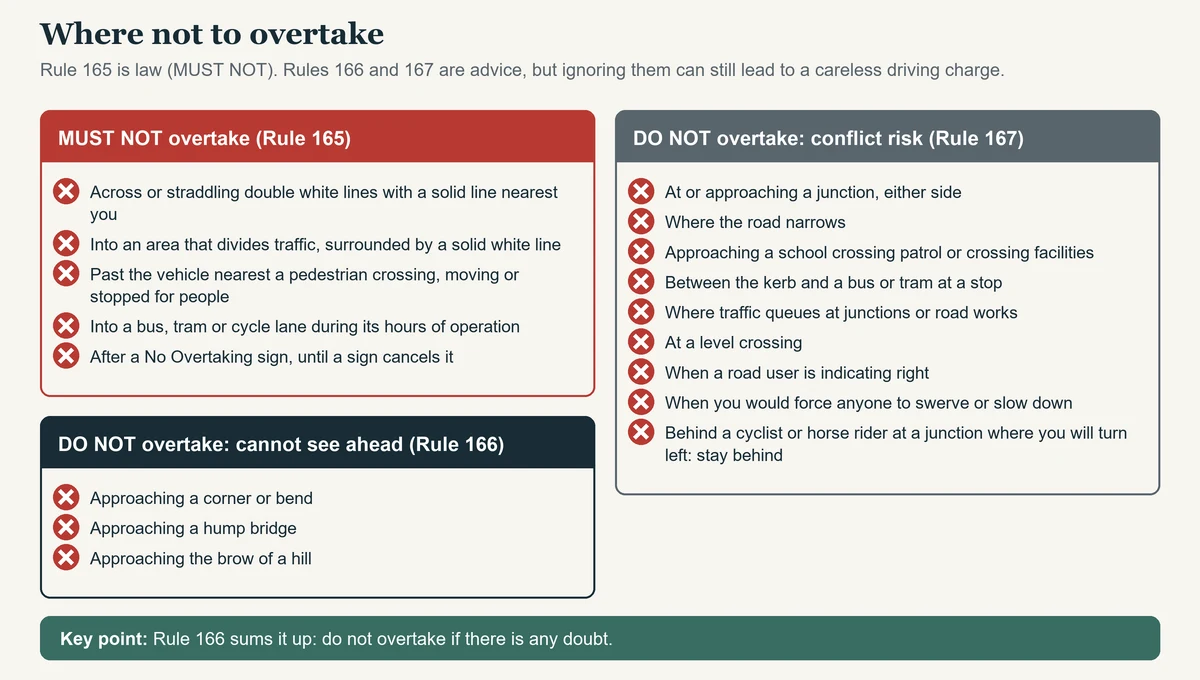
Rule 165 lists five places where overtaking is illegal, such as across a solid white line on your side or after a “No Overtaking” sign.
Rules 166 and 167 list places you should not overtake: bends, hump bridges, hill brows, junctions, crossings, level crossings and more.
Overtake on the right. Passing on the left is only for set situations, such as a vehicle ahead signalling right.
Vulnerable road users need a set minimum gap: at least 1.5 metres for cyclists at up to 30 mph, at least 2 metres for horse riders and pedestrians in the road.
Being overtaken: keep a steady course and speed, never speed up, and drop back to restore a two-second gap.
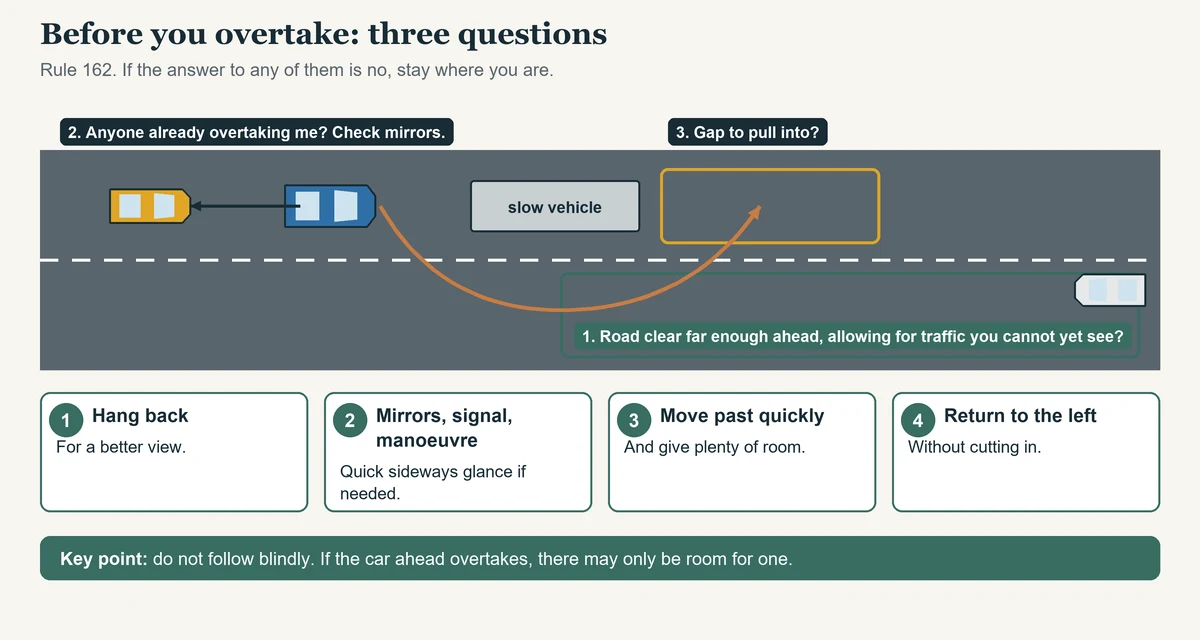
Before you overtake: the three questions in Rule 162
Rule 162 says that before overtaking you should make sure:
The three Rule 162 checks and how to overtake. Illustrative diagram, not to scale.
Is the road clear far enough ahead? You need room to pass and get back in, allowing for oncoming traffic you cannot yet see.
Is anyone already overtaking me? Check your mirrors. A car or motorcycle may be coming past.
Is there a gap to pull into? There must be a suitable space in front of the vehicle you are passing.
If the answer to any of these is no, stay where you are. Rule 166 sums it up: do not overtake if there is any doubt.
How to overtake safely (Rule 163)
Rule 163 says overtake only when it is safe and legal. Broken down into steps:
Hang back. Do not get too close to the vehicle you intend to pass. Staying back gives you a better view ahead.
Mirrors, signal, manoeuvre. Check your mirrors, signal when it is safe, and take a quick sideways glance into the blind spot if necessary before moving out.
Do not follow blindly. If the vehicle ahead overtakes, there may only be room for one. Make your own check.
Commit and move past quickly. Once you have started, pass without dawdling and give plenty of room.
Return to the left without cutting in. Move back as soon as you can, but not so sharply that the other driver has to brake.
Rule 163 also asks for extra care at night and in poor visibility, when speed and distance are harder to judge. When passing parked cars or other obstructions on your side of the road, give way to oncoming vehicles first.
Passing on the left: the only exceptions
Under Rule 163, you should only overtake on the left if:
the vehicle in front is signalling to turn right and there is room to pass, or
traffic is moving in queues and the queue on your right is moving more slowly than yours. In that case you may pass on the left, but stay in your lane.
Rule 151 adds that in slow-moving traffic you should not change lanes to the left to overtake.
How much room to give cyclists, horses and pedestrians
Rule 163 says to give motorcyclists, cyclists, horse riders and horse-drawn vehicles at least as much room as you would when overtaking a car. As a guide:
Road user
Minimum gap
Speed
Cyclist
At least 1.5 metres
At speeds up to 30 mph; give more space at higher speeds
Horse rider or horse-drawn vehicle
At least 2 metres
Under 10 mph
Pedestrian walking in the road
At least 2 metres
Keep to a low speed
Give more space in bad weather, including high winds, and at night. If you cannot leave these gaps, wait behind and do not overtake. Our guides to overtaking cyclists and passing horses safely go into more detail.
Where you MUST NOT overtake (Rule 165)
These are legal requirements. Breaking them is an offence. You MUST NOT overtake:
Where the Highway Code says you must not, or should not, overtake. Illustrative diagram, not to scale.
if you would have to cross or straddle double white lines with a solid line nearest to you (but see the exceptions below)
if you would have to enter an area designed to divide traffic, where it is surrounded by a solid white line
the nearest vehicle to a pedestrian crossing, especially when it has stopped to let pedestrians cross
if you would have to enter a lane reserved for buses, trams or cycles during its hours of operation
after a “No Overtaking” sign, until you pass a sign cancelling the restriction
The solid white line exceptions (Rule 129)
Rule 129 says you may cross a solid white line on your side, if the road is clear, to pass a stationary vehicle, or to overtake a pedal cycle, horse or road maintenance vehicle travelling at 10 mph or less. You may also cross it when you need to enter adjoining premises or a side road. If the line nearer to you is broken, Rule 128 allows you to cross to overtake if it is safe and you can finish before a solid line on your side. See road markings.
Where you should not overtake (Rules 166 and 167)
These rules use “DO NOT” rather than “MUST NOT”, but ignoring them can still lead to a careless or dangerous driving charge.
Where you cannot see far enough ahead (Rule 166)
approaching a corner or bend
approaching a hump bridge
approaching the brow of a hill
Where you might come into conflict with others (Rule 167)
approaching or at a road junction on either side of the road
where the road narrows
when approaching a school crossing patrol
on the approach to crossing facilities
where a vehicle ahead is slowing to stop for a pedestrian crossing from a pedestrian island
between the kerb and a bus or tram when it is at a stop
where traffic is queuing at junctions or road works
when you would force another road user to swerve or slow down
at a level crossing
when a road user is indicating right, even if you think the signal should have been cancelled
when you are following a cyclist, horse rider or horse-drawn vehicle approaching a roundabout or junction and you intend to turn left: stay behind and do not cut across them
when a tram is at a kerbside stop and there is no clearly marked passing lane
Overtaking large vehicles (Rule 164)
Lorries, buses, tractors with trailers and other long vehicles take longer to pass. Rule 164 says to:
drop back, so you can see further ahead and the driver can see you in their mirrors
make sure you have enough room to complete the manoeuvre before committing; if in doubt, do not overtake
remember there may be another slow vehicle in front of the one you are following
not assume you can follow a car that is overtaking a long vehicle, because it may abort and pull back in
Rule 168 says that if a driver is trying to overtake you, keep a steady course and speed, slowing down if necessary to let them pass. Never obstruct them. Speeding up or driving unpredictably while being overtaken is dangerous. If they pull into the gap in front of you, drop back to restore a two-second gap (see stopping distances and the two second rule).
Rule 169 says do not hold up a long queue, especially in a large or slow vehicle. Check your mirrors often and, if necessary, pull in where it is safe to let traffic pass.
Scenario: a tractor on a country road
You are behind a tractor doing about 20 mph on a national speed limit single carriageway. A straight stretch opens up, but there is a farm entrance on the left and the road dips out of sight 300 metres ahead.
The dip means you cannot see far enough ahead to be sure it is clear. Rule 166 says do not overtake.
The farm entrance is a junction where the tractor might turn. Rule 167 says do not overtake approaching a junction.
Wait for a stretch where you can see the whole overtake, with a gap to return to.
Tractor drivers often pull in to let traffic pass, as Rule 169 asks. For more on country roads, see learning to drive on rural roads.
Common questions
Is it illegal to overtake on the left in the UK?
Not always, but it should be rare. Rule 163 allows it when the vehicle in front is signalling right and there is room, or in slow queues where the lane on your right is moving more slowly. On motorways, Rule 268 says do not overtake on the left.
Can I cross a solid white line to overtake a cyclist?
Yes, if the road is clear and the cyclist is travelling at 10 mph or less (Rule 129). You still need to leave at least 1.5 metres.
Can I overtake at a pedestrian crossing?
You MUST NOT overtake the moving vehicle nearest the crossing, or the vehicle nearest the crossing that has stopped for pedestrians (Rules 165 and 191).
What should I do if someone overtakes me and cuts in?
Ease off and drop back to restore a two-second gap. Do not react or chase them.
Can I overtake in a bus lane?
Not during its hours of operation. Rule 165 says you MUST NOT overtake if it means entering a bus, tram or cycle lane while it is in operation.
How do I know when a no overtaking zone ends?
A no overtaking restriction lasts until you pass a sign cancelling it (Rule 165).