Author: Get Driving Test Ready

  • Mobile Phone Driving Law UK: Phones, Sat Navs and In-Car Tech

    Mobile Phone Driving Law UK: Phones, Sat Navs and In-Car Tech

    Photo: Mike Bird / Pexels. Illustrative photograph.

    In Great Britain it is illegal to hold and use a phone, sat nav, tablet or any device that can send or receive data while you are driving, even when you are stopped at traffic lights or queuing. The penalty is 6 penalty points and a £200 fine, and if you passed your test in the last 2 years you lose your licence. This explainer is for learners, new drivers and the people who supervise them. It covers Highway Code Rules 148 to 150, the exceptions, hands-free use, and what the rules say about driver assistance and self-driving features.

    The law in one minute

    • No hand-held use at all while driving: no calls, texts, photos, videos, browsing or scrolling music.
    • It still counts when you are stopped at lights, queuing in traffic, offline, in flight mode, or in a car whose engine cuts out when you stop.
    • Supervisors are covered too. The ban applies to anyone supervising a learner.
    • Penalty: 6 points and £200. In court, a fine of up to £1,000 and a possible ban.
    • New drivers: 6 points within 2 years of passing means your licence is revoked.
    • Hands-free is allowed, as long as you never hold the device and stay in full control.

    What counts as “using” a phone while driving?

    Rule 149 says you MUST NOT use a hand-held mobile phone, or a similar device capable of interactive communication such as a tablet, for any purpose when driving or supervising a learner driver. The ban covers all use, and it applies even when the device’s connection is switched off or unavailable.

    The Highway Code was updated on 25 March 2022 to make clear that the ban covers all uses, not just calls and texts. GOV.UK lists examples of what you must not do with a device in your hand:

    • text or make calls
    • take photos or videos
    • browse the web

    Rule 149 also says you MUST NOT pick up the phone to dial and then put it in a cradle for the conversation, and you MUST NOT pick up and use your phone while stationary in traffic.

    Situations that still break the law

    GOV.UK is specific that the law still applies if you are:

    • stopped at traffic lights
    • queuing in traffic
    • supervising a learner driver
    • driving a car that turns off the engine when you stop moving
    • holding and using a device that is offline or in flight mode

    If you are sitting in the passenger seat supervising a learner, picking up your phone to reply to a message is treated the same as the driver doing it. See supervising a learner driver for the other rules that apply to supervisors.

    The exceptions

    GOV.UK says you can use a device held in your hand only if:

    1. you need to call 999 or 112 in an emergency and it is unsafe or impractical to stop
    2. you are safely parked
    3. you are making a contactless payment in a vehicle that is not moving, for example at a drive-through
    4. you are using the device to park your vehicle remotely

    For contactless payments, Rule 149 adds that the vehicle MUST be stationary and you MUST receive the goods or services at the same time as, or after, the payment. For remote parking, the app or device MUST be legal and you should not put anyone in danger.

    “Safely parked” means parked, not just stopped. Pulling over on a motorway hard shoulder to take a call is not safe parking: Rule 271 says do not stop on any part of a motorway to make or receive calls, except in an emergency.

    Hands-free phones and sat navs: what is allowed?

    You can use a device hands-free as long as you do not hold it at any time while using it. GOV.UK gives these examples of hands-free access:

    • a Bluetooth headset
    • voice command
    • a dashboard holder or mat
    • a windscreen mount
    • a built-in sat nav

    The device must not block your view of the road and traffic ahead. Legal does not mean safe, though. Rule 149 says hands-free equipment is also likely to distract you and that it is far safer not to use any phone while driving: find a safe place to stop or let calls go to voicemail.

    Sat nav set-up before you go

    Rule 150 warns that sat navs, multimedia screens and other in-vehicle systems can distract you. Do not be distracted by maps or screen information while driving; if necessary, find a safe place to stop. The practical habit is simple: enter the destination and choose your music before you move off. On the driving test you may follow a sat nav during the independent driving section. GOV.UK says the examiner sets it up for you and you cannot use your own. See independent driving and the sat nav.

    Penalties for using a phone while driving

    Offence Penalty (GB)
    Holding and using a phone, sat nav, tablet or any device that can send and receive data 6 penalty points and a £200 fine
    Same offence, if you passed your test in the last 2 years Licence lost (6 points reaches the new driver limit)
    Not having a full view of the road and traffic ahead, or proper control of the vehicle 3 penalty points
    If the case goes to court Possible driving ban and a fine of up to £1,000 (£2,500 for a lorry or bus driver)

    Annex 5 of the Highway Code lists the same maximum: a £1,000 fine (£2,500 for a passenger or goods vehicle), discretionary disqualification and 6 points for using a hand-held mobile phone when driving. The phone offence carries the endorsement code CU80, which covers breaches of requirements for control of the vehicle, such as using a mobile phone.

    Why new drivers are hit hardest

    Under the special rules for new drivers in Annex 5, anyone who reaches 6 or more points within 2 years of passing their first test has their licence revoked automatically. Points picked up before passing count too. To drive again you must reapply for a provisional licence and pass the tests again. One phone offence is enough. Read the New Drivers Act and penalty points and endorsement codes.

    Other distractions in Rule 148

    Rule 148 asks you to avoid distractions such as loud music, reading maps, starting or adjusting music or the radio, arguing with passengers or other road users, eating and drinking, and smoking. It also sets out the smoking law: in England and Wales the driver MUST NOT smoke, or let anyone smoke, in an enclosed private vehicle carrying someone under 18. In Scotland it is an offence for anyone aged 18 or over to smoke in a private vehicle in a public place when someone under 18 is in it.

    Driver assistance and self-driving features

    Rule 150 says do not rely on driver assistance systems such as motorway assist, lane departure warnings or remote control parking. You remain responsible for the vehicle when you use them, and you MUST have full control over them at all times.

    The Highway Code introduction separates these from self-driving vehicles: vehicles listed as automated by the Secretary of State for Transport under the Automated and Electric Vehicles Act 2018. While a listed self-driving vehicle is driving itself in a valid situation, you are not responsible for how it drives and may view content on the built-in infotainment screen. You still MUST NOT use a hand-held phone, and you MUST be ready to take back control when the vehicle prompts you. Other laws still apply too: you MUST be fit to drive and within the drink and drug limits, and the vehicle MUST be taxed, insured, roadworthy and have an MOT if it needs one. Ordinary cars with cruise control or lane-keeping are not self-driving, so Rule 150 applies to them.

    Common questions

    Can I use my phone at traffic lights?

    No. GOV.UK says the law still applies when you are stopped at traffic lights or queuing in traffic.

    Can I use my phone as a sat nav?

    Yes, if it is in a holder or windscreen mount, you do not touch or hold it while driving, and it does not block your view. Set the route before you move off.

    Can I touch my phone in a holder?

    GOV.UK says hands-free means you do not hold the device at any time during use. Even with hands-free use, the police can stop you if they think you are not in control because you are distracted.

    Is it illegal for a supervising driver to use their phone?

    Yes. Rule 149 and GOV.UK both say the hand-held ban applies when supervising a learner.

    Can I take a photo of a crash while driving?

    No. Taking photos with a hand-held device while driving is specifically listed as illegal. Stop safely first.

    How many points for using a phone while driving?

    6 points and a £200 fine. If you passed in the last 2 years, that means losing your licence.

    Back to the main guide: Learning to Drive in Great Britain.

    Sources

    • GOV.UK, “Using a phone, sat nav or other device when driving” (gov.uk)
    • Department for Transport, “The Highway Code: General rules, techniques and advice for all drivers and riders (103 to 158)” (gov.uk)
    • Department for Transport, “The Highway Code: Annex 5. Penalties” (gov.uk)
    • Department for Transport, “The Highway Code: Introduction” (gov.uk)
    • Department for Transport, “The Highway Code: Updates” (gov.uk)
    • Department for Transport, “The Highway Code: Motorways (253 to 274)” (gov.uk)
    • GOV.UK, “Penalty points (endorsements): Endorsement codes and penalty points” (gov.uk)
    • GOV.UK, “Driving test: What happens during the test” (gov.uk)
  • Stopping Distances UK: Thinking, Braking and the Two Second Rule

    Stopping Distances UK: Thinking, Braking and the Two Second Rule

    Photo: Dominik Gryzbon / Pexels. Illustrative photograph.

    In Great Britain, the Highway Code gives a typical stopping distance for a car of 12 metres at 20 mph, rising to 96 metres at 70 mph on a dry road. Rule 126 says to leave at least a two-second gap on high-speed roads, at least double that in the wet, and up to ten times more on ice. This explainer is for learner drivers in England, Scotland and Wales, and for the parents helping them practise. It breaks down the official figures, shows how to measure a two-second gap, and covers the braking rules (117 to 122) that sit alongside it.

    Key facts

    • Stopping distance = thinking distance + braking distance. The Highway Code diagram shows both parts for each speed.
    • At 30 mph: 23 metres in total, which the Highway Code says is about six car lengths.
    • At 70 mph: 96 metres in total, or about twenty-four car lengths.
    • Two-second gap: the minimum on high-speed roads and in tunnels (Rule 126).
    • Wet roads: stopping distances are at least double (Rules 126 and 227).
    • Icy roads: the gap may need to be up to ten times greater (Rules 126 and 230).

    The Highway Code stopping distances table

    These are the figures from the “Typical stopping distances” diagram published with Rule 126. The Highway Code uses an average car length of 4 metres (13 feet) for the car-length comparison.

    Stacked bars for 20 to 70 mph showing thinking and braking distance: 12 m at 20 mph, 23 m at 30 mph, 36 m at 40 mph, 53 m at 50 mph, 73 m at 60 mph and 96 m at 70 mph.
    Highway Code typical stopping distances for a car on a dry road. Illustrative diagram, not to scale.
    Speed Thinking distance Braking distance Overall stopping distance Roughly
    20 mph (32 km/h) 6 m 6 m 12 m (40 feet) 3 car lengths
    30 mph (48 km/h) 9 m 14 m 23 m (75 feet) 6 car lengths
    40 mph (64 km/h) 12 m 24 m 36 m (118 feet) 9 car lengths
    50 mph (80 km/h) 15 m 38 m 53 m (175 feet) 13 car lengths
    60 mph (96 km/h) 18 m 55 m 73 m (240 feet) 18 car lengths
    70 mph (112 km/h) 21 m 75 m 96 m (315 feet) 24 car lengths

    The Highway Code describes these as a general guide. The real distance depends on your attention (which affects thinking distance), the road surface, the weather and the condition of your vehicle at the time.

    Spot the pattern

    Look down the thinking distance column: it goes up by 3 metres for every extra 10 mph. Thinking distance grows in step with speed because you cover more ground in the same reaction time.

    Braking distance behaves differently. Going from 30 mph to 60 mph doubles your speed, but braking distance goes from 14 metres to 55 metres, nearly four times as far. That is why a small increase in speed makes a big difference to whether you can stop in time.

    How to remember the figures for the theory test

    Stopping distances come up in the safety margins topic of the theory test. One way to learn them without memorising six random numbers:

    1. Learn the thinking distances first: 6, 9, 12, 15, 18, 21 metres. Each one is the speed’s first digit multiplied by 3.
    2. Learn the totals: 12, 23, 36, 53, 73, 96 metres.
    3. If you need a braking distance, subtract the thinking distance from the total. At 50 mph, 53 minus 15 gives 38 metres.

    What is the two second rule?

    Rule 126 tells you to drive at a speed that lets you stop well within the distance you can see to be clear. It says the safe rule is never to get closer than the overall stopping distance, and to allow at least a two-second gap between you and the vehicle in front on high-speed roads and in tunnels where visibility is reduced.

    A car follows another past a roadside sign used as a fixed point for counting two seconds, with four panels: at least two seconds when dry, at least double when wet, up to ten times on ice, and at least 5 metres when stopped in a tunnel.
    How to check a two-second gap and when to leave more. Illustrative diagram, not to scale.

    How to measure a two-second gap

    1. Pick a fixed point ahead, such as a road sign, bridge or lamp post. The Highway Code illustration uses a sign.
    2. When the rear of the vehicle in front passes that point, start counting two seconds at a steady pace.
    3. If you reach the point before you finish counting, you are too close. Ease off and count again.

    A time gap works at any speed, which is why it is easier to use than trying to judge metres. The faster you go, the more ground two seconds covers.

    When to leave more than two seconds

    Condition What the Highway Code says
    Dry, high-speed road At least a two-second gap (Rule 126)
    Wet road The gap should be at least doubled; stopping distances will be at least double (Rules 126 and 227)
    Icy or snowy road Up to ten times greater; stopping distances can be ten times greater than on dry roads (Rules 126 and 230)
    Following a large vehicle or motorcycle Remember they need a greater distance to stop (Rule 126)
    Stopped in a tunnel Leave at least a 5-metre gap to the vehicle in front (Rule 126)

    Rule 227 explains why the wet makes such a difference: your tyres have less grip on the road. If the steering suddenly feels unresponsive, water is probably stopping the tyres gripping. Ease off the accelerator and slow down gradually. For more on bad weather, see driving in rain, ice, fog, wind and heat.

    Tailgating

    The Highway Code defines tailgating as leaving a gap so small that you could not stop safely if the vehicle in front braked suddenly. It calls tailgating dangerous and intimidating, and says the police enforce dangerous and careless driving offences such as tailgating. If someone overtakes and pulls into your gap, Rule 168 says drop back to restore a two-second gap. Read more in tailgating and road rage.

    If someone is following you too closely, don’t brake to make a point or speed up to get away. Leave a bigger gap in front, so that if you need to slow down you can do it gently, and let them pass when it is safe. Two seconds is a minimum check in good conditions, not a target: grow the gap whenever grip, visibility or your own concentration is worse than usual.

    In slow-moving traffic, Rule 151 lets you close up to keep traffic flowing, but you should never get so close that you cannot stop safely, and you should leave room to steer round a vehicle that breaks down.

    Braking and control: Rules 117 to 122

    Stopping distances assume you brake well. The control rules set out how.

    • Normal braking (Rule 117): brake early and lightly, more firmly as you begin to stop, then ease off just before the car stops to avoid a jerk.
    • Emergency braking (Rule 118): brake immediately, but try not to brake so harshly that the wheels lock, because locked wheels can lead to loss of control.
    • Skids (Rule 119): skids are usually caused by harsh braking, accelerating or steering, or by going too fast for the conditions. Remove the cause by releasing the brake fully or easing off the accelerator, then steer in the direction of the skid. If the rear skids to the right, steer right.
    • ABS (Rule 120): follow the vehicle handbook. In an emergency, press the footbrake firmly and keep the pressure on until you have slowed enough. ABS should help you keep steering control, but do not assume it will stop you in a shorter distance.
    • Brakes after deep water (Rule 121): test them gently at the first safe opportunity. If they are not fully effective, apply light pressure while driving slowly to dry them out.
    • Coasting (Rule 122): travelling in neutral or with the clutch down removes engine braking, lets speed build quickly downhill, makes the footbrake work harder and affects steering on bends.

    Your examiner may ask you to do an emergency stop on the practical test. See driving test manoeuvres for how the test works.

    Scenario: a wet dual carriageway at 60 mph

    You are driving at 60 mph on a dual carriageway in steady rain. The dry overall stopping distance at 60 mph is 73 metres. Rule 227 says wet stopping distances will be at least double, so you should allow for well over 140 metres. In practice, that means counting at least four seconds behind the car ahead rather than two, and easing your speed if spray is cutting your view.

    Common questions

    What is the stopping distance at 30 mph in the UK?

    The Highway Code gives 23 metres (75 feet): 9 metres thinking distance and 14 metres braking distance. That is about six car lengths.

    What is the stopping distance at 70 mph?

    96 metres (315 feet): 21 metres thinking and 75 metres braking, or about twenty-four car lengths.

    Is the two second rule a legal requirement?

    Rule 126 uses advisory wording (“should”), so not following it is not an offence in itself. But the Highway Code can be used as evidence in court, and driving too close can amount to careless or dangerous driving, which are offences.

    How much space should I leave on ice?

    Rule 126 says the gap may need to be up to ten times greater than on a dry road, and Rule 230 says icy or snowy stopping distances can be ten times greater.

    Do the stopping distances apply to all cars?

    They are a general guide for a typical car. The Highway Code says your attention, the road surface, the weather and the condition of your vehicle all change the real figure.

    Does ABS mean I stop sooner?

    Not necessarily. Rule 120 says ABS should let you keep steering control, but you should not assume it stops the car in a shorter distance.

    Back to the main guide: Learning to Drive in Great Britain.

    Sources

    • Department for Transport, “The Highway Code: General rules, techniques and advice for all drivers and riders (103 to 158)” (gov.uk)
    • Department for Transport, “The Highway Code: Typical stopping distances” diagram (assets.publishing.service.gov.uk)
    • Department for Transport, “The Highway Code: Driving in adverse weather conditions (226 to 237)” (gov.uk)
    • Department for Transport, “The Highway Code: Using the road (159 to 203)” (gov.uk)
    • Department for Transport, “The Highway Code: Introduction” (gov.uk)
  • Child Car Seat and Seat Belt Law in GB: Rules 99 to 102

    Child Car Seat and Seat Belt Law in GB: Rules 99 to 102

    Photo: Maxim Hopman / Unsplash. Illustrative photograph.

    In Great Britain, children must use a child car seat until they are 12 years old or 135 cm tall, whichever comes first, and the driver is legally responsible for every passenger under 14. Adults aged 14 and over are responsible for wearing their own seat belt. This guide is for learner and new drivers in England, Scotland and Wales who will soon be carrying younger brothers, sisters or friends’ children. It explains Highway Code Rules 99 to 102, the seat types allowed, the exceptions and the fines.

    Key facts

    • You MUST wear a seat belt in a car, van or other goods vehicle if one is fitted (Rule 99).
    • Children need a child car seat until 12 years old or 135 cm tall, whichever comes first.
    • The driver is responsible for passengers under 14. Passengers 14 and over are responsible for themselves.
    • Only seats labelled with the E in a circle and R129 (height-based) or ECE R44 (weight-based) can be used in the UK.
    • Never fit a rear-facing baby seat in a seat protected by an active frontal airbag (Rule 101).
    • The fine is up to £500 for not wearing a seat belt, or for carrying a child under 14 without the correct seat or belt (as of November 2026).

    Who is responsible for wearing a seat belt?

    The Highway Code sets out who is legally responsible in a table under Rule 99. Here it is in plain terms:

    A timeline from birth: a child car seat until 12 years old or 135 cm, a seat belt after that, and below it the driver responsible for every passenger under 14 and the passenger responsible from 14.
    Which restraint a passenger needs and who is legally responsible. Illustrative diagram, not to scale.
    Who Front seat Rear seat Who is responsible
    Driver Seat belt must be worn if fitted Not applicable Driver
    Child under 3 Correct child restraint must be used Correct child restraint must be used. In a taxi without one, the child may travel unrestrained in the rear Driver
    Child from 3rd birthday until 135 cm tall or 12th birthday (whichever first) Correct child restraint must be used Correct child restraint must be used where seat belts are fitted (see the exceptions below) Driver
    Child over 135 cm, or aged 12 or 13 Seat belt must be worn if available Seat belt must be worn if available Driver
    Adult passenger aged 14 and over Seat belt must be worn if available Seat belt must be worn if available Passenger

    GOV.UK also says only one person is allowed in each seat fitted with a seat belt. Two children sharing one belt is not allowed.

    Which child car seat does a child need?

    GOV.UK describes two types of approved seat. Check the label before you buy or borrow one.

    A panel on height-based R129 seats, rear-facing until over 15 months, above a bar chart of the five overlapping ECE R44 weight groups from 0 to 36 kg with their seat types.
    R129 height-based seats and the overlapping R44 weight groups. Illustrative diagram, not to scale.

    Height-based seats (R129)

    These seats are chosen by the child’s height. The child must be rear-facing until they are over 15 months old. After that they can face forward. Check the seat label to make sure it suits your child’s height.

    Weight-based seats (ECE R44)

    Group Child’s weight Seat types
    0 Up to 10 kg Lie-flat or lateral baby carrier, rear-facing baby carrier, or rear-facing baby seat with harness
    0+ Up to 13 kg Rear-facing baby carrier or rear-facing baby seat with harness
    1 9 to 18 kg Rear or forward-facing seat with harness or safety shield
    2 15 to 25 kg Rear or forward-facing high-backed booster seat or booster cushion, with seat belt, harness or safety shield
    3 22 to 36 kg Rear or forward-facing high-backed booster seat or booster cushion, with seat belt, harness or safety shield

    The weight ranges overlap, so more than one seat type can suit a child. Manufacturers can now only make new booster cushions approved for Group 3, but existing Group 2 cushions can still be used.

    How to fit a child seat legally

    1. Use the seat only with a diagonal seat belt strap, unless it is designed for a lap belt or fitted using ISOFIX anchor points.
    2. Fit it exactly as the manufacturer’s instructions say (Rule 100).
    3. Never put a rear-facing baby seat in a front seat with an active frontal airbag. Deactivate the airbag first (Rule 101 and GOV.UK).
    4. Do not fit a child seat in a side-facing seat.
    5. Put bags and shopping in the boot, with heavy items low down. Anything loose on a seat or parcel shelf can hit someone under hard braking, and Rule 98 says any load MUST be secure.
    6. Let children get in and out through the door nearest the kerb, and use child safety door locks where fitted (Rule 102).

    Rule 102 also advises not to let children sit behind the rear seats in an estate car or hatchback unless a special child seat has been fitted.

    When can a child travel without a car seat?

    GOV.UK lists a small number of exceptions:

    Situation Under 3 3 and over
    Taxi or minicab without a suitable seat May travel without a seat or belt, but only in the rear Must wear an adult seat belt, in the rear
    Unexpected, necessary, short journey and the correct seat is not available Only allowed in a licensed taxi or minicab, in the rear May use an adult seat belt
    Two occupied child seats in the back stop a third being fitted Must travel in the front in the correct child seat May sit in the back using an adult belt
    Rear seat has no seat belt fitted Not covered: under 3s must be in a child car seat May travel in the back without a seat or belt

    Read these exceptions narrowly. The “unexpected, necessary, short” case needs all three: a planned school run does not become unexpected just because fetching the right seat is a hassle. The taxi exception covers licensed taxis and minicabs only, not a lift in a friend’s or relative’s car. If you are not sure an exception applies, get the correct seat or change the plan.

    Vans follow the same rules as cars. Coaches and minibuses have their own rules, and Rule 99 says passengers aged 14 and over in minibuses, buses and coaches must wear a seat belt where one is fitted.

    Exemptions for adults

    Rule 99 lists two exemptions: holders of a medical exemption certificate, and people making deliveries or collections in goods vehicles when travelling less than 50 metres. For a child who cannot use a restraint or belt because of a medical condition, a doctor can issue an exemption certificate. Children with disabilities otherwise follow the same rules, and may use a disabled person’s seat belt or a restraint designed for their needs.

    Fines

    • Up to £500 if you do not wear a seat belt when you are required to.
    • Up to £500 if you are driving and a child under 14 is not in the correct car seat or wearing a seat belt.

    Annex 8 of the Highway Code, the safety code for new drivers, asks you to make sure everyone in the car wears a seat belt throughout the journey. With friends in the car, say it before you set off. See carrying passengers for the first time.

    Scenario: the school run with three children

    You have passed your test and are asked to drive your 2-year-old cousin, your 7-year-old sister (125 cm) and her 13-year-old friend.

    • 2-year-old: must be in the correct child seat for their weight or height. You are responsible.
    • 7-year-old at 125 cm: under 12 and under 135 cm, so needs a child seat or booster. You are responsible.
    • 13-year-old: must wear a seat belt. You are still responsible because they are under 14.
    • If the two child seats in the back leave no room for a third, the under 3 would have to go in the front in the correct seat, with the front airbag deactivated if the seat is rear-facing.

    Common questions

    What age can a child stop using a car seat in the UK?

    At 12 years old or 135 cm tall, whichever comes first. After that they must wear a seat belt.

    Can a child sit in the front seat?

    The Highway Code table sets the same requirement for front and rear seats: the correct child restraint for the child’s age and height, or a seat belt once they are 12 or 135 cm. A rear-facing baby seat must never go in front of an active frontal airbag.

    Who gets fined if a 15-year-old passenger is not wearing a belt?

    Passengers aged 14 and over are responsible for wearing their own belt, so the passenger would be liable. For passengers under 14, it is the driver.

    Do I need a car seat in a taxi?

    Not if the taxi driver does not provide one. Children must sit in the back: under 3s may travel without a seat or belt, and children aged 3 and over must wear an adult belt.

    Can I use an old Group 2 booster cushion?

    Yes. New booster cushions can only be made as Group 3, but existing Group 2 cushions can still be used.

    What is the fine for not wearing a seat belt?

    Up to £500 (as of November 2026).

    Back to the main guide: Learning to Drive in Great Britain. Related: before you drive checks and the theory topic safety and your vehicle.

    Sources

    • Department for Transport, “The Highway Code: Rules for drivers and motorcyclists (89 to 102)” (gov.uk)
    • GOV.UK, “Child car seats: the law” (gov.uk)
    • GOV.UK, “Child car seats: when a child can travel without a car seat” (gov.uk)
    • GOV.UK, “Seat belts: the law” (gov.uk)
    • Department for Transport, “The Highway Code: Annex 8. Safety code for new drivers” (gov.uk)
  • UK Drink Drive Limits: England, Wales, Scotland and NI

    UK Drink Drive Limits: England, Wales, Scotland and NI

    Photo: Nathan J Hilton / Pexels. Illustrative photograph.

    The drink drive limit in England, Wales and Northern Ireland is 35 micrograms of alcohol per 100 ml of breath (80 mg per 100 ml of blood). Scotland is lower, at 22 micrograms per 100 ml of breath (50 mg per 100 ml of blood). This explainer is for learner and new drivers across the UK. It sets out every official limit, the drug driving rules, the penalties, and where the 2026 government consultation stands.

    Key facts

    • The limits are the same for learners, new drivers and experienced drivers. There is no lower novice limit in UK law as of November 2026.
    • There is no safe number of drinks. GOV.UK says alcohol affects people differently depending on weight, age, sex, metabolism, food and stress.
    • Driving over the limit carries a ban of at least 1 year, an unlimited fine and up to 6 months in prison.
    • In England, Scotland and Wales, it is illegal to drive with certain drugs in your blood above specified limits, even if your driving is not affected.
    • Annex 8 of the Highway Code, the safety code for new drivers, says simply: do not drive after drinking alcohol or taking drugs.

    What is the drink drive limit in each part of the UK?

    Measure England, Wales and Northern Ireland Scotland
    Breath (micrograms per 100 ml) 35 22
    Blood (milligrams per 100 ml) 80 50
    Urine (milligrams per 100 ml) 107 67

    Police usually test breath at the roadside. Blood or urine samples may be taken at a police station. If a UK court bans you for drink driving, GOV.UK says you cannot drive anywhere in the UK.

    Why the limit is not a target

    Rule 95 of the Highway Code for Great Britain says the safest option is not to drink at all if you plan to drive. It explains that alcohol gives a false sense of confidence, slows reactions, reduces coordination and affects your judgement of speed, distance and risk. Alcohol can impair your driving below the legal limit, and it can still be in your body the next morning or evening.

    Drug driving: the rules in England, Scotland and Wales

    Under the drug driving law, it is illegal to drive if you are unfit because of drugs, or if you have certain drugs in your blood above specified limits, whether or not your driving is affected. Rule 96 of the Highway Code explains that the limits for illegal drugs are very low, so even a small amount can put you over.

    Medicines covered by the law

    GOV.UK lists these prescription medicines as covered by drug driving limits:

    • amphetamine, for example dexamphetamine or selegiline
    • clonazepam
    • diazepam
    • flunitrazepam
    • lorazepam
    • methadone
    • morphine or opiate and opioid-based drugs, for example codeine, tramadol or fentanyl
    • oxazepam
    • temazepam

    You can drive after taking these if they were prescribed and you follow the advice of a healthcare professional, and they do not make you unfit to drive. If you are not sure, ask your doctor or pharmacist. Rule 96 says the limits for these medicines are set higher than levels expected from normal doses, and there is a statutory medical defence in some cases.

    Roadside testing

    Police can carry out a field impairment assessment, such as asking you to walk in a straight line, and can use a roadside drug kit that screens for cannabis and cocaine. If they think you are unfit to drive, you will be arrested and asked for a blood or urine sample at a police station.

    Northern Ireland

    GOV.UK says the drug driving law described above covers England, Scotland and Wales, not Northern Ireland. In Northern Ireland you can still be arrested if you are unfit to drive because of drugs.

    Drink and drug driving penalties

    Offence Prison (maximum) Fine Driving ban
    Being in charge of a vehicle while over the limit or unfit through drink 3 months Up to £2,500 Possible ban
    Driving or attempting to drive over the limit or unfit through drink 6 months Unlimited At least 1 year (3 years if convicted twice in 10 years)
    Refusing to provide a specimen of breath, blood or urine 6 months Unlimited At least 1 year
    Causing death by careless driving while under the influence of drink Life Unlimited At least 5 years, plus an extended driving test
    Drug driving (England, Scotland and Wales) 6 months Unlimited At least 1 year

    GOV.UK lists further consequences: a criminal record, much higher car insurance costs, possible problems with employers if you drive for work, and difficulty travelling to some countries, such as the USA. A drug driving conviction stays on your licence for 11 years. A court may offer a drink drive rehabilitation course, which can reduce a ban of 12 months or more.

    What it means for a new driver

    Any conviction that adds penalty points counts towards the new driver limit. In Great Britain, if you reach 6 or more points within 2 years of passing your first test, your licence is cancelled and you must pass the theory and practical tests again. See the New Drivers Act and driving penalties and endorsement codes.

    Is the UK lowering the drink drive limit?

    Not yet. The Department for Transport ran a consultation called “Proposed changes to penalties for motoring offences” from 7 January to 11 May 2026. Drink and drug driving were among the areas covered. As of November 2026, GOV.UK shows the consultation as closed, with the department analysing feedback and no outcome published.

    You may see reports of a lower limit for new drivers. No such limit is in force. Until the law changes, the limits in the table above apply. Check GOV.UK for the outcome before relying on any change.

    Scenario: the morning after

    You were at a party until 2am and plan to drive to college at 8am. Rule 95 warns that alcohol may still be in your body the next morning. There is no way to tell when you are under the limit. The only safe choice is not to drive if you have any doubt, and to plan a lift or public transport the night before.

    Common questions

    How many drinks can I have and still drive?

    GOV.UK says there is no way to drink and know you are under the limit, because it depends on your weight, age, sex, metabolism, what you drink, whether you have eaten and your stress levels. The safest number is none.

    Is the drink drive limit lower for new drivers?

    No. As of November 2026 the same limits apply to everyone in each part of the UK. A consultation closed in May 2026 and its outcome had not been published by November 2026.

    Do the limits apply to learner drivers?

    The learner is the driver, so the limits apply to them in full. A supervisor has to be able to take control and spot hazards for the learner, so the safe choice is for them not to drink either. Our guide to supervising a learner driver covers what supervisors must do.

    Can I drive on prescribed medicine?

    Yes, if it was prescribed, you follow the advice of a healthcare professional, and it does not make you unfit to drive. Check the label and ask your pharmacist.

    Why is Scotland’s limit lower?

    Scotland sets its own drink drive limit. The Highway Code for Great Britain shows Scotland at 22 micrograms per 100 ml of breath and 50 mg per 100 ml of blood, lower than England and Wales.

    Back to the main guide: Learning to Drive in Great Britain. In Northern Ireland, see Learning to Drive in Northern Ireland. For fitness to drive more widely, see fitness to drive and the DVLA.

    Sources

    • GOV.UK, “The drink drive limit” (gov.uk)
    • GOV.UK, “Drink-driving penalties” (gov.uk)
    • GOV.UK, “Drugs and driving: the law” (gov.uk)
    • Department for Transport, “The Highway Code: Rules for drivers and motorcyclists (89 to 102)” (gov.uk)
    • Department for Transport, “The Highway Code: Annex 8. Safety code for new drivers” (gov.uk)
    • Department for Transport, “Proposed changes to penalties for motoring offences” (gov.uk)
    • GOV.UK, “Penalty points (endorsements): new drivers” (gov.uk)
  • Overtaking Cyclists in GB: The 1.5 Metre Rule (Rule 163)

    Overtaking Cyclists in GB: The 1.5 Metre Rule (Rule 163)

    Photo: Shamba Datta / Pexels. Illustrative photograph.

    In Great Britain, Rule 163 of the Highway Code says you should leave at least 1.5 metres when overtaking a cyclist at speeds up to 30 mph, and give them more space when overtaking at higher speeds. This explainer is for learner and new drivers in England, Scotland and Wales. It sets out every passing distance in Rule 163, what “more space” means in practice, and when the Code says you should not overtake at all.

    Key facts: Rule 163 passing distances

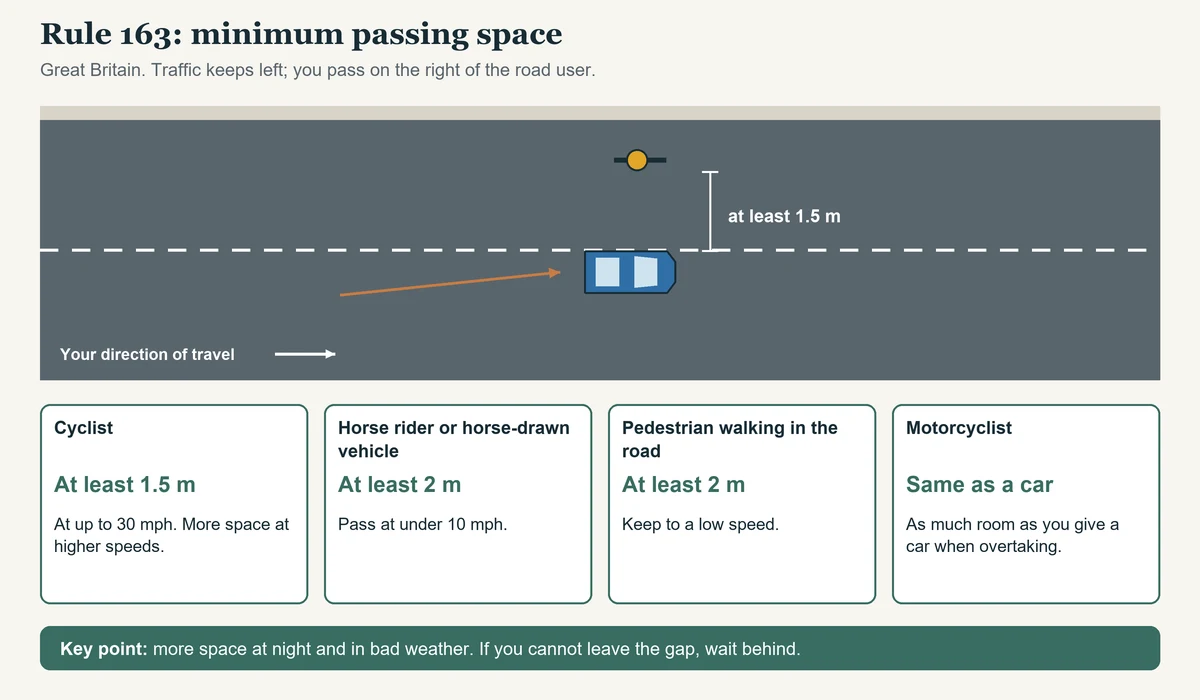
    • Cyclists: at least 1.5 metres at speeds up to 30 mph, more at higher speeds.
    • Horse riders and horse-drawn vehicles: pass at under 10 mph with at least 2 metres.
    • Pedestrians walking in the road: at least 2 metres, at a low speed.
    • Motorcyclists: as much room as you would give a car.
    • In bad weather (including high winds) and at night, give more space.
    • If you cannot meet these clearances, wait behind and do not overtake.
    Top-down view of a car passing a cyclist on a left-hand traffic road with a gap of at least 1.5 metres, above four cards giving the minimum space for cyclists, horse riders, pedestrians in the road and motorcyclists.
    Minimum passing space under Highway Code Rule 163. Illustrative diagram, not to scale.

    The full Rule 163 distance table

    Who you are passing Minimum space Speed
    Cyclist 1.5 metres Up to 30 mph. Give more space at higher speeds.
    Horse rider or horse-drawn vehicle 2 metres Under 10 mph
    Pedestrian walking in the road (for example, where there is no pavement) 2 metres Low speed
    Motorcyclist As much room as a car Normal overtaking

    These distances were added to Rule 163 in the Highway Code update of 29 January 2022. Rule 212 says the same thing in general terms: give motorcyclists, cyclists, horse riders, horse-drawn vehicles and pedestrians walking in the road at least as much room as you would when overtaking a car.

    Is the 1.5 metre rule the law?

    Rule 163 uses “should”, not MUST. In the Highway Code, MUST marks a legal requirement. “Should” marks advice. The Code’s introduction says that advisory rules can still be used as evidence in court to help establish liability. So an overtake that is too close can still form part of a careless or dangerous driving case. On the driving test, an examiner can mark a close pass as a serious fault.

    How much is “more space” at higher speeds?

    The Code does not give a figure for speeds above 30 mph. It says only to give them more space. In practice, on a 60 mph country road, that means a full overtake on the other side of the road, as you would for a car, and only when the road ahead is clear. If you cannot see far enough ahead to pass with a wide margin, Rule 166 says do not overtake.

    How to overtake a cyclist safely: step by step

    1. Hang back. Rule 163 says do not get too close to the vehicle you intend to overtake. Staying back gives you a better view.
    2. Check the road ahead. Is it clear for the whole time you will be alongside, with room for 1.5 metres or more?
    3. Check you can legally overtake. See the list of places you must not overtake below.
    4. Mirrors, signal, blind spot. Use your mirrors, signal when it is safe, take a quick sideways glance if needed, then move out.
    5. Pass and keep the gap. Do not cut back in early. Return to the left only when you are well past.
    6. If in doubt, wait. A short wait behind a cyclist costs seconds.

    The mirror routine is covered in detail in mirror, signal, manoeuvre.

    When you should not overtake a cyclist

    Rules 165 to 167 list places where you must not, or should not, overtake. For cyclists, the most relevant are:

    • Approaching a junction where you plan to turn left. Stay behind the cyclist and do not cut across them (Rule 167 and Rule H3).
    • At or approaching any junction, where the road narrows, or approaching a school crossing patrol or pedestrian crossing (Rule 167).
    • Where you would force another road user to swerve or slow down (Rule 167).
    • Approaching a bend, a hump bridge or the brow of a hill, where you cannot see far enough ahead (Rule 166).
    • Where you would have to enter a bus, tram or cycle lane during its hours of operation (Rule 165).
    • After a “No Overtaking” sign, until you pass a sign cancelling it (Rule 165).

    Double white lines

    Rule 129 says you MUST NOT cross or straddle double white lines where the line nearest you is solid. There is an exception: you may cross the line if necessary, provided the road is clear, to overtake a pedal cycle, horse or road maintenance vehicle travelling at 10 mph or less. A cyclist going faster than 10 mph cannot be overtaken by crossing a solid line nearest you.

    Why cyclists move out before you overtake

    Rule 72 tells cyclists to ride in the centre of their lane approaching junctions or road narrowings where it would be unsafe for drivers to overtake. Rule 67 tells them to keep at least a door’s width or 1 metre from parked cars. When a cyclist moves out, that is usually a signal that passing would not leave enough space. Read Highway Code rules for cyclists for the full picture.

    Scenario: a cyclist on a 30 mph road with oncoming traffic

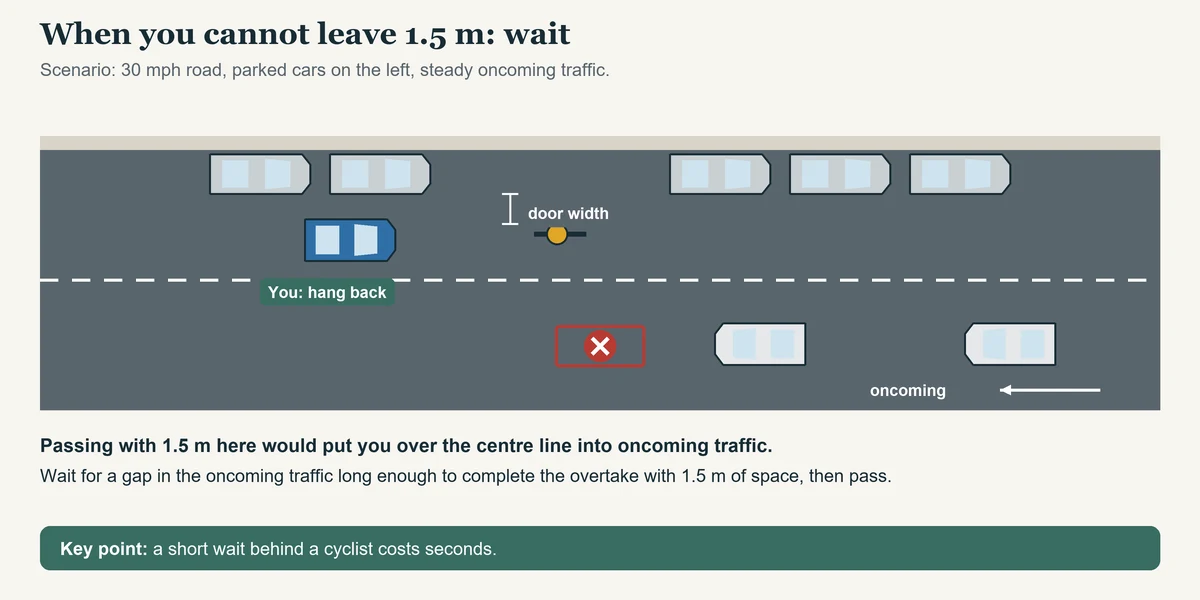
    You are driving at 25 mph behind a cyclist on a residential road. Cars are parked on the left, and there is a steady flow of oncoming traffic.

    A cyclist rides a door width from parked cars. Overtaking with 1.5 metres would put the car into the oncoming lane, so the driver waits behind.
    If a 1.5 metre pass would take you into oncoming traffic, wait behind. Illustrative diagram, not to scale.
    • The cyclist is riding about a door’s width from the parked cars. Passing with 1.5 metres would put you over the centre line into oncoming traffic.
    • Rule 163 says that if you cannot meet the clearance, wait behind.
    • Hang back and wait for a gap in the oncoming traffic long enough to complete the overtake with 1.5 metres of space, then pass.

    Common questions

    How much room should you give a cyclist when overtaking in the UK?

    The Highway Code for Great Britain says at least 1.5 metres at speeds up to 30 mph, and more at higher speeds.

    Can I overtake a cyclist on a solid white line?

    Only where the solid line nearest you is part of a double white line system, the road is clear, and the cyclist is travelling at 10 mph or less (Rule 129). Otherwise you must not cross it.

    Do I have to give 1.5 metres if the cyclist is in a cycle lane?

    Rule 163 does not make an exception for cycle lanes. It says to give at least 1.5 metres when overtaking cyclists at speeds up to 30 mph.

    What about two cyclists side by side?

    Measure the gap from the outer rider. Rule 66 says cyclists can ride two abreast, and they should let you pass when it is safe, for example by moving into single file.

    Does the rule apply in Northern Ireland?

    This explainer covers the Highway Code for England, Scotland and Wales. Northern Ireland has its own Highway Code. See NI vs GB Highway Code differences.

    Related: passing horses safely, overtaking rules in the Highway Code and the hierarchy of road users. Back to the main guide: Learning to Drive in Great Britain.

    Sources

    • Department for Transport, “The Highway Code: Using the road (159 to 203)” (gov.uk)
    • Department for Transport, “The Highway Code: Road users requiring extra care (204 to 225)” (gov.uk)
    • Department for Transport, “The Highway Code: General rules, techniques and advice for all drivers and riders (103 to 158)” (gov.uk)
    • Department for Transport, “The Highway Code: Rules for cyclists (59 to 82)” (gov.uk)
    • Department for Transport, “The Highway Code: Introduction” and “Updates” (gov.uk)
  • Highway Code Rules for Cyclists: What GB Drivers Must Know

    Highway Code Rules for Cyclists: What GB Drivers Must Know

    Photo: Gawon Lee / Pexels. Illustrative photograph.

    The Highway Code rules for cyclists in Great Britain (Rules 59 to 82) tell people on bikes where to ride, how to signal and what equipment the law requires. Drivers need to know them too, because they explain why a cyclist rides in the middle of the lane, rides two abreast or signals right on a roundabout they are not leaving. This guide is for learner and new drivers in England, Scotland and Wales. It explains the cyclist rules from the driver’s seat and sets out what the Code asks of you in return.

    Key facts

    • Cyclists may ride in the centre of their lane on quiet roads, in slow traffic and when approaching junctions or road narrowings (Rule 72).
    • On busy roads, cyclists are advised to keep at least 0.5 metres from the kerb when letting faster traffic pass (Rule 72).
    • Cyclists can ride two abreast, which the Code says can be safer, especially in larger groups (Rule 66).
    • Cyclists are not obliged to use cycle lanes or cycle tracks (Rule 61).
    • At night a bicycle MUST have a white front light, a red rear light and a red rear reflector (Rule 60).
    • Drivers should leave at least 1.5 metres when overtaking a cyclist at speeds up to 30 mph, and more at higher speeds (Rule 163).

    Where should cyclists ride? Rule 72 road positions

    Rule 72 describes two basic positions. Knowing them helps you understand what a cyclist is about to do.

    Position When the Code suggests it What it means for you
    Centre of the lane On quiet roads or streets (moving left to let faster vehicles pass when safe); in slower-moving traffic; at the approach to junctions or road narrowings where it would be unsafe to overtake The cyclist is telling you it is not safe to pass yet. Wait behind.
    At least 0.5 metres from the kerb (further if safer) On busy roads with vehicles moving faster, letting traffic overtake when it is safe You may overtake when safe, with at least 1.5 metres of space.

    Rule 67 also advises cyclists to leave at least a door’s width or 1 metre when passing parked cars. So a cyclist moving out past a row of parked cars is following the Code, not wobbling.

    Riding two abreast (Rule 66)

    Rule 66 says cyclists can ride two abreast and that it can be safer to do so, particularly in larger groups or when accompanying children or less experienced riders. It also says cyclists should be aware of drivers behind them and allow them to overtake, for example by moving into single file or stopping, when it is safe to do so.

    For drivers, a pair of cyclists side by side is shorter to overtake than a long single-file line. You still need to give 1.5 metres from the outer rider.

    Cycle lanes, tracks and bus lanes

    • Cycle lanes are marked by a white line, which may be broken. Use of cycle lanes and tracks is not compulsory, and cyclists can choose the road if that is safer for them (Rule 61).
    • Drivers MUST NOT drive or park in a cycle lane marked by a solid white line during its times of operation (Rule 140).
    • Most bus lanes can be used by cyclists, as shown on the signs (Rule 65).
    • Cyclists MUST NOT cycle on the pavement (Rule 64).

    See bus lanes and cycle lanes for signs and operating times.

    What cyclists must do by law

    Rules that say MUST are legal requirements. For cyclists in Great Britain these include:

    • At night: a white front light and red rear light lit, a red rear reflector, and amber pedal reflectors on cycles made after 1 October 1985 (Rule 60).
    • Efficient brakes (Annex 1).
    • Obeying all traffic signs and traffic light signals (Rule 69).
    • Not crossing the stop line when lights are red. At an advanced stop line, cyclists may cross the first line on red but MUST NOT cross the final stop line (Rule 71).
    • Not carrying a passenger unless the cycle is built or adapted for one, not holding on to a moving vehicle, and not riding dangerously, carelessly or inconsiderately, or under the influence of drink or drugs (Rule 68).

    What is advice, not law

    Rule 59 says cyclists should wear a correctly fitted cycle helmet and bright or reflective clothing. These are recommendations. There is no law in these rules requiring adult cyclists to wear a helmet or hi-vis, so do not assume a cyclist without one is breaking the law. Annex 1 also recommends a bell and points to Bikeability, the national cycle training scheme.

    Cyclists at junctions: what drivers must watch for

    Cyclists going straight ahead have priority

    Rule 76 says a cyclist going straight ahead at a junction generally has priority over traffic waiting to turn into or out of the side road, unless signs or markings say otherwise. Rule H3 tells drivers not to cut across cyclists going ahead when turning, and not to turn if it would make them stop or swerve. See Rules H1 to H3 explained.

    The left turn trap

    Rule 182 tells drivers to use mirrors and signal well before turning left, not to overtake just before turning left, and to check for cyclists or motorcyclists coming up on the left. Rule 183 says give way to cyclists using a cycle lane or track from either direction, including when they pass a queue of traffic. Rule 167 says do not overtake a cyclist as you approach a junction where you plan to turn left: stay behind.

    Crossing a cycle track

    A cycle track is a route physically separated from motor traffic, often between the road and the pavement. Rule 140 says give way to cyclists approaching or using the track when you turn into or out of a junction, and be prepared to stop and wait for a safe gap. Tracks may carry cyclists in both directions, so look both ways along the track, not just in the direction cars come from. If a cyclist appears while you wait, stay put: do not speed up to get across first because the driver behind is impatient.

    Advanced stop lines

    Rule 178 says drivers MUST stop at the first white line of an advanced stop line when the lights are amber or red, and should avoid blocking the cyclist area. When the lights go green, give cyclists in front of you time and space to move off.

    Turning right in two stages

    Some junctions mark a two-stage right turn for cyclists (Rule 75). The cyclist goes straight ahead to a marked area, waits, then completes the turn when the lights on the far side go green. A cyclist waiting in that box is not lost.

    Cyclists on roundabouts (Rules 78 to 80 and 186)

    • Rule 79 says cyclists may ride in either the left or right lane when turning right, moving left before their exit and signalling. Cyclists who stay in the left lane signal right to show they are not leaving at the next exit.
    • Rule 186 tells drivers to give cyclists priority on the roundabout, leave them plenty of room, not overtake them within their lane, and allow them to move across your path as they travel round.
    • Rule 80 asks cyclists to give long vehicles plenty of room on roundabouts.

    More on roundabouts in Rules 184 to 190 step by step and mini, double and spiral roundabouts.

    Crossings

    Cyclists should dismount at zebra, pelican and puffin crossings, and must not ride across equestrian crossings (Rule 81). At toucan crossings, cyclists may ride across with pedestrians on the green signal (Rule 82). As a driver, expect cyclists to appear at toucan crossings at more than walking pace.

    Overtaking and opening doors

    Rule 163 asks drivers to leave at least 1.5 metres when overtaking cyclists at speeds up to 30 mph, and more space at higher speeds. If you cannot, wait behind. The full detail is in overtaking cyclists: the 1.5 metre rule.

    When you park, Rule 239 says you should, where you can, open the door with the hand on the opposite side (for example, your left hand for a door on your right). This makes you turn your head and look over your shoulder for cyclists, motorcyclists and pedestrians before the door swings out. The technique is often called the “Dutch Reach”. Rule 67 is why cyclists keep a door’s width from parked cars.

    Scenario: a cyclist in the middle of the lane before a pinch point

    You are behind a cyclist on a 30 mph road. Ahead there is a traffic island. The cyclist moves from near the kerb to the centre of the lane.

    • Under Rule 72, this is the cyclist taking the centre of the lane at a narrowing where overtaking would be unsafe.
    • Stay behind. There is not room for 1.5 metres beside the island.
    • Once past the island, the cyclist may move back left. Overtake only when you can give 1.5 metres and see the road is clear.

    Common questions

    Do cyclists have to use cycle lanes?

    No. Rule 61 says use of cycle lanes and tracks is not compulsory, and will depend on the cyclist’s experience and the conditions.

    Is it legal for cyclists to ride two abreast?

    Yes. Rule 66 says cyclists can ride two abreast and that it can be safer, but they should let drivers behind overtake when it is safe, for example by moving into single file.

    Why do cyclists ride in the middle of the road?

    Rule 72 advises the centre of the lane on quiet roads, in slow traffic and approaching junctions or narrowings where it would be unsafe for drivers to overtake.

    Do cyclists have to wear a helmet in the UK?

    The Highway Code says cyclists should wear one, but it is advice, not a legal requirement for cyclists in these rules.

    Do cyclists have priority at junctions?

    A cyclist going straight ahead generally has priority over traffic turning into or out of a side road, unless signs or markings say otherwise (Rule 76). Drivers should not turn across them (Rule H3).

    Can cyclists go through red lights?

    No. Rule 71 says cyclists MUST NOT cross the stop line on red. At an advanced stop line, they may cross the first line but not the final one.

    Back to the main guide: Learning to Drive in Great Britain. For the theory test, revise the vulnerable road users topic.

    Sources

    • Department for Transport, “The Highway Code: Rules for cyclists (59 to 82)” (gov.uk)
    • Department for Transport, “The Highway Code: Annex 1. You and your bicycle” (gov.uk)
    • Department for Transport, “The Highway Code: Using the road (159 to 203)” (gov.uk)
    • Department for Transport, “The Highway Code: General rules, techniques and advice for all drivers and riders (103 to 158)” (gov.uk)
    • Department for Transport, “The Highway Code: Introduction” (gov.uk)
    • Department for Transport, “The Highway Code: Waiting and parking (238 to 252)” (gov.uk)
    • Department for Transport, “The Highway Code: Updates” (gov.uk)
  • Passing Horses Safely: GB Highway Code Rules for Drivers

    Passing Horses Safely: GB Highway Code Rules for Drivers

    Photo: VINTTRO Ltd / Pexels. Illustrative photograph.

    When you meet a horse on the road in Great Britain, the Highway Code tells you to slow to no more than 10 mph, pass wide and slowly, and leave at least 2 metres of space. This guide is for learner and new drivers in England, Scotland and Wales who want to know exactly what Rules 163 and 215 ask, why horses need different treatment from cars and bikes, and what the rules for riders themselves (Rules 47 to 58) mean for you behind the wheel.

    Key facts: horses and the Highway Code

    • Slow down to a maximum of 10 mph when you see a horse on the road (Rule 215).
    • Pass wide and slowly, leaving at least 2 metres where possible (Rules 163 and 215).
    • Do not sound your horn or rev your engine near horses.
    • Horse riders may ride two abreast, but never more, and in single file on narrow or busy roads and around bends (Rule 53).
    • Children under 14 MUST wear a helmet that complies with the regulations when riding on the road (Rule 49).
    • Horse riders are in the group the Highway Code says is most at risk, under the hierarchy of road users.

    How do you pass a horse safely? The five steps

    Rule 215 sets out how to deal with horse riders and horse-drawn vehicles. Put into a sequence you can practise:

    1. Spot it early. Rule 154 tells drivers on country roads to expect horse riders, pedestrians, cyclists and slow farm vehicles. Scan well ahead, especially on bends and near bridleways.
    2. Slow to 10 mph or less. Ease off smoothly. Harsh braking or a sudden engine note can startle a horse.
    3. Watch the rider. If they signal you to slow down or stop, do so. Riders often know when their horse is uneasy.
    4. Pass wide and slowly when it is safe, giving at least 2 metres. If oncoming traffic means you cannot give that space, wait behind.
    5. Pull away gently. Do not accelerate hard as soon as you are past. Keep your speed down until you are well clear.

    What not to do

    • Do not sound your horn or rev your engine.
    • Do not pass close, even slowly.
    • Do not overtake a horse rider as you approach a junction or roundabout where you are turning left. Rule 167 says stay behind.
    • Do not cut across a horse rider going straight ahead when you turn (Rule H3).

    What Rule 163 says about distance and speed

    Rule 163, the main overtaking rule, gives minimum clearances for people who are more exposed than car drivers. For horses it says to pass at speeds under 10 mph and allow at least 2 metres of space.

    Road user Rule 163 guidance
    Horse riders and horse-drawn vehicles Under 10 mph, at least 2 metres
    Cyclists At least 1.5 metres at speeds up to 30 mph, more at higher speeds
    Pedestrians walking in the road At least 2 metres, at low speed
    Motorcyclists As much room as for a car

    Rule 163 adds that you should give more space in bad weather, including high winds, and at night. If you cannot meet these clearances, you should wait behind and not overtake. Our overtaking cyclists explainer covers the cyclist figures, and overtaking rules covers when you must not overtake at all.

    Can you cross double white lines to pass a horse?

    Rule 129 says you MUST NOT cross or straddle double white lines where the line nearest you is solid, with some exceptions. One of them: you may cross if necessary, provided the road is clear, to overtake a pedal cycle, horse or road maintenance vehicle travelling at 10 mph or less. You still need to be able to give the full 2 metres and see that the road is clear.

    Why horses need different treatment

    A horse is a large animal that can react to sudden noise or movement, and the rider is sitting high with no protection apart from a helmet. Rule 214, on animals generally, tells drivers to pass slowly, give plenty of room, be ready to stop, and not use the horn, rev the engine or accelerate quickly near them. The Highway Code places horse riders in the group most at risk in a collision.

    Rule 215 adds several points worth remembering. Treat every horse as a potential hazard: horses are flight animals and can move very quickly if startled, however good the rider. Many riders are children, so take extra care. Two riders side by side may be escorting a young or inexperienced horse or rider. Feral or semi-feral ponies, such as those in the New Forest, on Exmoor and on Dartmoor, need the same slow, wide approach as a ridden horse.

    Rules for riders that drivers should know (Rules 47 to 58)

    Knowing what riders are told to do helps you predict what they will do next.

    Position on the road

    • Riders keep to the left and keep both hands on the reins unless signalling (Rule 53).
    • A led horse is kept on the rider’s left.
    • Riders should never ride more than two abreast, and should ride single file on narrow or busy roads and when riding round bends (Rule 53).
    • Rule 213 says horse riders may ride in the centre of the lane on narrow roads. Expect this where the road is too narrow for you to overtake safely.
    • Riders MUST NOT take a horse onto a footpath or pavement (Rule 54), so they will be in the road where there is no bridleway.

    Signals and roundabouts

    Riders look behind and give a clear arm signal before moving off or turning (Rule 53). Rule 55 advises riders to avoid roundabouts where possible. If they do use one, they keep to the left and signal right when passing exits they are not taking, then signal left just before they leave. So a horse in the left lane signalling right is usually going round, not leaving. Do not cut across them (Rule 186).

    Clothing, helmets and night riding

    • Children under 14 MUST wear a helmet that complies with the regulations, securely fastened. A Sikh child wearing a turban is exempt (Rule 49).
    • Riders should wear light-coloured or fluorescent clothing in daylight and reflective clothing at night or in poor visibility (Rule 50).
    • Riding at night is discouraged. Riders who do ride at night should use reflective bands on the horse and a light showing white to the front and red to the rear on their right arm or leg (Rule 51).

    Horse-drawn vehicles

    Rule 48 says horse-drawn vehicles should have two red rear reflectors, and if used at night they MUST have a white light at the front and a red light at the rear. On an unlit lane, these may be the only warning you get, so drive at a speed that lets you stop within the distance you can see is clear.

    Equestrian crossings

    Some roads have equestrian crossings with a separate signal for horse riders. See the pedestrian crossings guide for how they work.

    Scenario: a pair of riders on a narrow lane

    You round a bend on a 60 mph rural road and see two riders side by side about 100 metres ahead. One of them signals to you to slow down.

    • Rule 215 says follow a rider’s signal to slow down or stop. Ease off to 10 mph or less.
    • The riders may move into single file to let you pass. Wait until they have done so and you can see well ahead.
    • If the lane is too narrow for 2 metres, stay behind until there is a wider stretch or a safe place.
    • Pass slowly and wide, then pull away gently.

    Our guide to learning to drive on rural roads covers bends, single-track lanes and tractors too, and herded animals and livestock on the road covers sheep, cattle and dogs.

    Horses on the theory and driving tests

    Horse riders fall under the vulnerable road users theory topic, and questions on passing horses often test the 10 mph and 2 metre figures. On the practical test, passing a horse too fast or too close is the kind of action an examiner can record as a serious or dangerous fault. See driving test faults explained.

    Common questions

    How fast should you pass a horse in the UK?

    The Highway Code for Great Britain says no more than 10 mph, passing wide and slowly with at least 2 metres of space.

    Is the 2 metre rule a legal requirement?

    Rules 163 and 215 use “should”, so they are advice rather than stand-alone legal duties. But the Highway Code can be used as evidence in court, for example in a careless driving case.

    Can horse riders ride two abreast?

    Yes, but never more than two, and they should go into single file on narrow or busy roads and around bends.

    Why do riders ride in the middle of the lane?

    Rule 213 says horse riders may use the centre of the lane on narrow roads. On a road that narrow, you could not give them 2 metres anyway, so wait behind.

    Should I beep to let a rider know I am there?

    No. The Code says not to sound your horn or rev your engine near horses. Slow down early so the rider has time to hear and see you.

    Do riders have to wear hi-vis?

    The Code advises it but does not make it law. The only legal requirement in these rules is a helmet for riders under 14, plus lights on horse-drawn vehicles at night.

    Back to the main guide: Learning to Drive in Great Britain.

    Sources

    • Department for Transport, “The Highway Code: Rules about animals (47 to 58)” (gov.uk)
    • Department for Transport, “The Highway Code: Road users requiring extra care (204 to 225)” (gov.uk)
    • Department for Transport, “The Highway Code: Using the road (159 to 203)” (gov.uk)
    • Department for Transport, “The Highway Code: General rules, techniques and advice for all drivers and riders (103 to 158)” (gov.uk)
    • Department for Transport, “The Highway Code: Introduction” (gov.uk)
  • Hierarchy of Road Users in GB: Highway Code Rules H1 to H3

    Hierarchy of Road Users in GB: Highway Code Rules H1 to H3

    Photo: Eric Luskin / Pexels. Illustrative photograph.

    The hierarchy of road users is the principle at the start of the Highway Code for England, Scotland and Wales. It says the people most at risk in a collision come first, and the people driving vehicles that can cause the most harm carry the most responsibility. It is set out in three rules, H1, H2 and H3, which came into force on 29 January 2022. This explainer is for learner and new drivers in Great Britain who want to know exactly what each rule asks of them, and how it affects the driving test.

    Key facts

    • The hierarchy and Rules H1 to H3 were added to the Highway Code in the update of 29 January 2022.
    • The Highway Code containing these rules applies to England, Scotland and Wales. Northern Ireland has its own Highway Code.
    • Most at risk: pedestrians, cyclists, horse riders and motorcyclists, with children, older adults and disabled people at greater risk still.
    • H2 tells drivers they should give way to pedestrians crossing or waiting to cross at a junction, and they MUST give way to pedestrians on a zebra crossing.
    • H3 tells drivers not to cut across cyclists, horse riders or horse-drawn vehicles going straight ahead when turning.

    What is the hierarchy of road users?

    The Highway Code introduction describes a hierarchy that places those road users most at risk in a collision at the top. Responsibility runs the other way: the drivers of vehicles that can do the most harm have the greatest duty to take care and reduce the danger they pose to others.

    Group Who it includes What the Code expects
    Most at risk Pedestrians, cyclists, horse riders, motorcyclists Their safety must be considered by everyone else
    Greater risk within those groups Children, older adults, disabled people Extra care, because they may move unpredictably or slowly
    Greatest responsibility Drivers of large goods and passenger vehicles, vans and minibuses, cars and taxis, motorcycles Reduce the danger they pose

    The Code is clear that the hierarchy does not remove anyone’s duty to behave responsibly. Pedestrians and cyclists must still take care. A learner driver in a car, though, sits near the top of the responsibility list.

    Rule H1: everyone is responsible for others’ safety

    H1 asks all road users to know the Highway Code, to be considerate to others and to understand their responsibility for other people’s safety. It also says that cyclists, horse riders and drivers of horse-drawn vehicles have a responsibility to reduce danger to pedestrians.

    H1 reminds drivers that some people have impaired sight, hearing or mobility that is not obvious. A pedestrian who does not react to your engine may simply not be able to hear it.

    Rule H2: giving way to pedestrians at junctions and crossings

    H2 is the rule that changed everyday driving most. It applies to drivers, motorcyclists, horse riders, cyclists and horse-drawn vehicles.

    • At a junction, you should give way to pedestrians crossing or waiting to cross the road you are turning into or out of.
    • On a zebra crossing, you MUST give way to pedestrians who are on it. This is the law. You should also give way to pedestrians waiting to cross.
    • On a parallel crossing (a zebra with a cycle crossing beside it), you MUST give way to pedestrians and cyclists on the crossing, and you should give way to those waiting to cross.
    • At light-controlled crossings, pedestrians have priority when they have a green signal.

    Rule 8 for pedestrians adds that if a pedestrian has already started to cross a road you are turning into, they have priority. H2 also reminds everyone that only pedestrians, including wheelchair and mobility scooter users, may use the pavement, and that pedestrians may use any part of the road and cycle tracks unless signs prohibit them. Our Highway Code rules for pedestrians and pedestrian crossings guide explain the related rules.

    Scenario: turning left into a side road

    You signal left to turn into a side street. A pedestrian is standing at the kerb on the corner, facing across the side street. Under H2 you should give way. Slow early, check your mirrors for cyclists on your left, and let them cross before you turn. If they have already stepped off the kerb, Rule 8 says they have priority.

    Rule H3: not cutting across cyclists and horse riders

    H3 is aimed at drivers and motorcyclists. When you turn into or out of a junction, or change direction or lane, you should not cut across cyclists, horse riders or horse-drawn vehicles going straight ahead. That applies whether they are in a cycle lane, on a cycle track or riding on the road.

    The rule says you should not turn if doing so would make the cyclist, horse rider or horse-drawn vehicle stop or swerve. Stop and wait for a safe gap if you need to. H3 also covers riders who are:

    • approaching, passing or moving off from a junction
    • moving past or waiting alongside stationary or slow traffic
    • travelling around a roundabout

    Rule 167 backs this up: if you are following a cyclist, horse rider or horse-drawn vehicle towards a junction or roundabout where you plan to turn left, stay behind them rather than overtaking and cutting in. For more, see Highway Code rules for cyclists, overtaking cyclists and passing horses safely.

    Do H1 to H3 affect the driving test?

    Yes. When the rules came in, the DVSA explained on its official blog that most of the changes reinforced good driving that examiners already looked for, but the junction rule did change assessment. Its guidance said:

    • Failing to give way to a pedestrian who is clearly waiting to cross, safely on the pavement, would normally be marked as a driving fault.
    • If your actions put someone already in the road at risk, a serious fault would normally be recorded.
    • Examiners take account of following traffic, your approach speed, how visible the pedestrian was and whether they appeared to intend to cross.

    See driving test faults explained for how faults add up.

    Do the hierarchy rules apply in Northern Ireland?

    The GB Highway Code says it applies to England, Scotland and Wales. Northern Ireland publishes its own Highway Code on nidirect, and the edition there is dated 2020, before the GB changes of January 2022. Drivers in NI should follow the NI Highway Code and check nidirect for any update. Our NI vs GB Highway Code guide covers the differences.

    Common questions

    Is it now the law to give way to pedestrians at junctions?

    Rule H2 uses “should” for junctions, so it is advice rather than a stand-alone legal duty. But the Highway Code can be used as evidence in court, and failing to give way can be marked as a fault on your test. Giving way on a zebra crossing is a legal requirement.

    When did the hierarchy of road users start?

    29 January 2022, when the Highway Code was updated with the new introduction and Rules H1, H2 and H3.

    Does the hierarchy mean cyclists can ignore the rules?

    No. The Code says the hierarchy does not remove everyone’s responsibility to behave responsibly. Cyclists must, for example, obey traffic lights and must not cycle on pavements.

    Who is at the top of the hierarchy?

    Pedestrians, cyclists, horse riders and motorcyclists are most at risk, with children, older adults and disabled people at greater risk still. Drivers of large vehicles, vans, cars and motorcycles carry the most responsibility.

    What should I do if a pedestrian is waiting at a side road as I turn?

    Slow down early and give way, as long as it is safe to do so with the traffic around you. If they have already stepped into the road, they have priority.

    Back to the main guide: Learning to Drive in Great Britain.

    Sources

    • Department for Transport, “The Highway Code: Introduction” (gov.uk)
    • Department for Transport, “The Highway Code: Updates” (gov.uk)
    • Department for Transport, “The Highway Code: Rules for pedestrians (1 to 35)” (gov.uk)
    • Department for Transport, “The Highway Code: Using the road (159 to 203)” (gov.uk)
    • Driver and Vehicle Standards Agency, “Changes to The Highway Code: how they affect driving tests” (despatch.blog.gov.uk)
    • nidirect, “The Highway Code” (nidirect.gov.uk)
  • Learning to Drive in Great Britain: Step by Step Guide

    Learning to Drive in Great Britain: Step by Step Guide

    Photo: Luke Seago / Pexels. Illustrative photograph.

    Learning to drive in Great Britain (England, Scotland and Wales) follows five stages: get a provisional licence, practise with a qualified supervisor, pass the theory test, pass the practical driving test, then survive the risky first two years as a new driver. This guide is for learners aged 17 and over and the parents helping them. It sets out each step in order, with the current fees, the rules you must follow and links to a deeper guide for every topic.

    Northern Ireland has its own licensing system run by the DVA, with a mandatory six month learning period from 1 October 2026. If you live there, read Learning to Drive in Northern Ireland instead.

    Key facts for learners in Great Britain

    • You can apply for a provisional licence from 15 years and 9 months. Most people can start driving a car at 17.
    • A first provisional licence costs £34 online or £43 by post (as of November 2026).
    • The car theory test costs £23. The practical test costs £62 on weekdays or £75 for evenings, weekends and bank holidays (as of November 2026).
    • Your supervisor must be at least 21 and have held a full licence for that type of car for three years.
    • The theory test pass marks are 43 out of 50 (multiple choice) and 44 out of 75 (hazard perception). Your pass lasts two years.
    • You pass the practical test with 15 or fewer driving faults and no serious or dangerous faults.
    • Get 6 or more penalty points within 2 years of passing and your licence is cancelled.

    The five stages at a glance

    Stage What you do Cost (as of November 2026)
    1. Provisional licence Apply to the DVLA from 15 years 9 months £34 online, £43 by post
    2. Learning Lessons with an approved driving instructor (ADI) and practice with a supervisor Varies (set by instructors and insurers)
    3. Theory test Multiple choice questions plus hazard perception £23
    4. Practical test About 35 minutes of driving with a DVSA examiner £62 weekday, £75 evening, weekend or bank holiday
    5. After passing Full licence, your own insurance, two-year new driver period Insurance cost varies

    Stage 1: Getting your provisional licence in Great Britain

    Who can apply

    According to GOV.UK, you can apply for your first provisional licence when you are at least 15 years and 9 months old. You must be able to read a number plate from 20 metres away, and you must have been given permission to live in Great Britain for at least 185 days. You need a provisional licence before you can take lessons, practise on the road or book a theory test.

    How to apply and what it costs

    1. Online through GOV.UK: £34, paid by debit or credit card. You sign in and may need to prove your identity, usually with photo ID such as a passport. Licences applied for online should arrive within one week, though extra DVLA checks can take longer.
    2. By post using form D1, available from most Post Offices: £43, paid by cheque or postal order.

    The page on provisional licence rules, supervising and L plates covers the application in more detail.

    Check what your licence covers and whether you are fit to drive

    A car licence is category B. Our guide to UK driving licence categories explains what a category B licence lets you drive and tow. Two health rules matter from day one:

    If you have a disability, reading difficulty or other need, read about extra support for the theory and driving tests.

    Stage 2: Learning to drive legally (Annex 3 of the Highway Code)

    Annex 3 of the Highway Code sets out the legal requirements for learners in Great Britain. These are law, not advice.

    The learner driver checklist

    • You hold a valid provisional licence.
    • You are supervised by someone who is at least 21 and has held a full licence for that type of car (manual or automatic) for three years.
    • The car shows red L plates that are visible from the front and rear. In Wales you can use red D plates, L plates or both.
    • The car is insured for you to drive. Insurance must at least cover injury or damage to third parties.
    • The car is taxed and, if it is more than three years old, has a valid MOT.

    L plates should be taken off or covered when a qualified driver is using the car, unless it is a driving school car. Parents and friends who want to help should read supervising a learner driver. For tax, MOT, insurance and the V5C logbook, see car documents explained.

    When and where learners can drive

    GOV.UK confirms that learners in Great Britain can drive at any time, day or night, and the speed limits are the same as for full licence holders. Learners can drive on motorways only in England, Scotland or Wales, with an approved driving instructor, in a car with dual controls. The details are in learners and motorways.

    Is there a minimum number of lessons?

    Not at the moment. The Department for Transport ran a consultation on introducing a minimum learning period for car learners from 7 January to 11 May 2026. It asked about a minimum time between passing the theory test and taking the practical test, plus supervised hours and a set syllabus. As of November 2026 the outcome has not been published and no minimum is in force. Follow it in minimum learning period for learner drivers.

    Manual or automatic?

    If you pass in an automatic, your licence only covers automatics. Read automatic licence restrictions and how to upgrade to manual before you choose.

    Stage 3: The theory test

    You must pass the theory test before you can book the practical test. It costs £23 (as of November 2026), and you need your provisional licence number to book. GOV.UK says you must have lived in England, Wales or Scotland for at least 185 days in the 12 months before the test.

    How the theory test works

    Part Format Pass mark
    Multiple choice 50 questions in 57 minutes, including a short video case study with 3 questions 43 out of 50
    Hazard perception 14 video clips with at least one developing hazard each (one clip has two), up to 5 points per hazard 44 out of 75

    You must pass both parts at the same sitting. If you fail, you must wait at least 3 working days before taking it again. Your pass certificate number lasts 2 years, so you need to pass the practical test within that time or take the theory test again.

    Theory test guides on this site

    The 14 DVSA theory test topics

    The multiple choice questions are drawn from 14 topic areas. Each has its own revision page:

    GOV.UK lists three official books for revision: The Highway Code, Know Your Traffic Signs and Driving: the essential skills. The theory test itself is only available in English, Welsh or British Sign Language.

    Rules of the road: the Highway Code topics to learn

    The Highway Code applies to England, Scotland and Wales. Rules that use MUST or MUST NOT are legal requirements. Other rules are advice, but they can be used in court as evidence. The guides below follow the order of the Code.

    Who has priority: the hierarchy and vulnerable road users

    You, your car and the law

    Speed, space and control

    Junctions, roundabouts and crossings

    Parking, lanes and road works

    Signs, signals and markings

    Conditions, motorways and emergencies

    Stage 4: The practical driving test

    Booking the test under the 2026 rules

    Once you have passed your theory test, you can book the practical test on GOV.UK with your licence number and a card. The DVSA changed the booking rules in three stages in 2026:

    1. From 31 March 2026: you can make only 2 changes to a booked test. Changing the date and centre together counts as one change. A swap with another learner also counts as one.
    2. From 12 May 2026: only the learner can book, change, swap or cancel their own test. Instructors and other people cannot do it for you, and using unofficial services that scan the booking system for cancellations is not allowed.
    3. From 9 June 2026: you can move a test only to one of the 3 centres nearest to where it is currently booked, or back to the centre you first booked on that booking.

    If the DVSA changes your test, for example because of bad weather, your changes reset to 2. More detail is in driving test booking rules 2026, and when a driving test is cancelled or goes wrong covers refunds and complaints.

    What happens on the test

    The test includes around 35 minutes of driving. It is made up of five parts:

    1. Eyesight check: read a number plate from 20 metres (new-style plates) or 20.5 metres (old-style plates). If you fail, the test ends.
    2. Show me, tell me: one “tell me” question before you drive and one “show me” question while you drive. See all current show me, tell me questions.
    3. General driving: different road and traffic conditions, but not motorways. You may be asked to pull over, pull out from behind a parked car, do a hill start or make an emergency stop.
    4. One reversing manoeuvre: parallel park, park in a bay, or pull up on the right, reverse about 2 car lengths and rejoin traffic. See driving test manoeuvres explained.
    5. Independent driving: 20 to 35 minutes following a sat nav the examiner sets up, traffic signs, or both. A wrong turn is not a fault in itself. Read independent driving on the test.

    How the test is marked

    Fault Meaning Effect
    Driving fault (minor) Not potentially dangerous, but repeating it could make it serious Up to 15 allowed
    Serious fault Potentially dangerous Fail
    Dangerous fault Actual danger to you, the examiner, the public or property Fail

    If you fail, the next test date must be at least 10 working days away, and you pay again. Our practical test guides go deeper:

    Stage 5: After you pass

    Getting your full licence

    If you pass, the examiner gives you a pass certificate and can send your full licence automatically if you hand over your provisional licence. You can drive straight away without waiting for it to arrive. If you choose not to use automatic issue, you must apply for your full licence within 2 years of passing. Before you drive alone, make sure your insurance lets you drive without supervision.

    The New Drivers Act

    For 2 years after passing your first test, reaching 6 or more penalty points means your licence is cancelled. Unexpired points from your provisional licence count. To get your licence back you must apply for a new provisional licence and pass both the theory and practical tests again. Read the New Drivers Act explained.

    The safety code for new drivers (Annex 8)

    Annex 8 of the Highway Code is written for the first 12 months after passing, and notes that as many as one new driver in five has some kind of collision in their first year. Its advice, in short:

    • Avoid driving between midnight and 6 am unless it is really necessary.
    • Do not let passengers distract you or encourage you to take risks.
    • Do not show off or compete with other drivers.
    • Never drive after drinking alcohol or taking drugs, and check medicine labels.
    • Make sure everyone wears a seat belt for the whole journey.
    • Keep your speed down, especially on bends.
    • Build experience before driving a high-powered car.
    • Consider further training such as Pass Plus.

    New driver guides

    Worked example: a realistic timeline from 15 years 9 months

    This example shows how the legal rules line up. It is not a target, because how many lessons you need depends on you.

    • Age 15 years 9 months: apply for a provisional licence online (£34). Start reading the Highway Code.
    • 17th birthday: first lessons with an ADI. Private practice once a supervisor aged 21 or over with 3 years’ experience is insured for you.
    • A few months in: book and pass the theory test (£23). The 2-year clock on your certificate starts.
    • When your instructor says you are ready: book the practical test yourself (£62 weekday). You now have 2 changes available on that booking.
    • Test day: pass with 15 or fewer driving faults. Your 2-year new driver period starts.

    Common questions

    How old do you have to be to learn to drive in the UK?

    In Great Britain you can apply for a provisional licence at 15 years and 9 months, and most people can start driving a car at 17. Northern Ireland has different rules, set out in our NI guide.

    How much does it cost to get a driving licence in Great Britain?

    The official fees as of November 2026 are £34 for a provisional licence online (£43 by post), £23 for the theory test and £62 for a weekday practical test (£75 for evenings from 4:30pm, weekends and bank holidays). Lessons and insurance are extra and vary.

    Can my parent supervise me?

    Yes, if they are at least 21, have held a full licence for that type of car for 3 years, and the car is insured for you to drive. They must not use a hand-held phone while supervising.

    Can my driving instructor book my test for me?

    No. Since 12 May 2026 only the learner can book, change, swap or cancel their test. You can add your instructor’s reference number to the booking.

    How long is the theory test certificate valid?

    Two years from the date you pass. If you have not passed the practical test by then, you take the theory test again.

    Can I drive on a motorway as a learner?

    Only in England, Scotland or Wales, with an approved driving instructor, in a car with dual controls. A parent cannot take you on a motorway.

    Can I drive straight after passing?

    Yes. You do not need to wait for your full licence to arrive, but your insurance must cover you to drive unsupervised.

    Sources

    • GOV.UK, “Apply for your first provisional driving licence” (gov.uk)
    • GOV.UK, “Driving lessons and learning to drive” (gov.uk)
    • GOV.UK, “Driving test: cost” (gov.uk)
    • GOV.UK, “Theory test: revision and practice”, “Multiple-choice questions”, “Hazard perception test” and “Pass mark and test result” (gov.uk)
    • GOV.UK, “Book your theory test” (gov.uk)
    • GOV.UK, “Driving test: what happens during the test” and “Driving test faults and your result” (gov.uk)
    • Driver and Vehicle Standards Agency, “Changes to driving test booking rules in 2026” (gov.uk)
    • GOV.UK, “Driving eyesight rules” (gov.uk)
    • GOV.UK, “Penalty points (endorsements): new drivers” (gov.uk)
    • Department for Transport, “Introducing a minimum learning period for learner drivers” (gov.uk)
    • Department for Transport, “The Highway Code: Introduction” (gov.uk)
    • Department for Transport, “The Highway Code: Annex 3. Motor vehicle documentation and learner driver requirements” (gov.uk)
    • Department for Transport, “The Highway Code: Annex 8. Safety code for new drivers” (gov.uk)
  • Pregnancy and Learning to Drive in the UK and Ireland

    Pregnancy and Learning to Drive in the UK and Ireland

    Photo: Ivan S / Pexels. Illustrative photograph.

    In Great Britain, pregnancy does not stop you having lessons or taking your test: GOV.UK says you can take the driving test at any stage of pregnancy, as long as you are able and willing to do an emergency stop. In Northern Ireland and Ireland, ask the DVA or RSA if you have any concerns. You must still wear a seat belt unless a doctor has given you a medical exemption certificate.

    Seat belts in pregnancy: the law

    Great Britain Northern Ireland Republic of Ireland
    Must you wear one? Yes. Highway Code Rule 99 allows exemptions only for holders of medical exemption certificates (and some delivery drivers). Yes, unless a doctor certifies you as exempt. Produce the certificate if police ask. Yes. The RSA says pregnancy is not an automatic exemption; only a doctor can exempt you on medical grounds.
    Penalty for not wearing one Fine of up to £500 £500 fine and 3 penalty points for a driver Check the current figure with the RSA or Garda

    How to wear the belt around a bump

    • Lap strap: as low as possible across your hips, under the bump, not over it.
    • Diagonal strap: between your breasts and around the side of the bump, over your shoulder rather than your neck.
    • Keep the belt snug.

    The RSA warns against lap-only belts, which can seriously injure an unborn baby in sudden braking or a crash. If you are unsure about seating position or comfort, ask your midwife.

    Taking the practical test while pregnant

    Great Britain

    GOV.UK says you can take a driving test at any stage of pregnancy, but you must be able and willing to do an emergency stop. Mention your pregnancy when you book if you want the examiner to know.

    Northern Ireland and Ireland

    If you are pregnant, talk to your midwife or doctor about any test-day concerns, and ask the DVA or RSA in advance if you are worried about the emergency stop or the length of the test.

    If you need to move your test

    In GB, as of November 2026:

    • change or cancel a car test with at least 10 full working days’ notice to keep your fee (Monday to Saturday count; Sundays and public holidays do not)
    • you can change a car test up to 2 times; after that you must cancel and rebook
    • if illness or injury means you cannot give that notice, you can ask DVSA for a short-notice refund, with a fit note or medical certificate as evidence

    In Northern Ireland and Ireland, check the notice period with the DVA or RSA before you change a booking. More on GB cancellations: when a driving test is cancelled or goes wrong.

    Pregnancy-related conditions and your licence

    • Gestational diabetes on insulin: in GB you only tell the DVLA if insulin continues for more than 3 months after the birth, or you have disabling hypos. Ireland’s guidelines give the same 3-months-after-delivery rule for the NDLS. See diabetes and learning to drive (GB) and diabetes and your Irish learner permit.
    • Fainting or light-headedness: the DVLA lists pregnancy with fainting or light-headedness as a temporary condition. Usually you do not need to tell the DVLA when clinical advice is not to drive for less than 3 months. Your doctor will tell you if you do.
    • Ireland: Slainte agus Tiomaint says pregnancy should not normally be a barrier to driving, but fainting, severe sickness (hyperemesis gravidarum), high blood pressure in pregnancy and recovery from a caesarean section may need a caution about driving. It also says seat belts should continue to be worn.

    When it is safe to drive after a caesarean or with symptoms is a question for your doctor or midwife.

    Practical points for lessons

    • Adjust the seat and steering wheel before each lesson so you can reach the pedals comfortably, and readjust as your bump grows.
    • Plan shorter lessons with breaks if you get tired.
    • Your instructor can pause a lesson at any time if you feel unwell.

    Related guides: GB medical conditions and disability, Northern Ireland medical conditions and disability, Ireland medical conditions and disability, seat belts and child car seats (UK), seat belts in Ireland.

    Sources

    • GOV.UK, “Driving test: if you have a disability, health condition or learning difficulty” (gov.uk)
    • Department for Transport, “The Highway Code: Rules for drivers and motorcyclists (89 to 102)” (gov.uk)
    • GOV.UK, “Seat belts: the law” (gov.uk)
    • GOV.UK, “Change your driving test appointment” (gov.uk)
    • DVLA, “Diabetes mellitus: assessing fitness to drive” and “Miscellaneous conditions: assessing fitness to drive”, updated 7 November 2025 (gov.uk)
    • nidirect, “Wearing a seat belt and exemptions” (nidirect.gov.uk)
    • Road Safety Authority, “Safe use of seat belts during pregnancy” (rsa.ie)
    • National Office for Traffic Medicine and Road Safety Authority, “Slainte agus Tiomaint: Medical Fitness to Drive Guidelines”, 2020 edition (ndls.ie)