Category: United Kingdom

  • What to Do if Your Car Breaks Down: Roads, Motorways, Crossings

    What to Do if Your Car Breaks Down: Roads, Motorways, Crossings

    Photo: John Joshua Mejia Jose / Pexels. Illustrative photograph.

    If your car breaks down in Great Britain, get it off the road if you can, put your hazard warning lights on, and get yourself and your passengers away from moving traffic. On an ordinary road, place a warning triangle at least 45 metres behind the car if you can do it safely, taking great care placing and collecting it. Never use a triangle on a motorway. On a motorway, the Highway Code’s routine is “Go left, Get safe, Get help”. On a level crossing, get everyone out and clear first. This checklist turns Highway Code Rules 275 to 280 and Rule 299 into steps for new drivers in England, Scotland and Wales.

    Where is the safest place to stop?

    Rule 275 says try to stop in a place of relative safety, where you, your passengers and your car are less at risk from moving traffic.

    • Best: somewhere designed for parking. On motorways and other high-speed roads, that means a service area.
    • Next best: a lay-by or an emergency area.
    • Last resort: a hard shoulder. Rule 275 warns it gives less protection because it is so close to fast traffic.

    Wherever you stop, keep well away from the car and moving traffic if you can. Traffic could hit your car and push it into you.

    Checklist: breakdown on an ordinary road (Rule 276)

    • Get the car off the road if possible.
    • Switch on your hazard warning lights if the car is causing an obstruction.
    • If it is dark or visibility is poor, keep your sidelights on if possible.
    • Wear light-coloured or fluorescent clothing in daylight, and reflective clothing at night or in poor visibility.
    • Place a warning triangle on the road at least 45 metres (147 feet) behind the car, on the same side of the road, or use other permitted warning devices. Take great care placing and collecting it.
    • Do not stand, or let anyone stand, between your car and oncoming traffic.
    • At night or in poor visibility, do not stand where you block other drivers’ view of your lights.
    • Call your breakdown provider once everyone is safe.

    Checklist: breakdown on a motorway (Rule 277)

    First choice: leave at the next exit or pull into a service area. If you cannot, follow the three steps.

    1. Go left

    • Move into the left lane.
    • Pull into an emergency area or onto the hard shoulder if you can.
    • Stop as far left as possible, leaving room to get out, with your wheels turned to the left.
    • If you can, stop just beyond an emergency telephone.
    • Switch on hazard warning lights. Use sidelights if it is dark or visibility is poor.

    2. Get safe

    • Get out on the side away from traffic, if it is safe and possible, and get passengers to do the same.
    • Put on high-visibility clothing if it is within easy reach.
    • Get behind a safety barrier if there is one, watching for drops, uneven ground or debris.
    • Do not stand where your car could be pushed into you if something hits it.
    • Do not go back to your car, even if it is raining, cold or dark.
    • Keep passengers away from the carriageway and children under control.
    • Do not attempt repairs. Do not put a warning triangle on the carriageway.
    • Animals MUST stay in the car or, in an emergency, under control on the verge.

    If you cannot get out safely

    If you cannot reach the left lane or a place of relative safety, and cannot get out and away from the car and traffic, Rule 277 says:

    • stay in your vehicle
    • keep your seat belts and hazard warning lights on
    • call 999 immediately and ask for the police, or press your car’s SOS button if it has one and ask for the police

    3. Get help

    • Use the free emergency telephone for advice and help, or contact your breakdown service.
    • Face the traffic while you speak, so you can see anything coming towards you.
    • Tell them if you are vulnerable, for example disabled, older or travelling alone.
    • Wait well away from the car and traffic, behind the barrier if there is one.
    • If you cannot get out, or you are not near an emergency telephone, call 999 and ask for the police, or press your SOS button.

    Telling them where you are

    Method What to do
    eCall Press the SOS button if your car has one
    App Use a mapping app on your phone
    Marker posts or driver location signs Read out the numbers and letters on the posts or signs along the edge of the road

    Rejoining after a breakdown (Rule 278)

    • From a hard shoulder: build up speed, signal, and wait for a safe gap. Watch for vehicles, obstructions or debris on the hard shoulder.
    • From an emergency area: you MUST use the emergency telephone and follow the operator’s advice. A lane may need to be closed so you can rejoin safely.

    Emergency areas are marked by blue signs with an orange SOS telephone symbol and may have orange surfacing (Rule 270). See smart motorways and emergency areas.

    Disabled drivers (Rule 279)

    If a disability stops you following the motorway steps, switch on your hazard warning lights, stay in the car with your seat belt on, and call 999 for the police or press your SOS button. If you are deaf, hard of hearing or speech impaired, the Highway Code recommends registering for the 999 text service before you travel.

    Something falls off your car or someone else’s (Rule 280)

    • Motorway or other high-speed road: DO NOT remove the obstruction yourself. Stop in a place of relative safety and call 999.
    • Other roads: only remove it if it is safe to do so. Otherwise stop in a safe place and call 999.

    It makes no difference that the item is yours. Do not walk back along the road for it or send a passenger. If you see debris ahead, slow down under control and look at the space around you; a sudden swerve into an occupied lane can be more dangerous than the object. Checking that roof boxes and loads are secure before you set off is the easiest way to avoid the problem.

    If a vehicle carrying dangerous goods is involved (Rules 284 and 285)

    Vehicles carrying dangerous goods show plain orange reflective plates, and tankers carry hazard warning plates. If one is in an incident, switch off your engine and do not smoke, keep well away from it, and do not try to rescue anyone near it, because you could become a casualty yourself. Call 999 from a safe distance and describe the plates and labels you can already see. Do not move closer to read them. See vehicle markings and hazard plates.

    Checklist: breakdown on a level crossing (Rule 299)

    1. Get everyone out of the car and clear of the crossing immediately.
    2. Use the railway telephone, if there is one, to tell the signal operator. Follow their instructions.
    3. Move the car clear of the crossing only if there is time before a train arrives.
    4. If the alarm sounds or the amber light comes on, leave the car and get clear at once.

    People come first, the car second. See level crossings explained.

    Keep in the car for emergencies

    The Highway Code recommends carrying these.

    • a warning triangle (Rule 276; not for use on motorways)
    • reflective clothing for night-time breakdowns (Rule 276)
    • a mobile phone with emergency contacts saved, such as your breakdown service, and high-visibility clothing (Rule 97)
    • know-how as well as kit: while parked, find your hazard warning switch and any SOS button, and save your breakdown provider’s number before you need it
    • in winter, a kit of de-icer and scraper, torch, warm clothing and boots, first aid kit, jump leads, shovel, a warm drink and emergency food (Rule 228)

    Common questions

    How far behind my car should I put a warning triangle?

    At least 45 metres (147 feet) behind the car, on the same side of the road, and only if you can place and collect it safely. Never on a motorway.

    Should I stay in the car on the hard shoulder?

    Only if you cannot get out safely. Otherwise get out on the side away from traffic and wait behind the barrier. If you stay in, keep seat belts and hazard lights on and call 999.

    What if I break down in a live lane on a smart motorway?

    If you cannot get to the left lane or a place of relative safety, and cannot get out safely, stay in the car with seat belts and hazards on and call 999 for the police (Rule 277).

    Can I fix the car on the hard shoulder?

    No. Rule 277 says DO NOT attempt repairs on a motorway.

    Do I have to call the police if I break down?

    Not always. Call 999 if you cannot get out safely, cannot reach a place of relative safety, or are not near an emergency telephone. Otherwise use the emergency telephone or your breakdown service.

    Related: using your car lights, including hazard lights and after a car accident. Back to the main guide: Learning to Drive in Great Britain.

    Sources

    • Department for Transport, “The Highway Code: Breakdowns and incidents (275 to 287)” (gov.uk)
    • Department for Transport, “The Highway Code: Road works, level crossings and tramways (288 to 307)” (gov.uk)
    • Department for Transport, “The Highway Code: Motorways (253 to 274)” (gov.uk)
    • Department for Transport, “The Highway Code: Driving in adverse weather conditions (226 to 237)” (gov.uk)
    • Department for Transport, “The Highway Code: Rules for drivers and motorcyclists (89 to 102)” (gov.uk)
    • Department for Transport, “The Highway Code: Updates” (gov.uk)
  • Motorway Driving Tips for New Drivers: Joining, Lanes, Leaving

    Motorway Driving Tips for New Drivers: Joining, Lanes, Leaving

    Photo: Mike Bird / Pexels. Illustrative photograph.

    Your first motorway drive after passing your test in Great Britain comes down to four things the Highway Code spells out: join from the slip road by matching your speed to the left lane and giving priority to traffic already there; keep left unless overtaking; overtake only on the right; and move into the left lane in good time to leave. Learners can only drive on a motorway with an approved driving instructor in a dual-controlled car, so for many new drivers this is the first time on their own. This guide walks through the trip in order, using Highway Code Rules 253 to 274.

    Key facts

    • Speed limit: 70 mph for cars, 60 mph when towing, unless signs show a lower limit (Rules 124 and 261).
    • Keep left unless overtaking (Rule 264).
    • Overtake on the right only. Do not move to a lane on your left to overtake (Rules 267 and 268).
    • Red X: the lane is closed. You MUST NOT drive in it (Rule 258).
    • Missed your exit? Carry on to the next one. You MUST NOT reverse, cross the central reservation or drive against the traffic (Rule 263).
    • Breaks: at least 15 minutes after every two hours of driving is recommended (Rule 91).

    A note on rule numbers: the GOV.UK Highway Code page is titled “Motorways (253 to 274)”, and Rule 274 (speed after leaving) sits in this section. The page address still reads 253 to 273.

    Before you set off

    • Check the car. Fuel or charge, tyres, lights, screen wash. A breakdown on a motorway is far more dangerous than on a town road. See basic car maintenance.
    • Plan the route and exits. Know the junction number you need and the one before it. Set the sat nav before you move off.
    • Pick a quiet time. Rule 91 says avoid long journeys between midnight and 6 am, when natural alertness is at a minimum. A daytime trip outside rush hour is a sensible first run.

    Rule 253 lists who MUST NOT use a motorway: pedestrians, provisional motorcycle licence holders, riders of motorcycles under 50 cc, cyclists, horse riders, certain slow-moving vehicles, vehicles with oversized loads (except by special permission), agricultural vehicles, and powered wheelchairs and mobility scooters. Learner car drivers may use one only with an approved driving instructor, in a dual-controlled car showing L plates (D plates in Wales).

    Joining the motorway (Rule 259)

    You will normally join from a slip road on the left, or from another motorway. Rule 259 says you should:

    1. Give priority to traffic already on the motorway. They do not have to move over for you.
    2. Check the traffic and match your speed to fit safely into the flow in the left-hand lane. Use the slip road to build up speed.
    3. Do not cross solid white lines separating lanes, and do not use the hard shoulder.
    4. Stay on the slip road if it continues as an extra lane on the motorway.
    5. Stay in the left lane long enough to adjust to the speed before you think about overtaking.

    Use your mirrors and a quick look over your right shoulder to find your gap. Rule 254 reminds you that traffic on motorways is usually faster, so use your mirrors earlier and look much further ahead than on other roads.

    Judge the gap as it moves, not as it looked when you first saw it. A space can close as another driver changes lane, and the slip road itself can hold slow or queuing traffic. If the gap shrinks, adjust your speed and look for the next one rather than forcing your way in because the slip road is running out. Your indicator shows what you plan to do; it does not oblige anyone to make room. Once you are on, rebuild your following gap before thinking about another lane change.

    On the motorway (Rules 260 to 263)

    • Cruise steadily at a speed you and your car can handle safely, within the limit (Rule 260).
    • Keep your distance. Leave at least a two-second gap, more in the wet, on ice or in fog (Rules 126 and 260). See stopping distances.
    • Obey red-circle speed signs. You MUST NOT exceed a speed limit shown in a red circle, including on overhead signs (Rule 261).
    • Watch for tiredness. Rule 262 warns that motorway driving can make you sleepy. Use the service areas. Rule 91 says do not stop on the hard shoulder or in an emergency area for a rest.

    Signals over the lanes

    You see What to do
    Amber flashing lights Hazard ahead. Slow down and be ready. Only speed up again after a signal that is not flashing, or a national speed limit sign or “END”, when safe (Rule 257)
    Speed limit in a red circle A legal maximum. You MUST NOT exceed it (Rule 261)
    Red X or red flashing lights over your lane Lane closed. You MUST follow the signs to move to an open lane and MUST NOT drive in the closed lane (Rule 258)
    Red lights and all lanes closed Road closed. You MUST NOT go past the sign in any lane or use the hard shoulder unless police or traffic officers direct you (Rule 258)

    For more, read smart motorways, red X signals and emergency areas and motorway signs and signals.

    Lane discipline (Rules 264 to 266)

    • Keep in the left lane unless overtaking. After overtaking, return to the left when it is safe (Rule 264). Sitting in the middle lane with an empty left lane is poor lane discipline.
    • If people or vehicles are stopped on the hard shoulder or in an emergency area and you are in the left lane, move into the next lane if it is safe, to give them more room (Rule 264).
    • On a motorway with three or more lanes, vehicles towing a trailer MUST NOT use the right-hand lane, except in prescribed circumstances (Rule 265).
    • Approaching your junction, look well ahead for overhead signs and change lanes early. Some lanes lead directly off the motorway; only use them if you want that exit (Rule 266).

    Overtaking (Rules 267 and 268)

    Overtake only on the right, and only when you are sure it is safe and legal. Rule 267 says:

    1. Check your mirrors and take time to judge the speeds correctly.
    2. Make sure the lane you are joining is clear ahead and behind. Traffic may be coming up very fast.
    3. Take a quick sideways glance into your blind spot. Look out for motorcyclists.
    4. Signal in plenty of time, then move out.
    5. Do not cut in on the vehicle you have overtaken.

    Rule 268 says do not overtake on the left or move to a lane on your left to overtake. The exception is congestion: if lanes are moving at similar speeds and the left lane happens to move faster, you may keep up with your lane. Do not weave between lanes.

    Leaving the motorway (Rules 273 and 274)

    1. Watch for the signs counting down to your exit.
    2. Move into the left-hand lane well before the exit.
    3. Signal left in good time, and slow down on the slip road as needed (Rule 273).
    4. Check your speedometer. Rule 274 warns that after the motorway your speed may be higher than you realise: 50 mph may feel like 30 mph. Some slip roads and link roads have sharp bends.

    If you realise late that you are in the wrong lane, or a sat nav instruction comes too late, do not swerve across lane markings or into an occupied lane. Stay on a safe route, carry on to the next junction and let the sat nav recalculate. Before a first trip, decide which junction you would use if you missed your exit.

    Never on a motorway

    You MUST NOT Rule
    Reverse, including on slip roads, hard shoulders and emergency areas 263
    Cross the central reservation or drive against the traffic 263
    Use the hard shoulder except in an emergency or when directed 269
    Stop on the carriageway, hard shoulder, slip road, central reservation or verge except in an emergency or when told to 271
    Pick up or set down anyone, or walk on the motorway, except in an emergency 272

    Rule 271 also says do not stop anywhere on a motorway to make or receive phone calls, except in an emergency. If something goes wrong with the car, follow what to do if your car breaks down.

    Building up your experience

    If you want help before going solo, Pass Plus is a course of at least 6 hours with an instructor, and one of its 6 modules covers motorways. As a learner you can also have motorway lessons with an approved driving instructor in a dual-controlled car with L plates (D plates in Wales), as Rule 253 allows. See learners and motorways, and what Pass Plus adds.

    Common questions

    Can I drive on the motorway straight after passing?

    Yes. In Great Britain there is no waiting period after passing the car test. The learner restriction in Rule 253 ends once you hold a full licence.

    What speed should I join a motorway at?

    Fast enough to match the traffic in the left lane. Rule 259 says check the traffic and match your speed to fit safely into the flow.

    Which lane should I drive in?

    The left lane, unless you are overtaking (Rule 264).

    What if I miss my junction?

    Carry on to the next exit. You MUST NOT reverse or turn round (Rule 263).

    Can I undertake on a motorway?

    Rule 268 says do not overtake on the left or move left to overtake. In congested traffic you may keep pace with your own lane even if it passes slower traffic on your right.

    How often should I take a break?

    Rule 91 recommends at least 15 minutes after every two hours of driving. Stop at a service area, not on the hard shoulder.

    Back to the main guide: Learning to Drive in Great Britain.

    Sources

    • Department for Transport, “The Highway Code: Motorways (253 to 274)” (gov.uk)
    • Department for Transport, “The Highway Code: General rules, techniques and advice for all drivers and riders (103 to 158)” (gov.uk)
    • Department for Transport, “The Highway Code: Rules for drivers and motorcyclists (89 to 102)” (gov.uk)
    • GOV.UK, “Pass Plus: How Pass Plus training works” (gov.uk)
  • Parking Rules UK Highway Code: Where You Must Never Park

    Parking Rules UK Highway Code: Where You Must Never Park

    Photo: Ethan Wilkinson / Pexels. Illustrative photograph.

    In Great Britain you MUST NOT park on zig-zag lines at a crossing, on a clearway, on double white lines, in a cycle lane while it operates, in a reserved bay you are not entitled to use, or on the pavement in London or Scotland. The Highway Code also says not to park within 10 metres of a junction, on a bend, near a school entrance or at a bus stop. This guide is for learners and new drivers in England, Scotland and Wales. It sorts Highway Code Rules 238 to 247 into what is illegal and what is advice, with the Scotland-only rules set out separately.

    MUST NOT and DO NOT: why the difference matters

    The Highway Code uses “MUST” or “MUST NOT” for legal requirements: breaking them is an offence and can mean a fine or penalty points. Advice worded as “should” or “do not” is not an offence in itself, but it can be used as evidence in court, and parking somewhere dangerous can still break Rule 242. Both lists below matter for your driving test and your licence.

    Where you MUST NOT stop or park (Rules 238, 240 to 242)

    • Yellow lines during the times shown on nearby time plates, or zone entry signs in a Controlled Parking Zone. Double yellow lines mean no waiting at any time, even without upright signs (Rule 238).
    • School entrance markings when upright signs show a prohibition of stopping. That includes stopping to drop off or pick up (Rule 238).
    • A motorway carriageway, emergency area or hard shoulder, except in an emergency (Rule 240).
    • A pedestrian crossing, including the area marked by the zig-zag lines (Rules 191 and 240).
    • A clearway (Rule 240).
    • Taxi bays shown by upright signs and markings (Rule 240).
    • An urban clearway during its hours, except to pick up or set down passengers (Rule 240).
    • A road marked with double white lines, even if the line on your side is broken, except to pick up or set down passengers or load and unload goods (Rule 240).
    • A tram or cycle lane during its period of operation, and any cycle track (Rule 240).
    • Red lines on red routes, unless signs say otherwise (Rule 240).
    • Reserved spaces for Blue Badge holders, residents or motorcycles, unless you are entitled to use them (Rule 241).
    • Anywhere dangerous or where your vehicle or trailer causes unnecessary obstruction (Rule 242).

    Rule 240 notes that any vehicle may enter a bus lane to stop, load or unload where this is not prohibited. For the meaning of each line and sign, see yellow lines, red routes and loading bays.

    The penalty for parking on zig-zags

    Parking on the zig-zags is a contravention of the pedestrian crossing regulations. GOV.UK lists endorsement code PC30 (contravention of pedestrian crossing regulations with a stationary vehicle), which carries 3 penalty points. Leaving a vehicle in a dangerous position (MS10) also carries 3 points. For a new driver, two such offences reach the 6-point limit. See the New Drivers Act.

    Where you should not stop or park (Rule 243)

    Rule 243 says DO NOT stop or park:

    Top-down street with a side road, a zebra crossing and kerbside zones. Red zones mark double yellow lines and zig-zag lines, where you must not park. Amber zones mark places not to park: within 10 metres of or opposite a junction, a bus stop, an entrance and a lowered kerb.
    Places you must not park and places the Highway Code says not to park. Illustrative diagram, not to scale.
    Place Why it causes problems
    Near a school entrance Children are hidden behind parked cars
    Anywhere you would block access for emergency services Fire engines and ambulances need the width
    At or near a bus or tram stop or taxi rank Buses cannot pull in, so passengers step into the road
    On the approach to a level crossing or tramway crossing Blocks the view and the escape route
    Opposite or within 10 metres (32 feet) of a junction, unless in an authorised space Hides emerging traffic and pedestrians, and forces turning vehicles onto the wrong side
    Near the brow of a hill or a hump bridge Drivers coming over the top cannot see you
    Opposite a traffic island, or opposite another parked vehicle if that would cause an obstruction Narrows the road so traffic cannot pass
    Where you would force other traffic into a tram lane Puts drivers in the path of trams
    Where the kerb has been lowered for wheelchair and powered mobility users Blocks the only step-free crossing point
    In front of an entrance to a property Blocks driveways
    On a bend Other drivers come round the bend into your car
    Where you would obstruct cyclists’ use of cycle facilities Pushes cyclists into traffic

    The only exception is when you are forced to stop by stationary traffic.

    Pavement parking: London, Scotland and the rest of Great Britain

    Where The rule (Rule 244)
    London You MUST NOT park partially or wholly on the pavement. Exceptions are allowed in limited circumstances
    Scotland You MUST NOT park partially or wholly on the pavement. Exceptions are allowed in limited circumstances
    Rest of England, and Wales You should not park partially or wholly on the pavement unless signs permit it

    Rule 244 explains why: pavement parking can obstruct and seriously inconvenience pedestrians, wheelchair users, people with visual impairments and people with prams or pushchairs.

    The Scotland rules in detail

    • Pavement parking is banned under the Transport (Scotland) Act 2019. Transport Scotland says councils could start enforcing it from 11 December 2023, with a £100 penalty, reduced to £50 if paid within 14 days (as of November 2026).
    • Double parking: Rule 243 says in Scotland you MUST NOT double park.
    • Dropped kerbs: in Scotland you MUST NOT park anywhere the kerb has been lowered to help pedestrians or cyclists. The Highway Code was updated on 10 April 2025 to make the Scottish dropped kerb and pavement rules clear.
    • Exemptions: councils can exempt particular stretches of pavement. Transport Scotland gives safe access for emergency vehicles as one example of why. Follow the local signs.

    Choosing where to pull in

    A gap at the kerb is not automatically a good place to stop. Before you commit, check the whole space against the lists above: would the car hide a junction, block a crossing, a dropped kerb or a driveway, or squeeze pedestrians off the pavement? Then check your mirrors and blind spot as you slow down, because a cyclist can come up on your left while you move in. If the place turns out to be unsuitable, drive on to the next safe, legal spot. A little extra distance is better than a rushed stop. An instructor or examiner asking you to pull over does not override a parking restriction, so choose a legal place.

    Before you leave the car: Rule 239 checklist

    Rule 239 says use off-street car parks or marked bays wherever possible. If you have to stop at the roadside:

    A car parked at the left kerb with the driver door opening into the lane as a cyclist approaches from behind, above a checklist: switch off engine and lights, apply the handbrake, check before opening the door, use the opposite hand, and let passengers out on the kerb side.
    Checks before you leave a parked car. Illustrative diagram, not to scale.
    • do not park facing against the traffic flow
    • stop as close to the side as you can
    • do not stop too close to a vehicle showing a Blue Badge; the occupant may need extra room
    • you MUST switch off the engine, headlights and fog lights
    • you MUST apply the handbrake before leaving the vehicle
    • you MUST make sure you do not hit anyone when you open your door. Look all around and use your mirrors
    • where you can, open the door with the hand on the opposite side (left hand for a right-hand door) so you turn and look over your shoulder for cyclists and motorcyclists
    • let passengers, especially children, get out on the kerb side
    • ask passengers to wait and check before they open their doors too; the same duty not to hit anyone applies to them
    • put valuables out of sight and lock your vehicle

    Rule 239 also covers remote parking apps: you MUST make sure it is safe first and MUST stay in control throughout. At an electric vehicle charge point, park close to it and keep cables from becoming a trip hazard. More in parking at night and EV charging cables.

    Controlled Parking Zones, goods vehicles and loading (Rules 245 to 247)

    • Controlled Parking Zones (Rule 245): the zone entry signs show when restrictions apply across the zone. Outside those times parking may be allowed in some places; otherwise park in the signed and marked bays.
    • Goods vehicles over 7.5 tonnes (Rule 246): MUST NOT park on a verge, pavement or land between carriageways without police permission, except when essential for loading, and then they MUST NOT be left unattended. This will not apply to your car, but explains why lorries should not be on the verge.
    • Loading (Rule 247): do not load or unload where there are yellow kerb markings and upright signs show restrictions. On red routes, marked and signed bays show where and when loading is allowed.

    Common questions

    How close to a junction can I park?

    Rule 243 says do not park opposite or within 10 metres (32 feet) of a junction, unless in an authorised parking space.

    Is pavement parking illegal in England?

    In London, yes. Elsewhere in England and in Wales, Rule 244 says you should not do it unless signs permit. Causing an unnecessary obstruction is still an offence under Rule 242.

    When did the Scottish pavement parking ban start?

    Councils in Scotland could enforce it from 11 December 2023. Penalties are £100, or £50 if paid within 14 days.

    Can I stop on double yellow lines to drop someone off?

    Rule 238 says double yellow lines mean no waiting at any time. Check nearby signs and kerb markings for loading restrictions, and never stop on zig-zags or on school entrance markings where signs prohibit stopping.

    Can I park facing the wrong way at night?

    Rule 239 says do not park facing against the traffic flow. Rule 248 adds that at night you MUST NOT park on a road facing against the direction of traffic unless in a recognised parking space.

    Can I park across my own driveway?

    Rule 243 lists “in front of an entrance to a property” as a place not to park.

    Related: driving test manoeuvres and road markings. Back to the main guide: Learning to Drive in Great Britain.

    Sources

    • Department for Transport, “The Highway Code: Waiting and parking (238 to 252)” (gov.uk)
    • Department for Transport, “The Highway Code: Using the road (159 to 203)” (gov.uk)
    • Department for Transport, “The Highway Code: Introduction” (gov.uk)
    • Department for Transport, “The Highway Code: Updates” (gov.uk)
    • GOV.UK, “Penalty points (endorsements): Endorsement codes and penalty points” (gov.uk)
    • Transport Scotland, “Pavement parking ban” (transport.gov.scot)
  • How to Let Emergency Vehicles Pass Without Breaking the Law

    How to Let Emergency Vehicles Pass Without Breaking the Law

    Photo: George Morina / Pexels. Illustrative photograph.

    When an emergency vehicle comes up behind you in Great Britain, Highway Code Rule 219 says do not panic, think about the route it needs, and let it pass while complying with all traffic signs. That means you should not go through a red light or over a stop line, and you should not drive into a bus lane during its hours, just to get out of the way. If you need to, pull to the side and stop, but avoid stopping on a bend, a hill brow or a narrow stretch, and do not mount the kerb. This guide is for learners and new drivers in England, Scotland and Wales.

    Which lights mean what?

    Lights Who uses them (Rule 219)
    Flashing blue, red or green lights, sirens or flashing headlights Ambulances, fire engines, police, doctors and other emergency vehicles
    Flashing amber Traffic officer and incident support vehicles

    Rule 219 asks you to look and listen for all of these.

    What to do, step by step

    1. Stay calm. Rule 219 opens with “do not panic”. A sudden swerve or emergency stop causes more problems than it solves.
    2. Find it. Check your mirrors and work out where the vehicle is and which way it is likely to go.
    3. Think about its route. Will it pass on your right? Is it turning at the next junction? Make room where it needs it.
    4. Move over only when it is safe and legal. If needed, pull to the side of the road and stop.
    5. Pick your spot. Avoid stopping before the brow of a hill, on a bend or on a narrow section where the emergency vehicle cannot get past you.
    6. Do not brake harshly approaching a junction or roundabout. The driver behind may not have the same view as you.
    7. Signal and check before rejoining. There may be a second emergency vehicle following the first.

    Red lights, stop lines and bus lanes: what not to do

    Rule 219 tells you to let emergency vehicles pass while complying with all traffic signs. The rules on lights and lanes do not include an exception for getting out of the way.

    Temptation What the rules say
    Edge through a red light to clear a path Rule 176: you MUST NOT move forward over the white line when the red light is showing
    Move into the cyclists’ box at an advanced stop line Rule 178: you MUST stop at the first white line if the lights are amber or red
    Swerve into a bus lane during its hours Rule 141: unless otherwise indicated, you should not drive in a bus lane during its period of operation
    Mount the pavement Rule 219: avoid mounting the kerb. Rule 145 says you MUST NOT drive on a pavement except for lawful access to property or in an emergency

    Failing to comply with traffic light signals carries 3 penalty points (endorsement code TS10). Often the most useful thing at lights is to stay still and predictable so the emergency driver can choose their path.

    On motorways and dual carriageways

    • Keep in the left lane unless overtaking (Rule 264). This leaves the right-hand lanes freer.
    • If you see flashing lights in the distance, Rule 281 says there may be an incident ahead. Slow down and be ready to move safely into another lane or stop.
    • Emergency services and traffic authorities use closed lanes, shown by a red X, to reach incidents. You MUST NOT drive in a closed lane (Rule 258). See smart motorways and red X signals.
    • If emergency services or recovery workers are stopped on the hard shoulder or in an emergency area and you are in the left lane, Rule 264 says move into the next lane if it is safe, to give them more space.
    • You MUST follow any directions from police or traffic officers about passing an incident (Rule 281).

    In slow-moving or queuing traffic, Rule 151 says leave enough space to manoeuvre if an emergency vehicle needs to get past.

    Scenario: siren behind you at red lights

    You are first in the queue at a red light, in the right-hand of two lanes. An ambulance with blue lights and siren appears in your mirror.

    • Do not cross the stop line. Rule 176 still applies.
    • If there is room to ease slightly left within your lane without crossing the line or mounting the kerb, that may help. If not, stay where you are.
    • When the light turns green, move off and pull over once you are through the junction, somewhere wide and straight.

    Powered wheelchairs and mobility scooters (Rule 220)

    Rule 220 sits next to the emergency vehicle rule because it is about another road user you may meet unexpectedly. Powered vehicles used by disabled people travel at a maximum of 8 mph (12 km/h). On a dual carriageway with a speed limit over 50 mph they MUST have a flashing amber beacon, but on other roads you may get no advance warning. Be ready to slow down well in advance. See mobility scooters and powered wheelchairs.

    Common questions

    Can I go through a red light to let an ambulance pass?

    No. Rule 219 says let emergency vehicles pass while complying with all traffic signs, and Rule 176 says you MUST NOT cross the white line on red.

    Can I drive in a bus lane to let a fire engine through?

    Rule 141 says you should not drive in a bus lane during its period of operation unless signs allow it. Rule 219 asks you to let emergency vehicles pass while complying with traffic signs. Find another safe way to make room.

    Should I stop immediately when I hear a siren?

    Not necessarily. First work out where it is and where it is going. Stop only if it is needed and you are somewhere safe, not on a bend, hill brow or narrow road.

    What does a flashing green light on a car mean?

    Rule 219 lists flashing green among the lights used by emergency vehicles, a list that includes doctors. Treat it like any other emergency vehicle and let it pass safely.

    What do flashing amber lights on a vehicle mean?

    Traffic officers and incident support vehicles use flashing amber lights. Powered wheelchairs and mobility scooters on fast dual carriageways also MUST show a flashing amber beacon.

    Can I get a fine for moving out of the way?

    Breaking a traffic rule is an offence, even when you are trying to help. The safest course is to make room only in ways that are legal.

    Related: road users requiring extra care, bus lanes and cycle lanes and Highway Code light signals. Back to the main guide: Learning to Drive in Great Britain.

    Sources

    • Department for Transport, “The Highway Code: Road users requiring extra care (204 to 225)” (gov.uk)
    • Department for Transport, “The Highway Code: Using the road (159 to 203)” (gov.uk)
    • Department for Transport, “The Highway Code: General rules, techniques and advice for all drivers and riders (103 to 158)” (gov.uk)
    • Department for Transport, “The Highway Code: Motorways (253 to 274)” (gov.uk)
    • Department for Transport, “The Highway Code: Breakdowns and incidents (275 to 287)” (gov.uk)
    • GOV.UK, “Penalty points (endorsements): Endorsement codes and penalty points” (gov.uk)
  • Junction Rules UK: Emerging, Turning Right and Box Junctions

    Junction Rules UK: Emerging, Turning Right and Box Junctions

    Photo: Shamba Datta / Pexels. Illustrative photograph.

    At a junction in Great Britain, you MUST stop at a solid white “Stop” line, MUST give way to the main road at broken white lines, and MUST NOT enter a yellow box junction until your exit is clear, unless you are waiting to turn right. You should also give way to pedestrians crossing or waiting to cross the road you are turning into or out of. This guide covers Highway Code Rules 170 to 183 for learners and new drivers in England, Scotland and Wales: emerging, dual carriageways, box junctions, traffic lights, and turning right and left.

    Junction rules at a glance

    Situation What you do Rule
    “Stop” sign and solid white line You MUST stop behind the line, then wait for a safe gap 171
    “Give Way” sign, triangle or broken white lines You MUST give way to traffic on the main road 172
    Pedestrians crossing or waiting to cross your new road Give way; if they have started to cross they have priority 170, H2
    Yellow box junction MUST NOT enter until your exit is clear (right-turn exception) 174
    Red traffic light MUST NOT move forward over the white line 176
    Advanced stop line for cyclists MUST stop at the first white line on amber or red 178
    Crossing a dual carriageway Use the central gap only if it protects your whole vehicle 173

    Taking extra care at junctions (Rule 170)

    Rule 170 is the general rule for every junction. You should:

    • watch out for cyclists, motorcyclists and pedestrians, including people using powered wheelchairs and mobility scooters, who are not always easy to see and may not have seen or heard you
    • give way to pedestrians crossing or waiting to cross a road into which or from which you are turning. If they have started to cross they have priority, so give way
    • stay behind cyclists, horse riders, horse-drawn vehicles and motorcyclists at junctions, even if they are waiting to turn and are close to the kerb
    • watch for long vehicles turning ahead, which may need the whole width of the road
    • watch for horse riders, who may take a different line from the one you expect
    • not assume a vehicle coming from the right and signalling left will actually turn: wait and make sure
    • look all around before emerging, and only cross or join a road when the gap is large enough to do so safely

    The pedestrian priority wording comes from the 2022 hierarchy of road users changes. See Rules H1, H2 and H3.

    Emerging from a junction: Stop and Give Way

    Stop junctions (Rule 171)

    Where there is a “Stop” sign and a solid white line across the road, you MUST stop behind the line, even if you can see the road is clear. Then wait for a safe gap before moving off.

    Give Way junctions (Rule 172)

    The approach may have a “Give Way” sign or a triangle painted on the road. Where there are broken white lines across the road, you MUST give way to traffic on the main road. You do not have to stop if it is clear, but you must not make main road traffic slow down or swerve.

    Emerging: a step-by-step routine

    1. Check mirrors and signal in good time.
    2. Slow down and position correctly: close to the left for a left turn, just left of the centre line for a right turn.
    3. Look right, left and right again, and keep looking while you wait. Look for cyclists and motorcyclists, who are easy to miss.
    4. Where your view is blocked by parked cars or hedges, creep forward slowly until you can see.
    5. Go only when the gap is big enough to join without anyone slowing for you.

    Reading the junction and judging the gap

    Work through the junction in order: first the signs, signals and markings, then the path you will take into the new road, then every path that crosses it, including people on foot and in cycle lanes. A green light or a clear first lane gives you permission, not space. Check there is room for the whole car to clear the junction.

    No fixed number of seconds makes a gap safe. It depends on how fast the other traffic is closing, how far you can see and how long your car takes to complete the turn. A car that looks far away may be travelling quickly, and a van in the near lane can hide a motorcyclist behind it. If you are unsure, wait and keep looking around the whole junction, not just at one vehicle.

    A useful practice drill: with your instructor or supervising driver, while parked or as a passenger, point out a gap you would take and say why. Let them challenge it. After a hesitant or rushed attempt on a drive, ask yourself whether you misjudged speed, distance, the view or your own car’s acceleration, then practise that part.

    Crossing or turning right onto a dual carriageway (Rule 173)

    First judge whether the central reservation is deep enough to protect the full length of your vehicle.

    • If it is, treat each half as a separate road. Cross the first half, wait in the central reservation, then join or cross the second half when there is a safe gap.
    • If it is too shallow, wait until you can cross both carriageways in one go. Otherwise the back of your car would stick out into fast traffic.

    This matters more if you are towing, because your vehicle is longer.

    Box junctions (Rule 174)

    Box junctions have criss-cross yellow lines painted on the road. You MUST NOT enter the box until your exit road or lane is clear.

    Two crossroads with yellow box junctions. In the first, a driver going ahead waits before the box because the exit is blocked by a queue. In the second, a driver turning right waits in the box for oncoming traffic with the exit road clear.
    When you may and may not enter a yellow box junction. Illustrative diagram, not to scale.

    There is one exception: you may enter the box and wait when you want to turn right and are only stopped from doing so by oncoming traffic, or by other vehicles waiting to turn right. At signalled roundabouts you MUST NOT enter the box unless you can cross it completely without stopping.

    Can I be fined for stopping in a box junction?

    Yes. Rule 174 is a legal requirement. The Traffic Penalty Tribunal explains that councils in England granted moving traffic enforcement powers can use cameras to enforce yellow box junctions, with the penalty charge sent to the vehicle’s registered keeper. Charges vary by council, so check the amount on the notice and on the council’s own website.

    Junctions controlled by traffic lights (Rules 175 to 178)

    • Red (Rule 176): you MUST NOT move forward over the white line.
    • Amber (Rule 175): you MUST stop behind the white stop line unless you have already crossed it or are so close that stopping might cause a collision.
    • Green (Rule 176): only go if there is room to clear the junction safely, or you are moving forward to turn right.
    • Lights not working (Rule 176): treat it as an unmarked junction and go with great care.
    • Green filter arrow (Rule 177): marks a filter lane. Only use it if you want to go in the direction of the arrow. You may go when the arrow or the full green shows. Give other traffic, especially cyclists, time and room to get into the right lane.

    Advanced stop lines (Rule 178)

    Some junctions have a second stop line with a box in front for cyclists. You MUST stop at the first white line if the lights are amber or red. Avoid stopping in the cyclists’ area at other times. If you have already crossed the first line when the light turns red, stop as soon as possible and you MUST stop at the second line. When the lights turn green, give cyclists time and space to move off. For all light signals, see Highway Code light signals.

    Turning right (Rules 179 to 181)

    Before the turn (Rule 179)

    Well before you turn right:

    Two crossroads showing two cars from opposite directions both turning right. Right side to right side, each turns behind the other. Left side to left side, they turn in front of each other and the other car can hide an oncoming cyclist.
    Right side to right side and left side to left side turns when an oncoming car also turns right. Illustrative diagram, not to scale.
    1. use your mirrors to know where traffic behind you is
    2. give a right-turn signal
    3. position just left of the middle of the road, or in the space marked for right-turning traffic
    4. leave room for other vehicles to pass on your left, if possible

    Making the turn (Rule 180)

    Wait for a safe gap in oncoming traffic. Look out for cyclists, motorcyclists, pedestrians and others. Check your mirrors and blind spot again to make sure no one is overtaking you, then turn. Do not cut the corner. When turning right into a main road, watch for traffic in both directions.

    Plan where the turn ends as well as where it starts: pick the lane you are turning into and steer into it without drifting across a neighbouring lane. If you realise too late that you cannot make a turn safely, carry on and find another route. Don’t stop in the junction or swerve across a lane.

    When an oncoming car is also turning right (Rule 181)

    Method How it works Highway Code view
    Right side to right side (offside to offside) Keep the other vehicle on your right and turn behind it Generally the safer method: you have a clear view of approaching traffic as you finish the turn
    Left side to left side (nearside to nearside) Turn in front of each other Can block your view of oncoming vehicles; cyclists and motorcyclists may be hidden. Take extra care

    Road layout, markings or how the other driver positions can decide which method you use.

    Turning left (Rules 182 and 183)

    • Use your mirrors and signal left well before the turn.
    • Do not overtake just before you turn left.
    • Watch for traffic coming up on your left, especially cyclists and motorcyclists, who may be hidden from view.
    • Keep as close to the left as is safe and practicable.
    • Give way to anything using a bus lane, cycle lane, cycle track or tramway from either direction, including when they are passing slow or stationary traffic.
    • If a cyclist you saw in your mirror is no longer there, don’t assume they have stopped. They may be alongside you in your blind spot. Check before you turn.
    • Spot any two-way cycle track or contraflow lane across the side road before you start the turn, so you look in the direction you would not expect.
    • If a driver behind sounds their horn, still wait. Don’t squeeze a cyclist into the corner to save a few seconds.

    Rule 167 also says that if you are following a cyclist, horse rider or horse-drawn vehicle approaching a junction and you intend to turn left, stay behind and do not cut across them.

    Queuing traffic near junctions (Rule 151)

    In slow-moving traffic, Rule 151 says you should close up a little to help the flow, but never so close that you could not stop safely. It also says you should:

    • allow access into and out of side roads, because blocking them adds to the congestion
    • allow pedestrians and cyclists to cross in front of you
    • watch for cyclists and motorcyclists passing on either side
    • leave enough room to pull round the car ahead if it breaks down, or if an emergency vehicle needs to get through
    • not change lanes to the left to overtake

    Before you creep forward again, check just in front and to both sides of the car, not only the brake lights ahead. If you let a driver out of a side road, remember they still need to check for a cyclist or motorcyclist coming up the outside of the queue.

    Scenario: turning right at a busy crossroads

    You are waiting to turn right at lights. The light goes green. An oncoming car is also turning right, a cyclist is approaching straight on behind it, and a pedestrian is waiting to cross the road you are turning into.

    1. Move forward to your turning point, keeping clear of the junction exit.
    2. Turn right side to right side if the layout allows, so you can see past the other car.
    3. Wait for the cyclist to pass. They are going straight on and have priority.
    4. Check your mirror and right blind spot, then turn, giving way to the pedestrian crossing your new road (Rule 170).

    Common questions

    Do I have to stop at a Give Way line?

    Not if the road is clear. You MUST give way to traffic on the main road, but you only need to stop if there is traffic to give way to. At a Stop line you must always stop.

    Do I have to give way to pedestrians at a junction?

    Rule 170 says give way to pedestrians crossing or waiting to cross a road you are turning into or out of. If they have started to cross, they have priority.

    Can I wait in a yellow box to turn right?

    Yes, if your exit is clear and you are only held up by oncoming traffic or other vehicles waiting to turn right. This exception does not apply at signalled roundabouts.

    What do I do if the traffic lights are not working?

    Treat the junction as unmarked, where nobody has priority, and proceed with great care (Rule 176).

    What is the safest way to turn right when an oncoming car is also turning right?

    The Highway Code says right side to right side, turning behind the other vehicle, is generally safer because you can see approaching traffic.

    Can I go on amber?

    Only if you have already crossed the stop line or are so close that stopping might cause a collision (Rule 175).

    Related: roundabouts (Rules 184 to 190), mini and double roundabouts and signalling correctly. Back to the main guide: Learning to Drive in Great Britain.

    Sources

    • Department for Transport, “The Highway Code: Using the road (159 to 203)” (gov.uk)
    • Department for Transport, “The Highway Code: Introduction” (gov.uk)
    • Department for Transport, “The Highway Code: General rules, techniques and advice for all drivers and riders (103 to 158)”, Rule 151 (gov.uk)
    • Traffic Penalty Tribunal, “English authorities commence moving traffic enforcement” (tpt.gov.uk)
  • Highway Code Overtaking Rules: When You Must Not Overtake

    Highway Code Overtaking Rules: When You Must Not Overtake

    Photo: Michał Robak / Pexels. Illustrative photograph.

    Overtaking is one of the riskiest things a new driver does, because for a few seconds you are on the side of the road meant for oncoming traffic. In Great Britain, Highway Code Rules 162 to 169 set out when you may overtake, how to do it, where you MUST NOT, and how to behave when someone overtakes you. This guide is for learners and newly qualified drivers in England, Scotland and Wales. It turns those rules into a set of checks you can run through on the road, with the full “do not overtake” list from Rules 165 to 167.

    Key facts

    • Rule 165 lists five places where overtaking is illegal, such as across a solid white line on your side or after a “No Overtaking” sign.
    • Rules 166 and 167 list places you should not overtake: bends, hump bridges, hill brows, junctions, crossings, level crossings and more.
    • Overtake on the right. Passing on the left is only for set situations, such as a vehicle ahead signalling right.
    • Vulnerable road users need a set minimum gap: at least 1.5 metres for cyclists at up to 30 mph, at least 2 metres for horse riders and pedestrians in the road.
    • Being overtaken: keep a steady course and speed, never speed up, and drop back to restore a two-second gap.

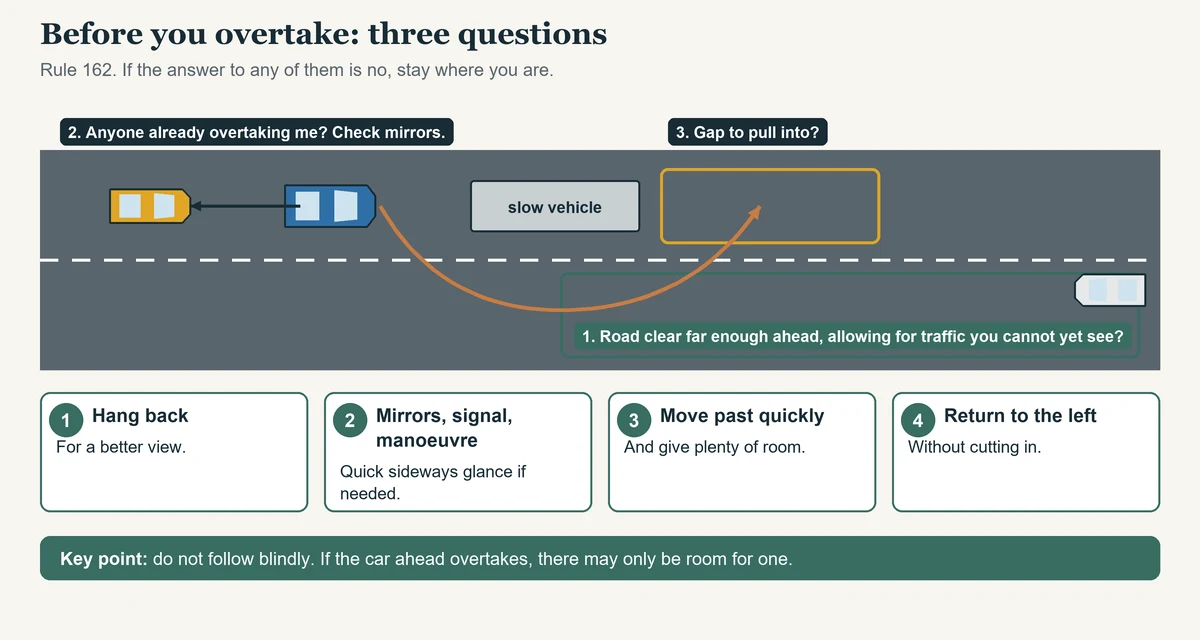
    Before you overtake: the three questions in Rule 162

    Rule 162 says that before overtaking you should make sure:

    Top-down road with a car behind a slow vehicle planning an overtake. Labels ask whether the road is clear far enough ahead, whether anyone is already overtaking, and whether there is a gap to pull back into, above four steps for overtaking safely.
    The three Rule 162 checks and how to overtake. Illustrative diagram, not to scale.
    1. Is the road clear far enough ahead? You need room to pass and get back in, allowing for oncoming traffic you cannot yet see.
    2. Is anyone already overtaking me? Check your mirrors. A car or motorcycle may be coming past.
    3. Is there a gap to pull into? There must be a suitable space in front of the vehicle you are passing.

    If the answer to any of these is no, stay where you are. Rule 166 sums it up: do not overtake if there is any doubt.

    How to overtake safely (Rule 163)

    Rule 163 says overtake only when it is safe and legal. Broken down into steps:

    1. Hang back. Do not get too close to the vehicle you intend to pass. Staying back gives you a better view ahead.
    2. Mirrors, signal, manoeuvre. Check your mirrors, signal when it is safe, and take a quick sideways glance into the blind spot if necessary before moving out.
    3. Do not follow blindly. If the vehicle ahead overtakes, there may only be room for one. Make your own check.
    4. Commit and move past quickly. Once you have started, pass without dawdling and give plenty of room.
    5. Return to the left without cutting in. Move back as soon as you can, but not so sharply that the other driver has to brake.

    Rule 163 also asks for extra care at night and in poor visibility, when speed and distance are harder to judge. When passing parked cars or other obstructions on your side of the road, give way to oncoming vehicles first.

    Passing on the left: the only exceptions

    Under Rule 163, you should only overtake on the left if:

    • the vehicle in front is signalling to turn right and there is room to pass, or
    • traffic is moving in queues and the queue on your right is moving more slowly than yours. In that case you may pass on the left, but stay in your lane.

    Rule 151 adds that in slow-moving traffic you should not change lanes to the left to overtake.

    How much room to give cyclists, horses and pedestrians

    Rule 163 says to give motorcyclists, cyclists, horse riders and horse-drawn vehicles at least as much room as you would when overtaking a car. As a guide:

    Road user Minimum gap Speed
    Cyclist At least 1.5 metres At speeds up to 30 mph; give more space at higher speeds
    Horse rider or horse-drawn vehicle At least 2 metres Under 10 mph
    Pedestrian walking in the road At least 2 metres Keep to a low speed

    Give more space in bad weather, including high winds, and at night. If you cannot leave these gaps, wait behind and do not overtake. Our guides to overtaking cyclists and passing horses safely go into more detail.

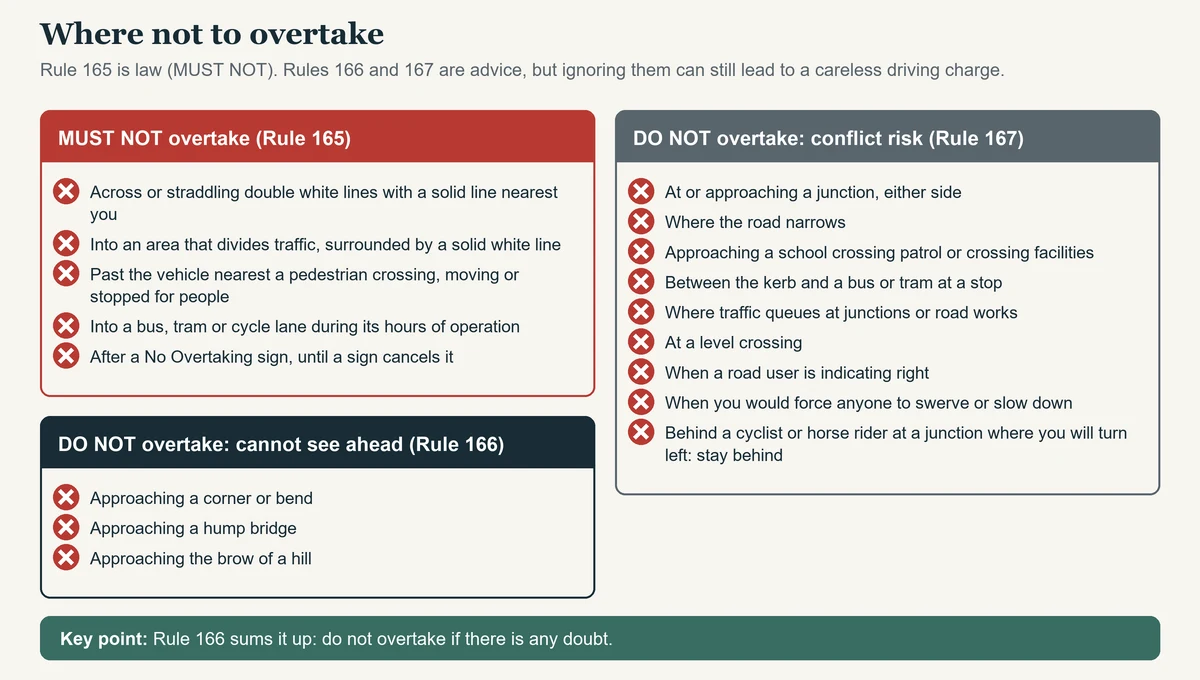
    Where you MUST NOT overtake (Rule 165)

    These are legal requirements. Breaking them is an offence. You MUST NOT overtake:

    Three lists: the five places you must not overtake under Rule 165, the three places you cannot see far enough ahead under Rule 166, and the places of conflict listed in Rule 167.
    Where the Highway Code says you must not, or should not, overtake. Illustrative diagram, not to scale.
    • if you would have to cross or straddle double white lines with a solid line nearest to you (but see the exceptions below)
    • if you would have to enter an area designed to divide traffic, where it is surrounded by a solid white line
    • the nearest vehicle to a pedestrian crossing, especially when it has stopped to let pedestrians cross
    • if you would have to enter a lane reserved for buses, trams or cycles during its hours of operation
    • after a “No Overtaking” sign, until you pass a sign cancelling the restriction

    The solid white line exceptions (Rule 129)

    Rule 129 says you may cross a solid white line on your side, if the road is clear, to pass a stationary vehicle, or to overtake a pedal cycle, horse or road maintenance vehicle travelling at 10 mph or less. You may also cross it when you need to enter adjoining premises or a side road. If the line nearer to you is broken, Rule 128 allows you to cross to overtake if it is safe and you can finish before a solid line on your side. See road markings.

    Where you should not overtake (Rules 166 and 167)

    These rules use “DO NOT” rather than “MUST NOT”, but ignoring them can still lead to a careless or dangerous driving charge.

    Where you cannot see far enough ahead (Rule 166)

    • approaching a corner or bend
    • approaching a hump bridge
    • approaching the brow of a hill

    Where you might come into conflict with others (Rule 167)

    • approaching or at a road junction on either side of the road
    • where the road narrows
    • when approaching a school crossing patrol
    • on the approach to crossing facilities
    • where a vehicle ahead is slowing to stop for a pedestrian crossing from a pedestrian island
    • between the kerb and a bus or tram when it is at a stop
    • where traffic is queuing at junctions or road works
    • when you would force another road user to swerve or slow down
    • at a level crossing
    • when a road user is indicating right, even if you think the signal should have been cancelled
    • when you are following a cyclist, horse rider or horse-drawn vehicle approaching a roundabout or junction and you intend to turn left: stay behind and do not cut across them
    • when a tram is at a kerbside stop and there is no clearly marked passing lane

    Overtaking large vehicles (Rule 164)

    Lorries, buses, tractors with trailers and other long vehicles take longer to pass. Rule 164 says to:

    • drop back, so you can see further ahead and the driver can see you in their mirrors
    • make sure you have enough room to complete the manoeuvre before committing; if in doubt, do not overtake
    • remember there may be another slow vehicle in front of the one you are following
    • not assume you can follow a car that is overtaking a long vehicle, because it may abort and pull back in

    See driving near lorries and buses for blind spots and spacing.

    When someone overtakes you (Rules 168 and 169)

    Rule 168 says that if a driver is trying to overtake you, keep a steady course and speed, slowing down if necessary to let them pass. Never obstruct them. Speeding up or driving unpredictably while being overtaken is dangerous. If they pull into the gap in front of you, drop back to restore a two-second gap (see stopping distances and the two second rule).

    Rule 169 says do not hold up a long queue, especially in a large or slow vehicle. Check your mirrors often and, if necessary, pull in where it is safe to let traffic pass.

    Scenario: a tractor on a country road

    You are behind a tractor doing about 20 mph on a national speed limit single carriageway. A straight stretch opens up, but there is a farm entrance on the left and the road dips out of sight 300 metres ahead.

    • The dip means you cannot see far enough ahead to be sure it is clear. Rule 166 says do not overtake.
    • The farm entrance is a junction where the tractor might turn. Rule 167 says do not overtake approaching a junction.
    • Wait for a stretch where you can see the whole overtake, with a gap to return to.

    Tractor drivers often pull in to let traffic pass, as Rule 169 asks. For more on country roads, see learning to drive on rural roads.

    Common questions

    Is it illegal to overtake on the left in the UK?

    Not always, but it should be rare. Rule 163 allows it when the vehicle in front is signalling right and there is room, or in slow queues where the lane on your right is moving more slowly. On motorways, Rule 268 says do not overtake on the left.

    Can I cross a solid white line to overtake a cyclist?

    Yes, if the road is clear and the cyclist is travelling at 10 mph or less (Rule 129). You still need to leave at least 1.5 metres.

    Can I overtake at a pedestrian crossing?

    You MUST NOT overtake the moving vehicle nearest the crossing, or the vehicle nearest the crossing that has stopped for pedestrians (Rules 165 and 191).

    What should I do if someone overtakes me and cuts in?

    Ease off and drop back to restore a two-second gap. Do not react or chase them.

    Can I overtake in a bus lane?

    Not during its hours of operation. Rule 165 says you MUST NOT overtake if it means entering a bus, tram or cycle lane while it is in operation.

    How do I know when a no overtaking zone ends?

    A no overtaking restriction lasts until you pass a sign cancelling it (Rule 165).

    Back to the main guide: Learning to Drive in Great Britain.

    Sources

    • Department for Transport, “The Highway Code: Using the road (159 to 203)” (gov.uk)
    • Department for Transport, “The Highway Code: General rules, techniques and advice for all drivers and riders (103 to 158)” (gov.uk)
    • Department for Transport, “The Highway Code: Motorways (253 to 274)” (gov.uk)
    • Department for Transport, “The Highway Code: Introduction” (gov.uk)
  • Mobile Phone Driving Law UK: Phones, Sat Navs and In-Car Tech

    Mobile Phone Driving Law UK: Phones, Sat Navs and In-Car Tech

    Photo: Mike Bird / Pexels. Illustrative photograph.

    In Great Britain it is illegal to hold and use a phone, sat nav, tablet or any device that can send or receive data while you are driving, even when you are stopped at traffic lights or queuing. The penalty is 6 penalty points and a £200 fine, and if you passed your test in the last 2 years you lose your licence. This explainer is for learners, new drivers and the people who supervise them. It covers Highway Code Rules 148 to 150, the exceptions, hands-free use, and what the rules say about driver assistance and self-driving features.

    The law in one minute

    • No hand-held use at all while driving: no calls, texts, photos, videos, browsing or scrolling music.
    • It still counts when you are stopped at lights, queuing in traffic, offline, in flight mode, or in a car whose engine cuts out when you stop.
    • Supervisors are covered too. The ban applies to anyone supervising a learner.
    • Penalty: 6 points and £200. In court, a fine of up to £1,000 and a possible ban.
    • New drivers: 6 points within 2 years of passing means your licence is revoked.
    • Hands-free is allowed, as long as you never hold the device and stay in full control.

    What counts as “using” a phone while driving?

    Rule 149 says you MUST NOT use a hand-held mobile phone, or a similar device capable of interactive communication such as a tablet, for any purpose when driving or supervising a learner driver. The ban covers all use, and it applies even when the device’s connection is switched off or unavailable.

    The Highway Code was updated on 25 March 2022 to make clear that the ban covers all uses, not just calls and texts. GOV.UK lists examples of what you must not do with a device in your hand:

    • text or make calls
    • take photos or videos
    • browse the web

    Rule 149 also says you MUST NOT pick up the phone to dial and then put it in a cradle for the conversation, and you MUST NOT pick up and use your phone while stationary in traffic.

    Situations that still break the law

    GOV.UK is specific that the law still applies if you are:

    • stopped at traffic lights
    • queuing in traffic
    • supervising a learner driver
    • driving a car that turns off the engine when you stop moving
    • holding and using a device that is offline or in flight mode

    If you are sitting in the passenger seat supervising a learner, picking up your phone to reply to a message is treated the same as the driver doing it. See supervising a learner driver for the other rules that apply to supervisors.

    The exceptions

    GOV.UK says you can use a device held in your hand only if:

    1. you need to call 999 or 112 in an emergency and it is unsafe or impractical to stop
    2. you are safely parked
    3. you are making a contactless payment in a vehicle that is not moving, for example at a drive-through
    4. you are using the device to park your vehicle remotely

    For contactless payments, Rule 149 adds that the vehicle MUST be stationary and you MUST receive the goods or services at the same time as, or after, the payment. For remote parking, the app or device MUST be legal and you should not put anyone in danger.

    “Safely parked” means parked, not just stopped. Pulling over on a motorway hard shoulder to take a call is not safe parking: Rule 271 says do not stop on any part of a motorway to make or receive calls, except in an emergency.

    Hands-free phones and sat navs: what is allowed?

    You can use a device hands-free as long as you do not hold it at any time while using it. GOV.UK gives these examples of hands-free access:

    • a Bluetooth headset
    • voice command
    • a dashboard holder or mat
    • a windscreen mount
    • a built-in sat nav

    The device must not block your view of the road and traffic ahead. Legal does not mean safe, though. Rule 149 says hands-free equipment is also likely to distract you and that it is far safer not to use any phone while driving: find a safe place to stop or let calls go to voicemail.

    Sat nav set-up before you go

    Rule 150 warns that sat navs, multimedia screens and other in-vehicle systems can distract you. Do not be distracted by maps or screen information while driving; if necessary, find a safe place to stop. The practical habit is simple: enter the destination and choose your music before you move off. On the driving test you may follow a sat nav during the independent driving section. GOV.UK says the examiner sets it up for you and you cannot use your own. See independent driving and the sat nav.

    Penalties for using a phone while driving

    Offence Penalty (GB)
    Holding and using a phone, sat nav, tablet or any device that can send and receive data 6 penalty points and a £200 fine
    Same offence, if you passed your test in the last 2 years Licence lost (6 points reaches the new driver limit)
    Not having a full view of the road and traffic ahead, or proper control of the vehicle 3 penalty points
    If the case goes to court Possible driving ban and a fine of up to £1,000 (£2,500 for a lorry or bus driver)

    Annex 5 of the Highway Code lists the same maximum: a £1,000 fine (£2,500 for a passenger or goods vehicle), discretionary disqualification and 6 points for using a hand-held mobile phone when driving. The phone offence carries the endorsement code CU80, which covers breaches of requirements for control of the vehicle, such as using a mobile phone.

    Why new drivers are hit hardest

    Under the special rules for new drivers in Annex 5, anyone who reaches 6 or more points within 2 years of passing their first test has their licence revoked automatically. Points picked up before passing count too. To drive again you must reapply for a provisional licence and pass the tests again. One phone offence is enough. Read the New Drivers Act and penalty points and endorsement codes.

    Other distractions in Rule 148

    Rule 148 asks you to avoid distractions such as loud music, reading maps, starting or adjusting music or the radio, arguing with passengers or other road users, eating and drinking, and smoking. It also sets out the smoking law: in England and Wales the driver MUST NOT smoke, or let anyone smoke, in an enclosed private vehicle carrying someone under 18. In Scotland it is an offence for anyone aged 18 or over to smoke in a private vehicle in a public place when someone under 18 is in it.

    Driver assistance and self-driving features

    Rule 150 says do not rely on driver assistance systems such as motorway assist, lane departure warnings or remote control parking. You remain responsible for the vehicle when you use them, and you MUST have full control over them at all times.

    The Highway Code introduction separates these from self-driving vehicles: vehicles listed as automated by the Secretary of State for Transport under the Automated and Electric Vehicles Act 2018. While a listed self-driving vehicle is driving itself in a valid situation, you are not responsible for how it drives and may view content on the built-in infotainment screen. You still MUST NOT use a hand-held phone, and you MUST be ready to take back control when the vehicle prompts you. Other laws still apply too: you MUST be fit to drive and within the drink and drug limits, and the vehicle MUST be taxed, insured, roadworthy and have an MOT if it needs one. Ordinary cars with cruise control or lane-keeping are not self-driving, so Rule 150 applies to them.

    Common questions

    Can I use my phone at traffic lights?

    No. GOV.UK says the law still applies when you are stopped at traffic lights or queuing in traffic.

    Can I use my phone as a sat nav?

    Yes, if it is in a holder or windscreen mount, you do not touch or hold it while driving, and it does not block your view. Set the route before you move off.

    Can I touch my phone in a holder?

    GOV.UK says hands-free means you do not hold the device at any time during use. Even with hands-free use, the police can stop you if they think you are not in control because you are distracted.

    Is it illegal for a supervising driver to use their phone?

    Yes. Rule 149 and GOV.UK both say the hand-held ban applies when supervising a learner.

    Can I take a photo of a crash while driving?

    No. Taking photos with a hand-held device while driving is specifically listed as illegal. Stop safely first.

    How many points for using a phone while driving?

    6 points and a £200 fine. If you passed in the last 2 years, that means losing your licence.

    Back to the main guide: Learning to Drive in Great Britain.

    Sources

    • GOV.UK, “Using a phone, sat nav or other device when driving” (gov.uk)
    • Department for Transport, “The Highway Code: General rules, techniques and advice for all drivers and riders (103 to 158)” (gov.uk)
    • Department for Transport, “The Highway Code: Annex 5. Penalties” (gov.uk)
    • Department for Transport, “The Highway Code: Introduction” (gov.uk)
    • Department for Transport, “The Highway Code: Updates” (gov.uk)
    • Department for Transport, “The Highway Code: Motorways (253 to 274)” (gov.uk)
    • GOV.UK, “Penalty points (endorsements): Endorsement codes and penalty points” (gov.uk)
    • GOV.UK, “Driving test: What happens during the test” (gov.uk)
  • Stopping Distances UK: Thinking, Braking and the Two Second Rule

    Stopping Distances UK: Thinking, Braking and the Two Second Rule

    Photo: Dominik Gryzbon / Pexels. Illustrative photograph.

    In Great Britain, the Highway Code gives a typical stopping distance for a car of 12 metres at 20 mph, rising to 96 metres at 70 mph on a dry road. Rule 126 says to leave at least a two-second gap on high-speed roads, at least double that in the wet, and up to ten times more on ice. This explainer is for learner drivers in England, Scotland and Wales, and for the parents helping them practise. It breaks down the official figures, shows how to measure a two-second gap, and covers the braking rules (117 to 122) that sit alongside it.

    Key facts

    • Stopping distance = thinking distance + braking distance. The Highway Code diagram shows both parts for each speed.
    • At 30 mph: 23 metres in total, which the Highway Code says is about six car lengths.
    • At 70 mph: 96 metres in total, or about twenty-four car lengths.
    • Two-second gap: the minimum on high-speed roads and in tunnels (Rule 126).
    • Wet roads: stopping distances are at least double (Rules 126 and 227).
    • Icy roads: the gap may need to be up to ten times greater (Rules 126 and 230).

    The Highway Code stopping distances table

    These are the figures from the “Typical stopping distances” diagram published with Rule 126. The Highway Code uses an average car length of 4 metres (13 feet) for the car-length comparison.

    Stacked bars for 20 to 70 mph showing thinking and braking distance: 12 m at 20 mph, 23 m at 30 mph, 36 m at 40 mph, 53 m at 50 mph, 73 m at 60 mph and 96 m at 70 mph.
    Highway Code typical stopping distances for a car on a dry road. Illustrative diagram, not to scale.
    Speed Thinking distance Braking distance Overall stopping distance Roughly
    20 mph (32 km/h) 6 m 6 m 12 m (40 feet) 3 car lengths
    30 mph (48 km/h) 9 m 14 m 23 m (75 feet) 6 car lengths
    40 mph (64 km/h) 12 m 24 m 36 m (118 feet) 9 car lengths
    50 mph (80 km/h) 15 m 38 m 53 m (175 feet) 13 car lengths
    60 mph (96 km/h) 18 m 55 m 73 m (240 feet) 18 car lengths
    70 mph (112 km/h) 21 m 75 m 96 m (315 feet) 24 car lengths

    The Highway Code describes these as a general guide. The real distance depends on your attention (which affects thinking distance), the road surface, the weather and the condition of your vehicle at the time.

    Spot the pattern

    Look down the thinking distance column: it goes up by 3 metres for every extra 10 mph. Thinking distance grows in step with speed because you cover more ground in the same reaction time.

    Braking distance behaves differently. Going from 30 mph to 60 mph doubles your speed, but braking distance goes from 14 metres to 55 metres, nearly four times as far. That is why a small increase in speed makes a big difference to whether you can stop in time.

    How to remember the figures for the theory test

    Stopping distances come up in the safety margins topic of the theory test. One way to learn them without memorising six random numbers:

    1. Learn the thinking distances first: 6, 9, 12, 15, 18, 21 metres. Each one is the speed’s first digit multiplied by 3.
    2. Learn the totals: 12, 23, 36, 53, 73, 96 metres.
    3. If you need a braking distance, subtract the thinking distance from the total. At 50 mph, 53 minus 15 gives 38 metres.

    What is the two second rule?

    Rule 126 tells you to drive at a speed that lets you stop well within the distance you can see to be clear. It says the safe rule is never to get closer than the overall stopping distance, and to allow at least a two-second gap between you and the vehicle in front on high-speed roads and in tunnels where visibility is reduced.

    A car follows another past a roadside sign used as a fixed point for counting two seconds, with four panels: at least two seconds when dry, at least double when wet, up to ten times on ice, and at least 5 metres when stopped in a tunnel.
    How to check a two-second gap and when to leave more. Illustrative diagram, not to scale.

    How to measure a two-second gap

    1. Pick a fixed point ahead, such as a road sign, bridge or lamp post. The Highway Code illustration uses a sign.
    2. When the rear of the vehicle in front passes that point, start counting two seconds at a steady pace.
    3. If you reach the point before you finish counting, you are too close. Ease off and count again.

    A time gap works at any speed, which is why it is easier to use than trying to judge metres. The faster you go, the more ground two seconds covers.

    When to leave more than two seconds

    Condition What the Highway Code says
    Dry, high-speed road At least a two-second gap (Rule 126)
    Wet road The gap should be at least doubled; stopping distances will be at least double (Rules 126 and 227)
    Icy or snowy road Up to ten times greater; stopping distances can be ten times greater than on dry roads (Rules 126 and 230)
    Following a large vehicle or motorcycle Remember they need a greater distance to stop (Rule 126)
    Stopped in a tunnel Leave at least a 5-metre gap to the vehicle in front (Rule 126)

    Rule 227 explains why the wet makes such a difference: your tyres have less grip on the road. If the steering suddenly feels unresponsive, water is probably stopping the tyres gripping. Ease off the accelerator and slow down gradually. For more on bad weather, see driving in rain, ice, fog, wind and heat.

    Tailgating

    The Highway Code defines tailgating as leaving a gap so small that you could not stop safely if the vehicle in front braked suddenly. It calls tailgating dangerous and intimidating, and says the police enforce dangerous and careless driving offences such as tailgating. If someone overtakes and pulls into your gap, Rule 168 says drop back to restore a two-second gap. Read more in tailgating and road rage.

    If someone is following you too closely, don’t brake to make a point or speed up to get away. Leave a bigger gap in front, so that if you need to slow down you can do it gently, and let them pass when it is safe. Two seconds is a minimum check in good conditions, not a target: grow the gap whenever grip, visibility or your own concentration is worse than usual.

    In slow-moving traffic, Rule 151 lets you close up to keep traffic flowing, but you should never get so close that you cannot stop safely, and you should leave room to steer round a vehicle that breaks down.

    Braking and control: Rules 117 to 122

    Stopping distances assume you brake well. The control rules set out how.

    • Normal braking (Rule 117): brake early and lightly, more firmly as you begin to stop, then ease off just before the car stops to avoid a jerk.
    • Emergency braking (Rule 118): brake immediately, but try not to brake so harshly that the wheels lock, because locked wheels can lead to loss of control.
    • Skids (Rule 119): skids are usually caused by harsh braking, accelerating or steering, or by going too fast for the conditions. Remove the cause by releasing the brake fully or easing off the accelerator, then steer in the direction of the skid. If the rear skids to the right, steer right.
    • ABS (Rule 120): follow the vehicle handbook. In an emergency, press the footbrake firmly and keep the pressure on until you have slowed enough. ABS should help you keep steering control, but do not assume it will stop you in a shorter distance.
    • Brakes after deep water (Rule 121): test them gently at the first safe opportunity. If they are not fully effective, apply light pressure while driving slowly to dry them out.
    • Coasting (Rule 122): travelling in neutral or with the clutch down removes engine braking, lets speed build quickly downhill, makes the footbrake work harder and affects steering on bends.

    Your examiner may ask you to do an emergency stop on the practical test. See driving test manoeuvres for how the test works.

    Scenario: a wet dual carriageway at 60 mph

    You are driving at 60 mph on a dual carriageway in steady rain. The dry overall stopping distance at 60 mph is 73 metres. Rule 227 says wet stopping distances will be at least double, so you should allow for well over 140 metres. In practice, that means counting at least four seconds behind the car ahead rather than two, and easing your speed if spray is cutting your view.

    Common questions

    What is the stopping distance at 30 mph in the UK?

    The Highway Code gives 23 metres (75 feet): 9 metres thinking distance and 14 metres braking distance. That is about six car lengths.

    What is the stopping distance at 70 mph?

    96 metres (315 feet): 21 metres thinking and 75 metres braking, or about twenty-four car lengths.

    Is the two second rule a legal requirement?

    Rule 126 uses advisory wording (“should”), so not following it is not an offence in itself. But the Highway Code can be used as evidence in court, and driving too close can amount to careless or dangerous driving, which are offences.

    How much space should I leave on ice?

    Rule 126 says the gap may need to be up to ten times greater than on a dry road, and Rule 230 says icy or snowy stopping distances can be ten times greater.

    Do the stopping distances apply to all cars?

    They are a general guide for a typical car. The Highway Code says your attention, the road surface, the weather and the condition of your vehicle all change the real figure.

    Does ABS mean I stop sooner?

    Not necessarily. Rule 120 says ABS should let you keep steering control, but you should not assume it stops the car in a shorter distance.

    Back to the main guide: Learning to Drive in Great Britain.

    Sources

    • Department for Transport, “The Highway Code: General rules, techniques and advice for all drivers and riders (103 to 158)” (gov.uk)
    • Department for Transport, “The Highway Code: Typical stopping distances” diagram (assets.publishing.service.gov.uk)
    • Department for Transport, “The Highway Code: Driving in adverse weather conditions (226 to 237)” (gov.uk)
    • Department for Transport, “The Highway Code: Using the road (159 to 203)” (gov.uk)
    • Department for Transport, “The Highway Code: Introduction” (gov.uk)
  • Child Car Seat and Seat Belt Law in GB: Rules 99 to 102

    Child Car Seat and Seat Belt Law in GB: Rules 99 to 102

    Photo: Maxim Hopman / Unsplash. Illustrative photograph.

    In Great Britain, children must use a child car seat until they are 12 years old or 135 cm tall, whichever comes first, and the driver is legally responsible for every passenger under 14. Adults aged 14 and over are responsible for wearing their own seat belt. This guide is for learner and new drivers in England, Scotland and Wales who will soon be carrying younger brothers, sisters or friends’ children. It explains Highway Code Rules 99 to 102, the seat types allowed, the exceptions and the fines.

    Key facts

    • You MUST wear a seat belt in a car, van or other goods vehicle if one is fitted (Rule 99).
    • Children need a child car seat until 12 years old or 135 cm tall, whichever comes first.
    • The driver is responsible for passengers under 14. Passengers 14 and over are responsible for themselves.
    • Only seats labelled with the E in a circle and R129 (height-based) or ECE R44 (weight-based) can be used in the UK.
    • Never fit a rear-facing baby seat in a seat protected by an active frontal airbag (Rule 101).
    • The fine is up to £500 for not wearing a seat belt, or for carrying a child under 14 without the correct seat or belt (as of November 2026).

    Who is responsible for wearing a seat belt?

    The Highway Code sets out who is legally responsible in a table under Rule 99. Here it is in plain terms:

    A timeline from birth: a child car seat until 12 years old or 135 cm, a seat belt after that, and below it the driver responsible for every passenger under 14 and the passenger responsible from 14.
    Which restraint a passenger needs and who is legally responsible. Illustrative diagram, not to scale.
    Who Front seat Rear seat Who is responsible
    Driver Seat belt must be worn if fitted Not applicable Driver
    Child under 3 Correct child restraint must be used Correct child restraint must be used. In a taxi without one, the child may travel unrestrained in the rear Driver
    Child from 3rd birthday until 135 cm tall or 12th birthday (whichever first) Correct child restraint must be used Correct child restraint must be used where seat belts are fitted (see the exceptions below) Driver
    Child over 135 cm, or aged 12 or 13 Seat belt must be worn if available Seat belt must be worn if available Driver
    Adult passenger aged 14 and over Seat belt must be worn if available Seat belt must be worn if available Passenger

    GOV.UK also says only one person is allowed in each seat fitted with a seat belt. Two children sharing one belt is not allowed.

    Which child car seat does a child need?

    GOV.UK describes two types of approved seat. Check the label before you buy or borrow one.

    A panel on height-based R129 seats, rear-facing until over 15 months, above a bar chart of the five overlapping ECE R44 weight groups from 0 to 36 kg with their seat types.
    R129 height-based seats and the overlapping R44 weight groups. Illustrative diagram, not to scale.

    Height-based seats (R129)

    These seats are chosen by the child’s height. The child must be rear-facing until they are over 15 months old. After that they can face forward. Check the seat label to make sure it suits your child’s height.

    Weight-based seats (ECE R44)

    Group Child’s weight Seat types
    0 Up to 10 kg Lie-flat or lateral baby carrier, rear-facing baby carrier, or rear-facing baby seat with harness
    0+ Up to 13 kg Rear-facing baby carrier or rear-facing baby seat with harness
    1 9 to 18 kg Rear or forward-facing seat with harness or safety shield
    2 15 to 25 kg Rear or forward-facing high-backed booster seat or booster cushion, with seat belt, harness or safety shield
    3 22 to 36 kg Rear or forward-facing high-backed booster seat or booster cushion, with seat belt, harness or safety shield

    The weight ranges overlap, so more than one seat type can suit a child. Manufacturers can now only make new booster cushions approved for Group 3, but existing Group 2 cushions can still be used.

    How to fit a child seat legally

    1. Use the seat only with a diagonal seat belt strap, unless it is designed for a lap belt or fitted using ISOFIX anchor points.
    2. Fit it exactly as the manufacturer’s instructions say (Rule 100).
    3. Never put a rear-facing baby seat in a front seat with an active frontal airbag. Deactivate the airbag first (Rule 101 and GOV.UK).
    4. Do not fit a child seat in a side-facing seat.
    5. Put bags and shopping in the boot, with heavy items low down. Anything loose on a seat or parcel shelf can hit someone under hard braking, and Rule 98 says any load MUST be secure.
    6. Let children get in and out through the door nearest the kerb, and use child safety door locks where fitted (Rule 102).

    Rule 102 also advises not to let children sit behind the rear seats in an estate car or hatchback unless a special child seat has been fitted.

    When can a child travel without a car seat?

    GOV.UK lists a small number of exceptions:

    Situation Under 3 3 and over
    Taxi or minicab without a suitable seat May travel without a seat or belt, but only in the rear Must wear an adult seat belt, in the rear
    Unexpected, necessary, short journey and the correct seat is not available Only allowed in a licensed taxi or minicab, in the rear May use an adult seat belt
    Two occupied child seats in the back stop a third being fitted Must travel in the front in the correct child seat May sit in the back using an adult belt
    Rear seat has no seat belt fitted Not covered: under 3s must be in a child car seat May travel in the back without a seat or belt

    Read these exceptions narrowly. The “unexpected, necessary, short” case needs all three: a planned school run does not become unexpected just because fetching the right seat is a hassle. The taxi exception covers licensed taxis and minicabs only, not a lift in a friend’s or relative’s car. If you are not sure an exception applies, get the correct seat or change the plan.

    Vans follow the same rules as cars. Coaches and minibuses have their own rules, and Rule 99 says passengers aged 14 and over in minibuses, buses and coaches must wear a seat belt where one is fitted.

    Exemptions for adults

    Rule 99 lists two exemptions: holders of a medical exemption certificate, and people making deliveries or collections in goods vehicles when travelling less than 50 metres. For a child who cannot use a restraint or belt because of a medical condition, a doctor can issue an exemption certificate. Children with disabilities otherwise follow the same rules, and may use a disabled person’s seat belt or a restraint designed for their needs.

    Fines

    • Up to £500 if you do not wear a seat belt when you are required to.
    • Up to £500 if you are driving and a child under 14 is not in the correct car seat or wearing a seat belt.

    Annex 8 of the Highway Code, the safety code for new drivers, asks you to make sure everyone in the car wears a seat belt throughout the journey. With friends in the car, say it before you set off. See carrying passengers for the first time.

    Scenario: the school run with three children

    You have passed your test and are asked to drive your 2-year-old cousin, your 7-year-old sister (125 cm) and her 13-year-old friend.

    • 2-year-old: must be in the correct child seat for their weight or height. You are responsible.
    • 7-year-old at 125 cm: under 12 and under 135 cm, so needs a child seat or booster. You are responsible.
    • 13-year-old: must wear a seat belt. You are still responsible because they are under 14.
    • If the two child seats in the back leave no room for a third, the under 3 would have to go in the front in the correct seat, with the front airbag deactivated if the seat is rear-facing.

    Common questions

    What age can a child stop using a car seat in the UK?

    At 12 years old or 135 cm tall, whichever comes first. After that they must wear a seat belt.

    Can a child sit in the front seat?

    The Highway Code table sets the same requirement for front and rear seats: the correct child restraint for the child’s age and height, or a seat belt once they are 12 or 135 cm. A rear-facing baby seat must never go in front of an active frontal airbag.

    Who gets fined if a 15-year-old passenger is not wearing a belt?

    Passengers aged 14 and over are responsible for wearing their own belt, so the passenger would be liable. For passengers under 14, it is the driver.

    Do I need a car seat in a taxi?

    Not if the taxi driver does not provide one. Children must sit in the back: under 3s may travel without a seat or belt, and children aged 3 and over must wear an adult belt.

    Can I use an old Group 2 booster cushion?

    Yes. New booster cushions can only be made as Group 3, but existing Group 2 cushions can still be used.

    What is the fine for not wearing a seat belt?

    Up to £500 (as of November 2026).

    Back to the main guide: Learning to Drive in Great Britain. Related: before you drive checks and the theory topic safety and your vehicle.

    Sources

    • Department for Transport, “The Highway Code: Rules for drivers and motorcyclists (89 to 102)” (gov.uk)
    • GOV.UK, “Child car seats: the law” (gov.uk)
    • GOV.UK, “Child car seats: when a child can travel without a car seat” (gov.uk)
    • GOV.UK, “Seat belts: the law” (gov.uk)
    • Department for Transport, “The Highway Code: Annex 8. Safety code for new drivers” (gov.uk)
  • UK Drink Drive Limits: England, Wales, Scotland and NI

    UK Drink Drive Limits: England, Wales, Scotland and NI

    Photo: Nathan J Hilton / Pexels. Illustrative photograph.

    The drink drive limit in England, Wales and Northern Ireland is 35 micrograms of alcohol per 100 ml of breath (80 mg per 100 ml of blood). Scotland is lower, at 22 micrograms per 100 ml of breath (50 mg per 100 ml of blood). This explainer is for learner and new drivers across the UK. It sets out every official limit, the drug driving rules, the penalties, and where the 2026 government consultation stands.

    Key facts

    • The limits are the same for learners, new drivers and experienced drivers. There is no lower novice limit in UK law as of November 2026.
    • There is no safe number of drinks. GOV.UK says alcohol affects people differently depending on weight, age, sex, metabolism, food and stress.
    • Driving over the limit carries a ban of at least 1 year, an unlimited fine and up to 6 months in prison.
    • In England, Scotland and Wales, it is illegal to drive with certain drugs in your blood above specified limits, even if your driving is not affected.
    • Annex 8 of the Highway Code, the safety code for new drivers, says simply: do not drive after drinking alcohol or taking drugs.

    What is the drink drive limit in each part of the UK?

    Measure England, Wales and Northern Ireland Scotland
    Breath (micrograms per 100 ml) 35 22
    Blood (milligrams per 100 ml) 80 50
    Urine (milligrams per 100 ml) 107 67

    Police usually test breath at the roadside. Blood or urine samples may be taken at a police station. If a UK court bans you for drink driving, GOV.UK says you cannot drive anywhere in the UK.

    Why the limit is not a target

    Rule 95 of the Highway Code for Great Britain says the safest option is not to drink at all if you plan to drive. It explains that alcohol gives a false sense of confidence, slows reactions, reduces coordination and affects your judgement of speed, distance and risk. Alcohol can impair your driving below the legal limit, and it can still be in your body the next morning or evening.

    Drug driving: the rules in England, Scotland and Wales

    Under the drug driving law, it is illegal to drive if you are unfit because of drugs, or if you have certain drugs in your blood above specified limits, whether or not your driving is affected. Rule 96 of the Highway Code explains that the limits for illegal drugs are very low, so even a small amount can put you over.

    Medicines covered by the law

    GOV.UK lists these prescription medicines as covered by drug driving limits:

    • amphetamine, for example dexamphetamine or selegiline
    • clonazepam
    • diazepam
    • flunitrazepam
    • lorazepam
    • methadone
    • morphine or opiate and opioid-based drugs, for example codeine, tramadol or fentanyl
    • oxazepam
    • temazepam

    You can drive after taking these if they were prescribed and you follow the advice of a healthcare professional, and they do not make you unfit to drive. If you are not sure, ask your doctor or pharmacist. Rule 96 says the limits for these medicines are set higher than levels expected from normal doses, and there is a statutory medical defence in some cases.

    Roadside testing

    Police can carry out a field impairment assessment, such as asking you to walk in a straight line, and can use a roadside drug kit that screens for cannabis and cocaine. If they think you are unfit to drive, you will be arrested and asked for a blood or urine sample at a police station.

    Northern Ireland

    GOV.UK says the drug driving law described above covers England, Scotland and Wales, not Northern Ireland. In Northern Ireland you can still be arrested if you are unfit to drive because of drugs.

    Drink and drug driving penalties

    Offence Prison (maximum) Fine Driving ban
    Being in charge of a vehicle while over the limit or unfit through drink 3 months Up to £2,500 Possible ban
    Driving or attempting to drive over the limit or unfit through drink 6 months Unlimited At least 1 year (3 years if convicted twice in 10 years)
    Refusing to provide a specimen of breath, blood or urine 6 months Unlimited At least 1 year
    Causing death by careless driving while under the influence of drink Life Unlimited At least 5 years, plus an extended driving test
    Drug driving (England, Scotland and Wales) 6 months Unlimited At least 1 year

    GOV.UK lists further consequences: a criminal record, much higher car insurance costs, possible problems with employers if you drive for work, and difficulty travelling to some countries, such as the USA. A drug driving conviction stays on your licence for 11 years. A court may offer a drink drive rehabilitation course, which can reduce a ban of 12 months or more.

    What it means for a new driver

    Any conviction that adds penalty points counts towards the new driver limit. In Great Britain, if you reach 6 or more points within 2 years of passing your first test, your licence is cancelled and you must pass the theory and practical tests again. See the New Drivers Act and driving penalties and endorsement codes.

    Is the UK lowering the drink drive limit?

    Not yet. The Department for Transport ran a consultation called “Proposed changes to penalties for motoring offences” from 7 January to 11 May 2026. Drink and drug driving were among the areas covered. As of November 2026, GOV.UK shows the consultation as closed, with the department analysing feedback and no outcome published.

    You may see reports of a lower limit for new drivers. No such limit is in force. Until the law changes, the limits in the table above apply. Check GOV.UK for the outcome before relying on any change.

    Scenario: the morning after

    You were at a party until 2am and plan to drive to college at 8am. Rule 95 warns that alcohol may still be in your body the next morning. There is no way to tell when you are under the limit. The only safe choice is not to drive if you have any doubt, and to plan a lift or public transport the night before.

    Common questions

    How many drinks can I have and still drive?

    GOV.UK says there is no way to drink and know you are under the limit, because it depends on your weight, age, sex, metabolism, what you drink, whether you have eaten and your stress levels. The safest number is none.

    Is the drink drive limit lower for new drivers?

    No. As of November 2026 the same limits apply to everyone in each part of the UK. A consultation closed in May 2026 and its outcome had not been published by November 2026.

    Do the limits apply to learner drivers?

    The learner is the driver, so the limits apply to them in full. A supervisor has to be able to take control and spot hazards for the learner, so the safe choice is for them not to drink either. Our guide to supervising a learner driver covers what supervisors must do.

    Can I drive on prescribed medicine?

    Yes, if it was prescribed, you follow the advice of a healthcare professional, and it does not make you unfit to drive. Check the label and ask your pharmacist.

    Why is Scotland’s limit lower?

    Scotland sets its own drink drive limit. The Highway Code for Great Britain shows Scotland at 22 micrograms per 100 ml of breath and 50 mg per 100 ml of blood, lower than England and Wales.

    Back to the main guide: Learning to Drive in Great Britain. In Northern Ireland, see Learning to Drive in Northern Ireland. For fitness to drive more widely, see fitness to drive and the DVLA.

    Sources

    • GOV.UK, “The drink drive limit” (gov.uk)
    • GOV.UK, “Drink-driving penalties” (gov.uk)
    • GOV.UK, “Drugs and driving: the law” (gov.uk)
    • Department for Transport, “The Highway Code: Rules for drivers and motorcyclists (89 to 102)” (gov.uk)
    • Department for Transport, “The Highway Code: Annex 8. Safety code for new drivers” (gov.uk)
    • Department for Transport, “Proposed changes to penalties for motoring offences” (gov.uk)
    • GOV.UK, “Penalty points (endorsements): new drivers” (gov.uk)