Photo: Zekai Zhu / Pexels. Illustrative photograph.
The Highway Code for Great Britain has four short reversing rules (200 to 203). The two that learners most often miss: do not reverse from a side road into a main road, and you MUST NOT reverse further than necessary. There is no separate U-turn rule, but the Code says to turn round only in a safe place, avoid busy roads, and avoid U-turns at mini-roundabouts. This explainer covers what is law, what is advice, and how reversing is marked on the test.
The four reversing rules at a glance
| Rule | What it says | Law or advice? |
|---|---|---|
| 200 | Choose a suitable place to manoeuvre. To turn round, wait for a safe place. Avoid reversing or turning on a busy road: use a quiet side road or drive round a block of side streets. | Advice |
| 201 | Do not reverse from a side road into a main road. On a driveway, reverse in and drive out if you can. | Advice |
| 202 | Check all mirrors and the blind spot behind you, and look for pedestrians (particularly children), cyclists, other road users and obstructions. Reverse slowly, looking mainly through the rear window. Remember the front swings out as you turn. Get someone to guide you if you cannot see clearly. | Advice |
| 203 | You MUST NOT reverse further than necessary. | Law (Construction and Use Regulations, reg 106) |
Why you never reverse from a side road into a main road
Reversing out puts the back of the car, where your view is worst, into the faster traffic. The safe alternatives in Rule 200 are to turn round in a quiet side road or to drive round a block. The same logic is behind Rule 201’s advice for driveways: reverse in from the road, then drive out forwards, so you can see the pavement as you cross it.
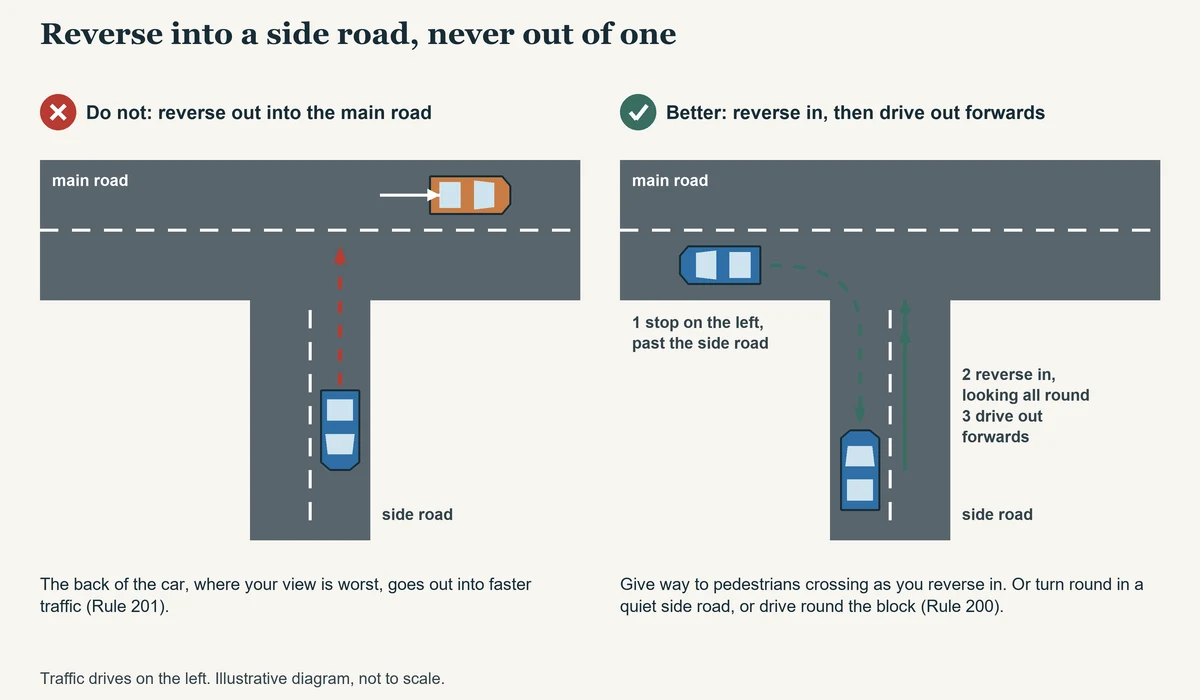
When you do cross a pavement, Rule 206 says give way to pedestrians on it and to cyclists in a cycle lane or track. When reversing into a side road, look all round and give way to any pedestrians crossing.
A safe reversing checklist
- Pick a place where reversing is safe and allowed, away from busy roads.
- Check all mirrors, then look over your shoulder at the blind spot behind.
- Look for pedestrians, especially small children who may be hidden behind the car.
- Reverse slowly, looking mainly through the rear window.
- Keep checking all round. Watch the front of the car as it swings out.
- Stop if anyone approaches. Ask for help if you cannot see.
- Reverse no further than you need to.
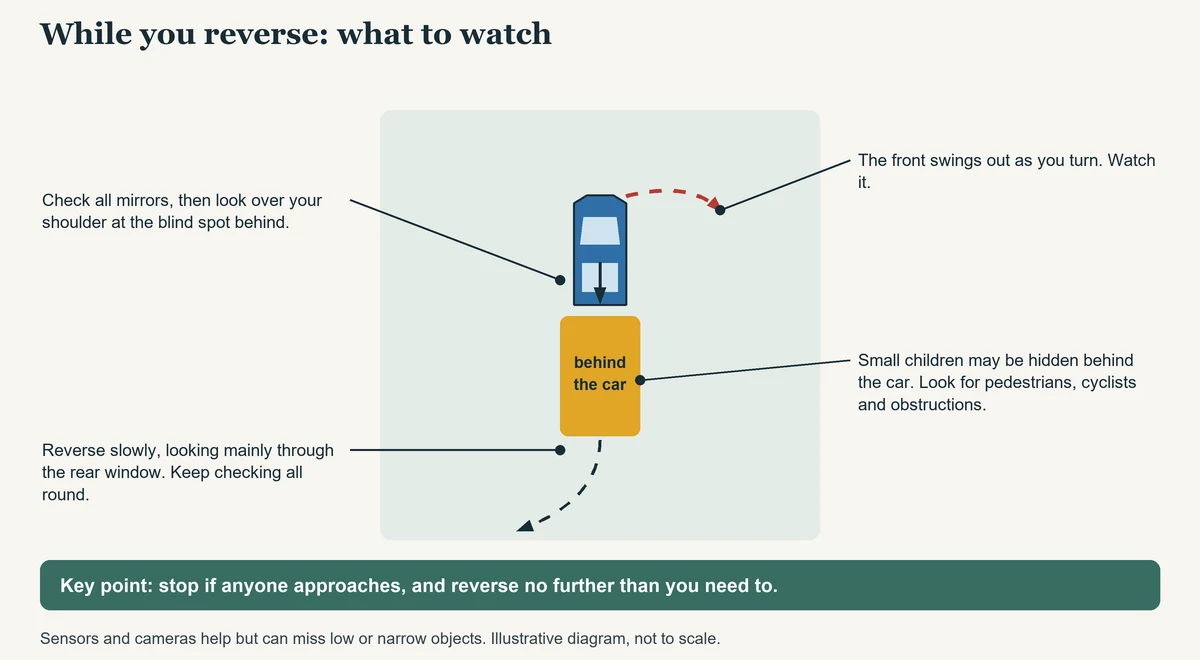
Parking cameras and sensors help, but they can miss low or narrow objects and show only part of the picture. Keep looking round the whole time the car is moving, not just once before you start, and pause to reassess if the view becomes unclear.
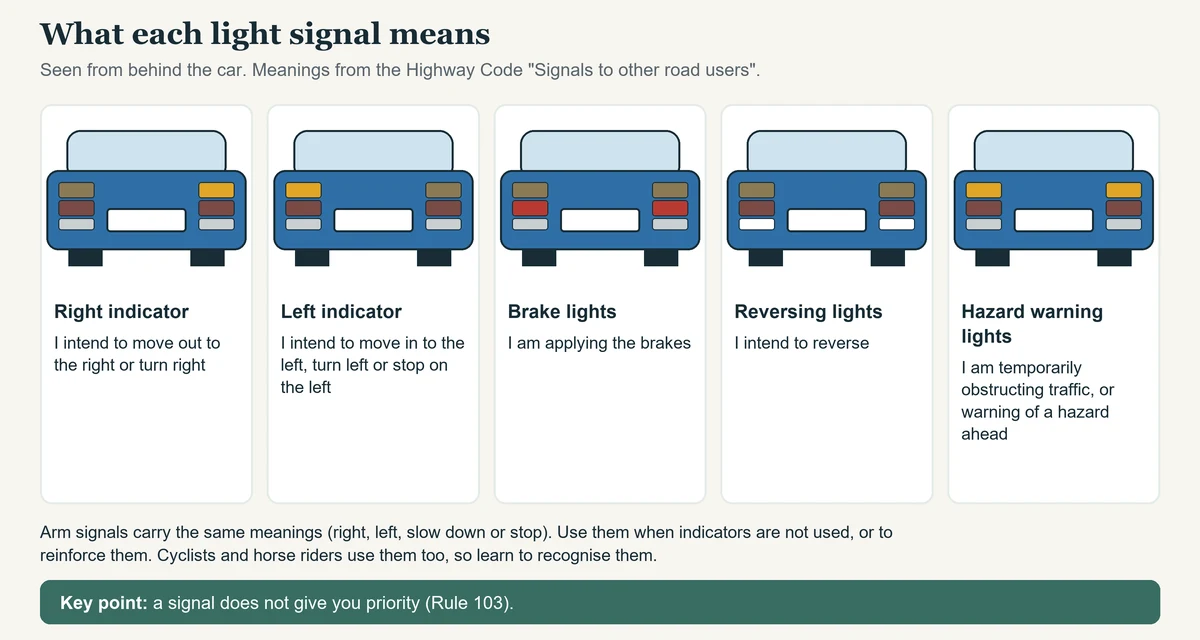
Reversing lights tell others “I intend to reverse”, but children may not understand them. See signalling correctly.
Are U-turns legal in the UK?
The Highway Code does not have a rule banning U-turns in general. The limits it and the traffic sign rules set are:
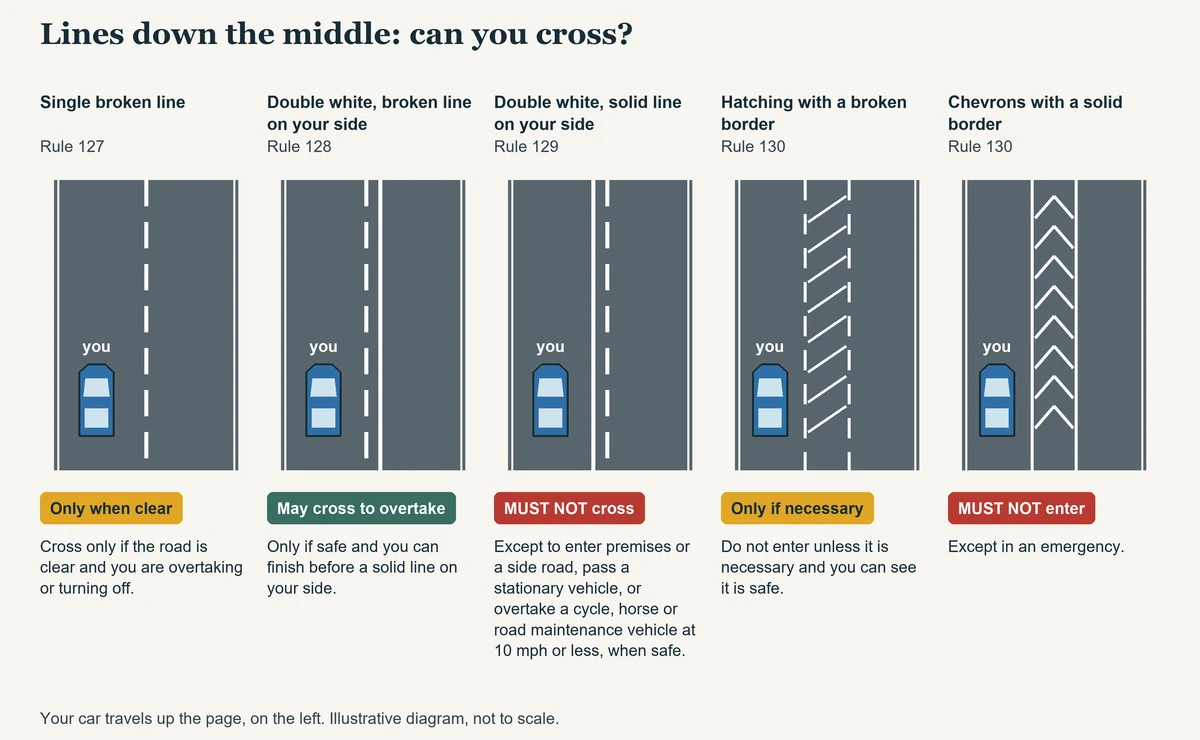
- “No U-turns” signs: these are signs giving orders, so you must obey them (Rule 109). See regulatory signs.
- Motorways: special regulations prohibit U-turns and reversing.
- Mini-roundabouts: Rule 188 says avoid U-turns at them, and be aware that others might do one. See mini and double roundabouts.
- Everywhere: Rule 200 says turn round only in a safe place and avoid busy roads.
Before a U-turn, use mirrors, look round for blind spots and only start when the road is clear in both directions. If the road is too narrow to turn in one sweep, a quiet side road or a drive round the block is usually the safer option.
Reversing on the driving test in Great Britain
You will be asked to do one reversing manoeuvre: a parallel park, a bay park, or pulling up on the right and reversing for about two car lengths. DVSA assesses control and all-round observation.
| Manoeuvre | Faults DVSA lists |
|---|---|
| Reverse park (parallel or bay) | Repositioning often because of poor control; touching or driving over the pavement; weak observations; not finishing within the bay |
| Pull up on the right and reverse | Missing hazards or road users; relying only on mirrors; touching the pavement; misjudging oncoming traffic when crossing to the right; parking too far from the pavement |
DVSA’s advice for the pull-up-on-the-right exercise is to read Rules 200 to 203. Step-by-step help: driving test manoeuvres explained.
Common questions
Is it illegal to reverse out of a side road onto a main road?
Rule 201 is worded as advice (“do not”) rather than a MUST rule. That does not make it safe: the Highway Code tells every driver not to do it, and Rule 203’s legal limit on reversing still applies.
How far can you legally reverse?
No set distance. Rule 203 says you MUST NOT reverse further than necessary.
Should I reverse into my driveway or drive in?
Rule 201 says reverse in and drive out if you can.
Can I rely on parking sensors and a reversing camera?
Not on their own. Rule 202 still asks you to check all round and look mainly through the rear window. On the test, relying only on mirrors is a listed fault for the reverse exercise.
Can I do a U-turn at a mini-roundabout?
Rule 188 says avoid U-turns at mini-roundabouts.
Is the turn in the road still on the test?
Not in Great Britain. The GB reversing exercises are the parallel park, bay park and pulling up on the right. Northern Ireland’s test differs: see driving test manoeuvres.
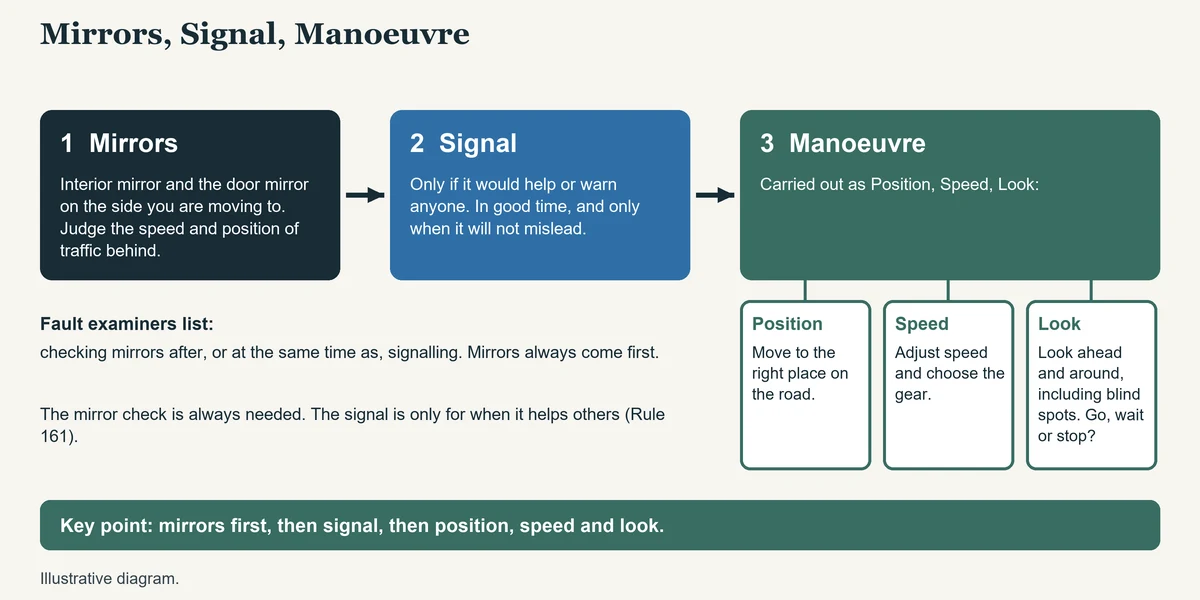
Back to the main guide: Learning to Drive in Great Britain. Related: mirror, signal, manoeuvre.
Sources
- Department for Transport, “The Highway Code: Using the road (159 to 203)” (gov.uk)
- Department for Transport, “The Highway Code: Road users requiring extra care (204 to 225)” (gov.uk)
- Department for Transport, “The Highway Code: Traffic signs” (gov.uk)
- Department for Transport, “Know your traffic signs: Motorway signs, signals and road markings” (gov.uk)
- Department for Transport, “The Highway Code: Signals to other road users” (gov.uk)
- DVSA, “Understanding your driving test result: Car driving test” (gov.uk)