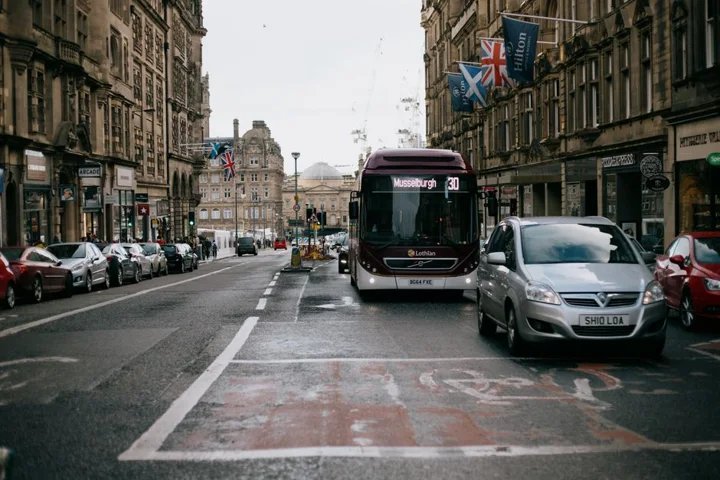
Photo: Tudor Smith / Pexels. Illustrative photograph.
The vehicle markings in the Highway Code for Great Britain tell you about the vehicle ahead: red and yellow rear markings mean a heavy or long vehicle, projection markers mean an overhanging load, orange hazard plates mean dangerous goods, and a “School bus” sign means children may be getting on or off. This explainer covers each one and what it means for how you drive.
Quick reference
| Marking | Where you see it | What it tells you |
|---|---|---|
| Large goods vehicle rear markings | Motor vehicles over 7,500 kg maximum gross weight; trailers over 3,500 kg | A heavy vehicle: allow more room and more stopping distance |
| Vertical rear markings | Commercial vehicles or combinations over 13 metres long (optional from 11 to 13 metres); builders’ skips in the road | A long vehicle, or a skip you need to steer round |
| Projection markers (side and end) | A load or equipment, such as a crane jib, overhanging the front or rear by more than 2 metres | Something sticks out beyond the vehicle body |
| Hazard warning plates and panels | Road tankers, tank containers, and vehicles carrying certain dangerous goods in packages | Dangerous goods on board |
| “School bus” sign | Front or rear window of a bus or coach | Children may be boarding or getting off |
Rear markings on lorries and long vehicles
The Highway Code shows the large goods vehicle rear markings in three positions: left, central and right. They are for lorries over 7,500 kg maximum gross weight and trailers over 3,500 kg. Vertical versions are used on vehicles or combinations over 13 metres long, can be used on those between 11 and 13 metres, and are also used on builders’ skips placed in the road.
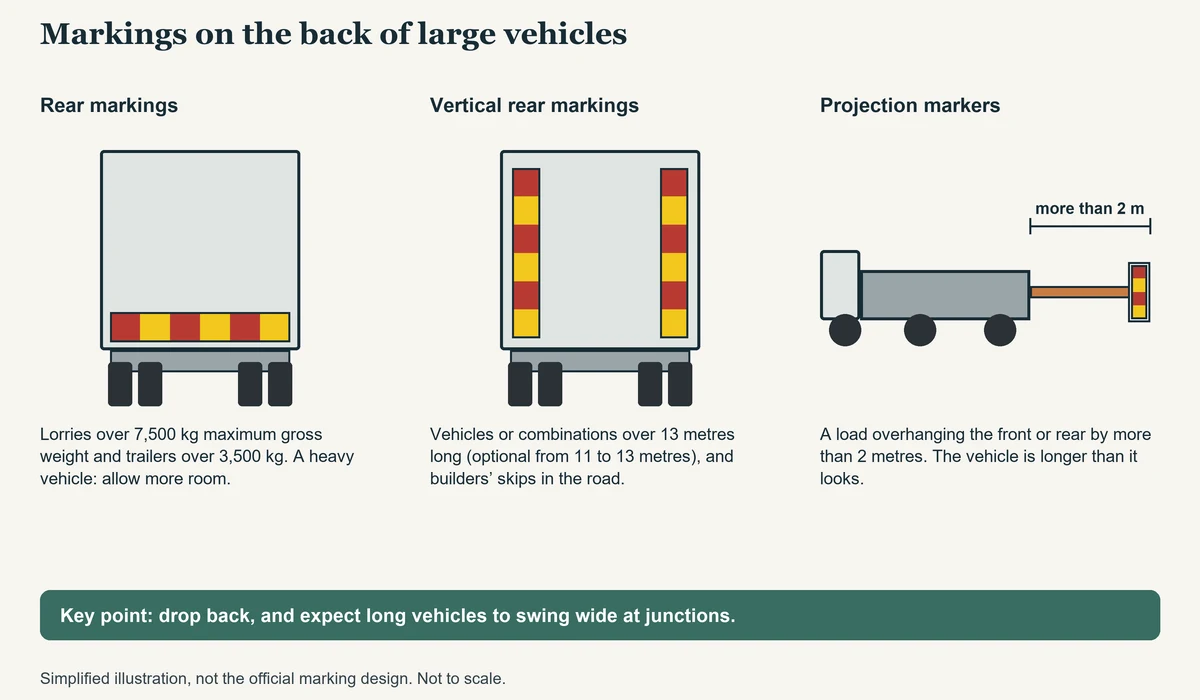
What to do: drop back so you can see past, expect wide swings at junctions and roundabouts, and do not overtake on the left as a long vehicle turns. Detail: driving near lorries, buses and large vehicles.
Projection markers
A side marker and an end marker are required when a load or equipment overhangs the front or rear by more than 2 metres. If you see them, the vehicle is effectively longer than it looks. Leave extra room when following, and take care when it turns, because the overhang can sweep across the pavement or the next lane.
Hazard warning plates: dangerous goods
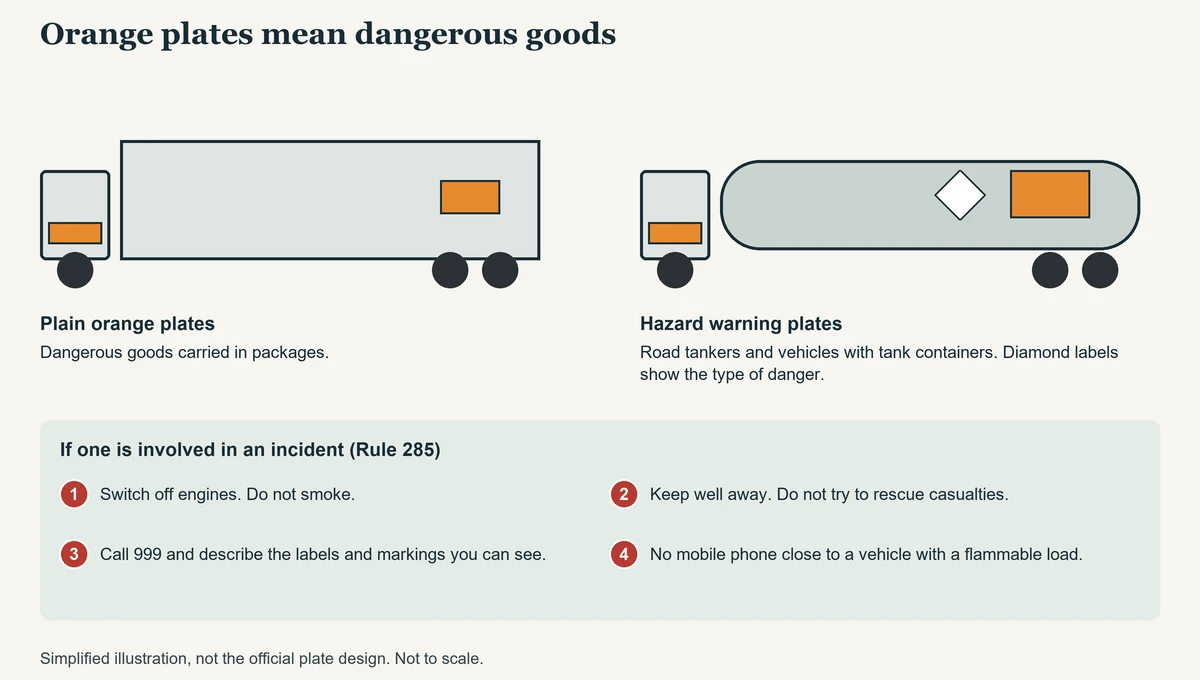
Rule 284 says vehicles carrying dangerous goods in packages are marked with plain orange reflective plates, and road tankers and vehicles carrying tank containers have hazard warning plates. The Highway Code shows panels with diamond symbols for these risks:
- flammable liquid
- toxic substance
- oxidising substance
- non-flammable compressed gas
- radioactive substance
- spontaneously combustible substance
- corrosive substance
You do not need to decode the information on a panel. If you report an incident, describe the labels and markings you can see.
If a dangerous goods vehicle is involved in an incident (Rule 285)
- Switch off engines. Do not smoke.
- Keep well away from the vehicle. Do not try to rescue casualties, as you could become one.
- Call the emergency services and give as much information as you can about the labels and markings on the vehicle.
- Do not use a mobile phone close to a vehicle carrying flammable loads.
Your wider duties at a collision: after a car accident in the UK.
School bus signs (Rule 209)
The “School bus” sign is shown in the front or rear window of a bus or coach. When you pass a stopped bus showing it, drive carefully and slowly, because children may be getting on or off. More on driving near schools: road users requiring extra care.
Common questions
What do the orange plates on lorries mean?
Dangerous goods. Plain orange reflective plates mean dangerous goods in packages; road tankers and tank containers carry hazard warning plates (Rule 284).
What should I tell 999 about a tanker crash?
As much as you can about the labels and markings on the vehicle (Rule 285), plus the location and direction of travel.
What do red and yellow stripes on the back of a lorry mean?
They are large goods vehicle rear markings, used on vehicles over 7,500 kg and trailers over 3,500 kg.
Do I have to stop for a school bus in the UK?
No law requires you to stop, unlike some other countries. Rule 209 says drive carefully and slowly past a stationary bus showing a “School bus” sign.
Is this in the theory test?
Yes, under other types of vehicle and incidents, accidents and emergencies.
Back to the main guide: Learning to Drive in Great Britain.
Sources
- Department for Transport, “The Highway Code: Vehicle markings” (gov.uk)
- Department for Transport, “The Highway Code: Breakdowns and incidents (275 to 287)” (gov.uk)
- Department for Transport, “The Highway Code: Road users requiring extra care (204 to 225)” (gov.uk)