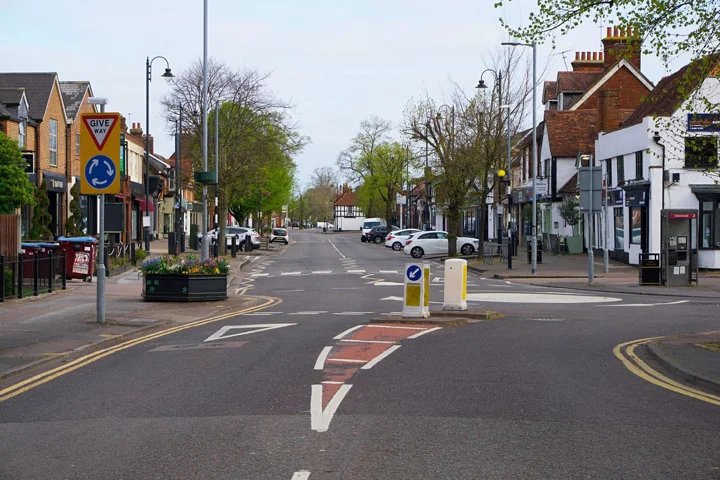
Photo: Gotta Be Worth It / Pexels. Illustrative photograph.
The car hazard perception test in Great Britain and Northern Ireland has 14 video clips with 15 scoreable developing hazards. Each hazard is worth up to 5 points, so the maximum is 75 and the pass mark is 44. The earlier you click once a hazard starts to develop, the more you score. Click continuously or in a pattern and that clip scores zero. Here is how the marking works and how to use it.
Key facts
- Clips: 14, each with at least one developing hazard. One clip has two.
- Scoreable hazards: 15 in total (13 clips with one, one clip with two).
- Points: up to 5 per developing hazard, 75 in total.
- Pass mark: 44 out of 75 for car and motorcycle candidates.
- Wrong clicks: do not lose points, but continuous or pattern clicking scores zero for that clip.
- One go: you cannot review or change your responses.
What is a developing hazard?
A developing hazard is something that would make you take action, such as changing speed or direction. DVSA’s example:
- A car parked at the side of the road is not a developing hazard while it is doing nothing.
- When its indicator starts flashing and it begins to pull out, it becomes a developing hazard: you would need to slow down.
So the test is not about spotting everything that could be a risk. It rewards you for noticing the moment a situation starts to need a response from you.
How the 5 point scoring works
Each developing hazard has a scoring window: a stretch of the clip that starts when the hazard begins to develop. DVSA confirms the clips have scoring windows and that responding earlier scores more, up to 5 points. It does not publish the exact length of each window or the timing of each point band.
| When you click | What you score |
|---|---|
| Before the hazard starts developing (the parked car doing nothing) | Nothing, but nothing is lost |
| Early in the scoring window (the indicator starts flashing) | Highest score, up to 5 |
| Later in the window | Fewer points |
| After the window closes | Zero for that hazard |
| Clicking continuously or in a pattern | Zero for the whole clip |
Why clicking more than once can help
Because an early click before the window opens scores nothing and costs nothing, a second click as the hazard clearly develops makes sure you land inside the window. A short series of clicks tied to what you see is fine. Rhythmic clicking all the way through a clip is what triggers a zero.
How zero scores happen
- Pattern or continuous clicking. The whole clip scores zero. DVA’s guidance says a message appears at the end of the clip to tell you it scored zero.
- Clicking too late. If you only react once the hazard is right in front of you, the window may have closed.
- Missing the second hazard in the clip that has two. Keep watching after your first response.
What a good response looks like
- Scan the whole scene: mirrors and side roads, pavements, parked cars, the road far ahead.
- Notice clues: an indicator, a pedestrian looking to cross, brake lights ahead, a ball rolling out.
- Click when the clue shows the situation is starting to change.
- Click again if it keeps developing.
- Keep watching to the end of the clip.
Clips include fog, rain, snow, ice, wind, night and low light at dawn or dusk, so expect hazards that are harder to see.
Common questions
How many hazards are in the hazard perception test?
15 scoreable developing hazards across 14 clips. One clip has two.
Do you lose points for clicking at the wrong time?
No. Wrong clicks do not cost points. Only continuous or pattern clicking zeroes a clip.
Is the maximum score 75?
Yes: 15 hazards at up to 5 points each.
Can I go back and rewatch a clip?
No. You get one attempt per clip and cannot review your responses.
What happens if I pass hazard perception but fail the questions?
You fail the theory test and retake both parts.
Is the test different in Northern Ireland?
No. The car pass mark is also 44 out of 75 in NI, and the same scoring applies.
Practise with our hazard perception test guide and the hazard awareness topic. Booking and test day: booking your theory test. Back to the main guide: Learning to Drive in Great Britain.
Sources
- GOV.UK, “Theory test: cars: Hazard perception test” (gov.uk)
- GOV.UK, “Theory test: cars: Pass mark and test result” (gov.uk)
- DVSA, “Make and sell driving theory test revision products” (gov.uk)
- nidirect, “Preparing for the theory test” (nidirect.gov.uk)