Category: United Kingdom

  • Types of Pedestrian Crossing UK: Zebra, Pelican, Puffin, Toucan

    Types of Pedestrian Crossing UK: Zebra, Pelican, Puffin, Toucan

    Photo: Airam Dato-on / Pexels. Illustrative photograph.

    Great Britain has six main types of pedestrian crossing: zebra, parallel, pelican, puffin, toucan and equestrian. The one difference drivers most often get wrong is that only pelican crossings have a flashing amber light, which means give way to anyone on the crossing and go only if it is clear. At every crossing you MUST NOT park on the crossing or its zig-zag lines, and you MUST NOT overtake the vehicle nearest the crossing. This guide covers Highway Code Rules 191 to 199 for drivers in England, Scotland and Wales, plus what the pedestrian rules (18 to 30) mean for you behind the wheel.

    The six crossings compared

    Crossing Who uses it How you spot it Lights for drivers What you must do
    Zebra Pedestrians Black and white stripes, flashing beacons None MUST give way once a pedestrian has moved onto the crossing; should give way to people waiting
    Parallel Pedestrians and cyclists Zebra stripes with a cycle route alongside None MUST give way once a pedestrian or cyclist has moved onto the crossing
    Pelican Pedestrians Push button operated by pedestrians Red, then flashing amber, then green MUST stop on red; on flashing amber MUST give way to anyone on the crossing
    Puffin Pedestrians Red and green figures above the control box on the pedestrian’s side Same sequence as traffic lights, no flashing amber Treat as traffic lights
    Toucan Pedestrians and cyclists together Push button; pedestrians and cyclists get the green signal together Same as traffic lights, no flashing amber Treat as traffic lights; cyclists may ride across
    Equestrian Horse riders Pavement barriers, wider space, horse and rider figures, a higher control panel Same as traffic lights, no flashing amber Treat as traffic lights

    A handy way to remember: toucans are for two (people and bikes), puffins have the signals on the pedestrian’s side, and pelicans are the only crossing with a flashing amber light.

    Rules for every crossing

    • Zig-zag lines (Rule 191): you MUST NOT park on a crossing or in the area covered by the zig-zag lines. Rule 240 repeats this ban on stopping or parking.
    • No overtaking (Rule 191): you MUST NOT overtake the moving vehicle nearest the crossing, or the vehicle nearest the crossing that has stopped to let pedestrians cross. A stopped vehicle can hide the very person stepping out in front of it, even if the lane beside it looks empty.
    • Keep it clear (Rule 192): in queuing traffic, do not move onto a crossing unless you can clear it completely, and do not block advanced stop lines for cycles.
    • Blocked views (Rule 193): take extra care when queuing traffic or badly parked vehicles hide the crossing. People may be crossing between stopped vehicles.
    • No pressure (Rule 194): give people plenty of time and do not rev your engine or edge forward.
    • After the lights change (Rule 198): give way to anyone still crossing after your signal turns green. This applies at all crossings.
    Top-down zebra crossing with zig-zag lines on both approaches. A car has stopped for a pedestrian, a car overtaking it is marked with a red cross, and a car parked on the zig-zags is marked with a red cross. Four cards list keep it clear, blocked views, no pressure and give way after green.
    The rules that apply at every pedestrian crossing. Illustrative diagram, not to scale.

    Zebra crossings (Rule 195)

    Zebra crossings have black and white stripes and flashing beacons. As you approach:

    1. Look out for people waiting to cross, and be ready to slow down or stop.
    2. You should give way to pedestrians waiting to cross.
    3. You MUST give way when a pedestrian has moved onto the crossing.
    4. Allow more stopping time on wet or icy roads.
    5. Do not wave, flash your lights or sound your horn to invite people across. Another vehicle may be coming.
    6. Watch for people approaching from the side of the crossing.

    A zebra crossing with a central island counts as two separate crossings. Once a pedestrian has reached the island, the half on your side may be clear for you to go, but watch for them stepping onto your half.

    Parallel crossings

    Parallel crossings look like a zebra with a cycle route running beside the stripes. The same rules apply, but for cyclists as well as pedestrians: you should give way to anyone waiting, and you MUST give way once a pedestrian or cyclist has moved onto the crossing. Expect cyclists to arrive faster than walkers.

    Pelican crossings and the flashing amber (Rules 196 and 197)

    Pelican crossings are signal-controlled crossings where a flashing amber light follows the red “Stop” light.
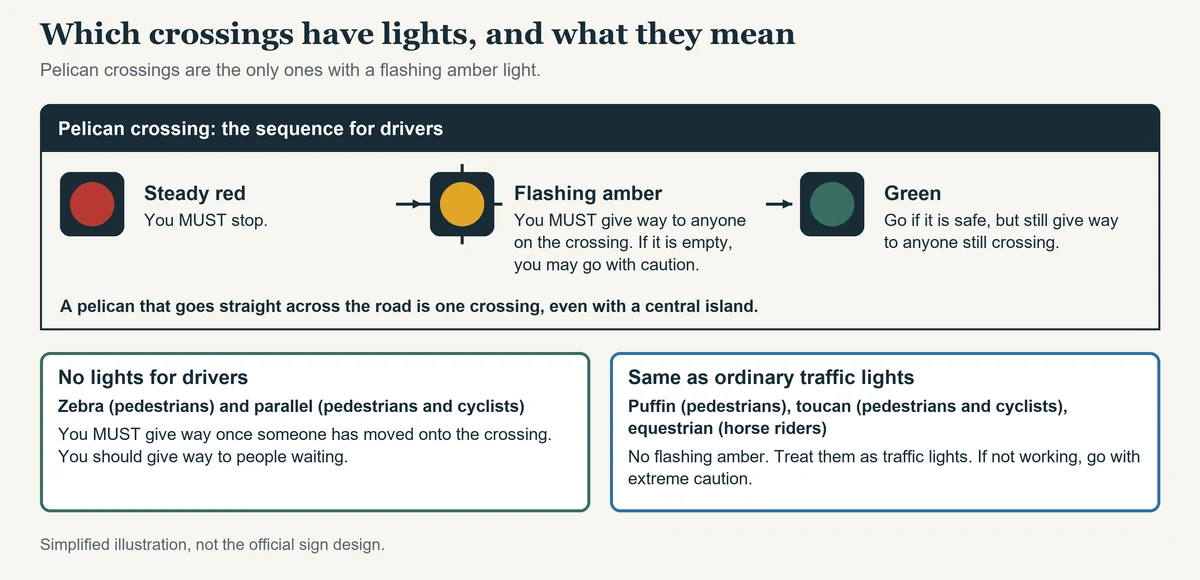
    The pelican crossing sequence for drivers: steady red means stop, flashing amber means give way to anyone on the crossing, green means go if safe. Below, zebra and parallel crossings have no lights for drivers, and puffin, toucan and equestrian crossings work like traffic lights with no flashing amber.
    Crossing lights for drivers, with the pelican flashing amber. Simplified illustration, not the official sign design.
    Light What it means for you
    Steady red You MUST stop
    Flashing amber You MUST give way to any pedestrians on the crossing. If nobody is on it, you may go with caution
    Green Go if it is safe, but still give way to anyone still crossing (Rule 198)

    A pelican crossing that goes straight across the road is one crossing, even if it has a central island. You MUST wait for pedestrians crossing from the other side of the island. A pedestrian on the far half still has priority over you.

    From the pedestrian side, Rule 22 says that when the green figure starts flashing, people should not start to cross, but anyone already crossing should have time to finish.

    Puffin, toucan and equestrian crossings (Rule 199)

    These work like pelican crossings but have no flashing amber phase. The light sequence for drivers is the same as at ordinary traffic lights. If the crossing is not working, go with extreme caution. Do not enter the crossing unless you can clear it completely, so you do not block pedestrians, cyclists or horse riders.

    • Puffin (Rule 23): the red and green figures are above the control box on the pedestrian’s side, and there is no flashing green figure.
    • Toucan (Rule 25): pedestrians and cyclists see the green signal together, and cyclists are allowed to ride across.
    • Equestrian (Rule 27): for horse riders, with pavement barriers, wider crossing spaces, horse and rider figures, and either two sets of controls (one higher) or just one higher control panel.

    Staggered crossings

    Rule 28 explains that where the two halves of a pelican or puffin crossing are not in line across a central refuge, they are two separate crossings. Pedestrians press the button again on the island. As a driver, your lights only control your half.

    What pedestrians are told, and why it matters to you

    Knowing the pedestrian rules helps you predict what people will do:

    • Rule 19 tells pedestrians that traffic does not have to stop until someone has moved onto a zebra crossing, and to keep looking in case a driver overtakes a stopped vehicle. That is exactly why overtaking near a crossing is banned.
    • Rule 18 tells pedestrians to check that traffic has stopped before they step out, to cross between the studs or over the stripes rather than at the side or on the zig-zag lines, and says they MUST NOT loiter on any crossing. Some still cross at the edges, so watch them.
    • Rule 26 says some crossings bleep or speak, and may have a tactile signal, for blind, partially sighted and deafblind people. Someone using these may need more time.
    • Rule 29 says pedestrians should only cross where a police officer, traffic warden or school crossing patrol signals them to. See signals by police and crossing patrols.

    For more on pedestrians, read Highway Code rules for pedestrians and the hierarchy of road users.

    Penalties for crossing offences

    Parking on zig-zags, overtaking at a crossing or failing to give way are breaches of the pedestrian crossing regulations. GOV.UK lists three endorsement codes, each carrying 3 penalty points:

    Code Offence Points
    PC10 Undefined contravention of pedestrian crossing regulations 3
    PC20 Contravention of pedestrian crossing regulations with a moving vehicle 3
    PC30 Contravention of pedestrian crossing regulations with a stationary vehicle 3

    For a new driver, two crossing offences reach 6 points, which means losing your licence within 2 years of passing. See the New Drivers Act.

    Common questions

    Do I have to stop for someone waiting at a zebra crossing?

    Rule 195 says you should give way to pedestrians waiting to cross, and you MUST give way once they have moved onto the crossing.

    What does flashing amber mean at a pelican crossing?

    You MUST give way to anyone on the crossing. If it is empty, you may go with caution.

    Which crossings have no flashing amber?

    Puffin, toucan and equestrian crossings. Their lights follow the normal traffic light sequence.

    Can I park on zig-zag lines to drop someone off?

    No. Rules 191 and 240 say you MUST NOT stop or park on a crossing or in the area marked by the zig-zag lines.

    Should I wave pedestrians across?

    No. Rule 195 says do not wave, flash your lights or sound your horn to invite people across, because another vehicle may be approaching.

    Is a crossing with a central island one crossing or two?

    A zebra with an island is two crossings. A pelican that goes straight across is one crossing, even with an island. Staggered pelican or puffin crossings are two.

    Related: traffic lights and signals. Back to the main guide: Learning to Drive in Great Britain.

    Sources

    • Department for Transport, “The Highway Code: Using the road (159 to 203)” (gov.uk)
    • Department for Transport, “The Highway Code: Rules for pedestrians (1 to 35)” (gov.uk)
    • Department for Transport, “The Highway Code: Waiting and parking (238 to 252)” (gov.uk)
    • GOV.UK, “Penalty points (endorsements): Endorsement codes and penalty points” (gov.uk)
  • NI R Plates: What Your Test Date Means for Your Plates and First Two Years

    NI R Plates: What Your Test Date Means for Your Plates and First Two Years

    Photo: Jonathan Borba / Pexels. Illustrative photograph.

    In Northern Ireland, the R plate you drive home with after your test depends on two dates: when you started learning and when you pass. Under Graduated Driver Licensing (GDL), new drivers show a blue R on a white background for 6 months, then a white R on a blue background for 18 months: 2 years in all. Learners on the old system who pass before 1 April 2027 show the amber R plate for 1 year, with a 45 mph limit. This guide explains what the new rules mean for your test date and your first two years on the road: which plate you will display, how to show it, and the penalty for getting it wrong.

    The three NI R plates at a glance

    Plate Who displays it For how long Speed limit
    Blue R on white GDL drivers, first stage First 6 months after passing None set by GDL (normal limits apply)
    White R on blue GDL drivers, second stage Next 18 months None set by GDL
    Amber R Drivers who passed under the old rules, including pre-GDL learners who pass before 1 April 2027 1 year after passing 45 mph
    Three R plates on a timeline from passing: under GDL a blue R on white for the first 6 months then a white R on blue for the next 18 months with no GDL speed limit, and under the old rules an amber R plate for 1 year with a 45 mph limit.
    How long each Northern Ireland R plate is shown. Simplified illustration, not the official sign design.

    Your start date and test date decide your plate

    1. Provisional entitlement started on or after 1 October 2026: you are on GDL. Blue on white for 6 months, then white on blue for 18 months.
    2. Provisional started before 1 October 2026 and you pass before 1 April 2027: amber R plate and 45 mph for 1 year. DVA’s reason: your training and test didn’t include driving above 45 mph.
    3. Provisional started before 1 October 2026 and you pass on or after 1 April 2027: you come under GDL, so the blue then white plates apply.
    4. You passed before 1 October 2026: keep the amber R plate and the old restrictions until your restricted period ends.
    A decision chart: provisional entitlement from 1 October 2026 leads to GDL plates. If it started earlier, passing before 1 April 2027 means the amber R plate with 45 mph for a year, and passing on or after 1 April 2027 means GDL plates.
    How your start date and pass date decide which R plate you display. Illustrative diagram, not to scale.

    If you started before 1 October 2026, your test date is the deciding factor. Passing before 1 April 2027 means the amber plate and 45 mph for 1 year; a pass on or after that date (including after a fail and retest) brings you under GDL instead. Book with that in mind, and be ready before the date you book. The transition is explained in full in the NI transition rules.

    Your first two years: why GDL has two plates

    The first-stage blue on white plate marks the 6 months when the night-time passenger rule applies to drivers under 24. It lets police and other enforcement agencies see who is in that period. The second plate covers the rest of the 2 years and warns other road users that you are still inexperienced.

    The 2 years match the probation period under the Road Traffic (New Drivers) (NI) Order 1998. Get 6 or more penalty points in that time and your licence can be revoked.

    Displaying R plates from the day you pass

    • Show the plate on the front and back of the car, clearly visible to others.
    • Plates must meet the legal specification, so buy proper plates rather than making your own.
    • Remove or cover them when someone who is not a newly qualified driver is driving.
    • Have your plates ready before test day so you can display them on the drive home.
    • Switch from blue on white to white on blue on the 6 month point. Keep a note of your test pass date.

    Penalty for not showing R plates

    The Department for Infrastructure says not displaying your R plates can bring a fine of up to £1,000 and 3 penalty points. Under GDL, 3 points takes you halfway to the 6 that can revoke your licence.

    The 45 mph limit: amber plates only

    Only to the amber R plate. GDL removed the 45 mph limit for learners and newly qualified drivers on the scheme. The older Highway Code for Northern Ireland (2020 impression) says the 45 mph limit applies to a car displaying R plates whether or not a restricted driver is driving. So if a parent drives an amber-plated car, take the plates off.

    Scenario: how one test date changes everything

    Ciara got her provisional licence in June 2026 and passes on 10 February 2027. She started before 1 October 2026 and passed before 1 April 2027, so she shows the amber R plate and keeps to 45 mph until February 2028. If she had failed and passed on 15 April 2027, GDL would apply: blue on white for 6 months, then white on blue, with no 45 mph limit.

    Common questions

    Do R plates apply to motorcyclists?

    Yes. DfI says GDL R plates apply to new car drivers and new motorcyclists on categories A1, A2 and A. The night-time passenger rule does not apply to motorcyclists.

    Can I drive on the motorway with R plates after my test?

    GDL sets no speed or motorway restriction after you pass. On the amber plate, the 45 mph limit still applies wherever you drive. After you pass you can still do the optional GDL Module 15 (motorway driving) with an ADI or supervising driver; see GDL Module 15.

    Do I need R plates when I drive in Great Britain or the Republic of Ireland?

    Check before you travel. R plates are a Northern Ireland requirement, and the rules where you are driving apply. See driving across the border.

    Does time disqualified count towards my R plate period?

    The 2020 Highway Code for Northern Ireland says the amber R plate period does not count periods of disqualification or revocation. For GDL, check the current rule with DVA.

    Looking for lessons or an instructor? Our sister site Compare Driving Instructors covers lesson prices and choosing an instructor.

    More on GDL: what changed on 1 October 2026. Main guide: Learning to drive in Northern Ireland.

    Sources

    • DVA, “Graduated Driver Licensing for newly qualified drivers” (nidirect.gov.uk)
    • Department for Infrastructure, “Graduated Driver Licensing FAQs” (infrastructure-ni.gov.uk)
    • DVA, “What Graduated Driver Licensing means for learner drivers” (nidirect.gov.uk)
    • DVA, “Motor vehicle documentation, learner and newly qualified driver requirements” (nidirect.gov.uk)
    • Department for Infrastructure, “The Official Highway Code for Northern Ireland”, twentieth impression 2020 (nidirect.gov.uk)
    • Department for Infrastructure, “The Highway Code for Northern Ireland”, current online edition updated for GDL, September and October 2026 (nidirect.gov.uk)
  • Level Crossing Rules UK: Barriers, Lights and User-Operated Gates

    Level Crossing Rules UK: Barriers, Lights and User-Operated Gates

    Photo: Jan Wright / Pexels. Illustrative photograph.

    A level crossing is where a road crosses a railway or tramway line. In Great Britain, the rule at every type of crossing is the same: never drive on until the road is clear on the other side, never stop on it, and always stop when red lights flash. This guide explains each type of crossing you will meet as a learner or new driver: full barrier, half barrier, open, and user-operated gates. It also covers the signs on the approach and what to do if you break down on the tracks. It is based on Highway Code Rules 291 to 299 and the Department for Transport’s Know Your Traffic Signs.

    Key rules at any level crossing

    • Never drive onto a crossing until the road is clear on the other side, and don’t get too close to the car in front (Rule 291).
    • Never stop or park on, or near, a crossing.
    • You MUST obey flashing red stop lights and stop behind the white line (Rule 293).
    • Never reverse onto or over a controlled crossing.
    • If a train passes and the red lights keep flashing, wait. Another train is coming.
    • Do not enter a yellow box at a crossing if traffic ahead could leave you stopped with any part of your car inside it.

    Types of level crossing in Great Britain

    Type What you see What you do
    Full barrier (controlled) Steady amber, then twin flashing red lights, alarm, barriers across the whole road Stop at the white line. Cross only when the lights go off and the barriers are fully up.
    Automatic half barrier Amber lights and alarm, then flashing red lights, then half barriers lower You MUST stop. Never zig-zag around the barriers: they lower automatically because a train is approaching.
    Automatic open (no barriers) Flashing red lights and alarm, St Andrew’s cross sign A train is approaching whenever the lights show. Stop and wait until they go off.
    Gates or barriers without traffic lights Gates or barriers, sometimes worked by an attendant Stop and wait when the barrier or gate begins to close. Don’t cross until it opens (Rule 295).
    User-operated, with miniature lights ‘Stop’ sign, small red and green lights, gates you open yourself You MUST NOT cross on red. Cross only on green (Rule 296).
    User-operated, no lights Gates or barriers, often a railway telephone Stop, look both ways and listen. If there’s a phone, always ring the signal operator first and again when clear (Rule 297).
    Open crossing No gates, barriers, attendant or lights. A ‘Give Way’ sign over a train symbol Look both ways, listen and make sure no train is coming before you cross (Rule 298).

    How do the lights at a level crossing work?

    1. Steady amber: means stop, as at normal traffic lights, unless it is unsafe to do so. If you have already crossed the white line when the amber comes on, keep going.
    2. Twin flashing red: means STOP. This applies to pedestrians too.
    3. Lights still flashing after a train passes: another train is coming. At automatic half-barrier crossings the barriers stay down and the alarm sound may change.
    4. Barriers rising: don’t move until the lights go out.
    Four panels showing level crossing lights in order: steady amber means stop unless unsafe, twin flashing red means you must stop, lights still flashing after a train means another train is coming, and lights out with the road clear means you may go.
    The level crossing light sequence and what each stage means. Simplified illustration, not the official sign design.

    Know Your Traffic Signs says to phone the signal operator if the red lights flash for more than three minutes without a train arriving (except at full-barrier crossings), or if a barrier lowers without the lights flashing.

    More on signals: Highway Code light signals.

    How to use a user-operated gated crossing

    These crossings have gates or barriers but no attendant. With miniature red and green lights, which are worked by an approaching train:

    1. Stop. You must stop even if the gates have been left open.
    2. Check the light. Red means a train is coming: don’t cross.
    3. On green, open the gates or barriers on both sides.
    4. Check the green light is still on, then cross quickly.
    5. Close the gates or barriers once you are clear.

    If there are no lights, follow the same steps, but stop, look both ways and listen before crossing. If there is a railway telephone, use it before you cross and again when you are clear.

    Signs on the approach to a level crossing

    • Warning triangle (gate or barrier): level crossing with a gate or barrier ahead.
    • Warning triangle (no gate or barrier): level crossing without a gate or barrier ahead.
    • Plate showing lights: advance warning of light signals at the crossing.
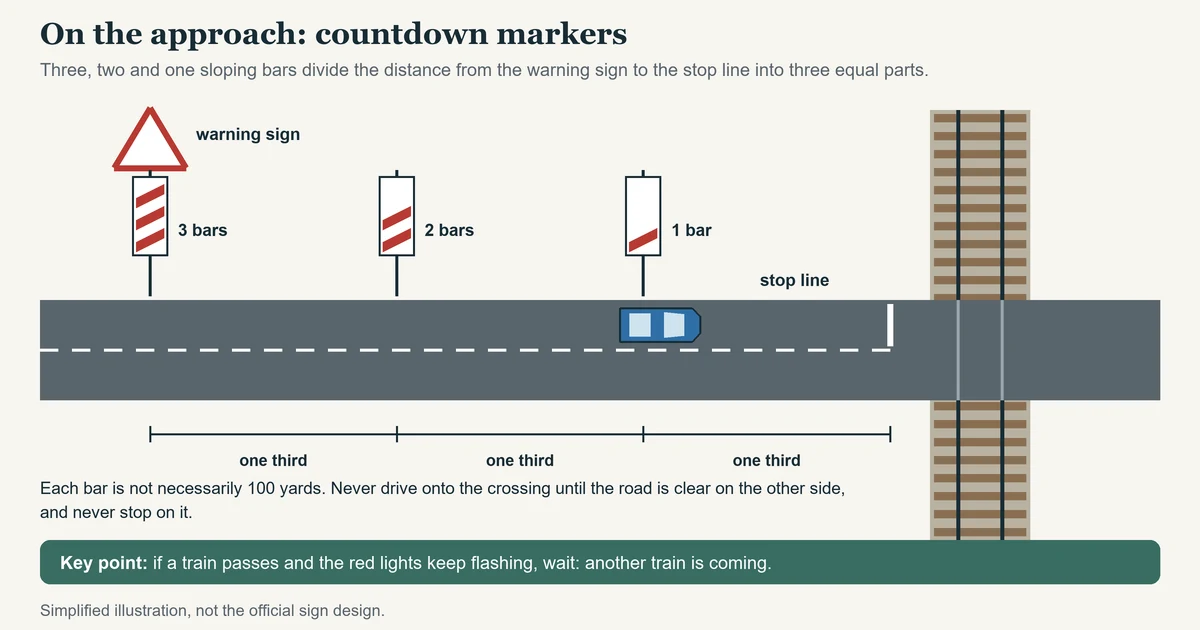
    • Countdown markers: three, two and one sloping bars on the approach. They divide the distance from the warning sign to the stop line into three equal parts. Each bar is not necessarily 100 yards.
    • St Andrew’s cross: used at crossings with no gates or barriers.
    • Overhead cable sign with a safe height: electrified lines ahead. Bells may hang over the road to warn vehicles that are too tall.
    • Yellow box markings: part of the road that must be kept clear.
    • Name and phone number board: for contacting the railway operator at crossings without a dedicated phone.
    Top-down road approaching a railway, with a warning sign then countdown markers with three, two and one sloping bars dividing the distance to the stop line into three equal parts.
    Countdown markers on the approach to a level crossing. Simplified illustration, not the official sign design.

    See UK warning signs for the sign shapes.

    Overhead electric lines and railway telephones

    • It is dangerous to touch overhead electric lines. You MUST obey safe-height signs. Don’t go on if your vehicle touches a height barrier or bells. The usual clearance is 5 metres (16 feet 6 inches), but it may be lower (Rule 292).
    • Drivers of large or slow vehicles, long low vehicles that could ground, or anyone herding animals MUST obey signs telling them to phone for permission before crossing. They must phone again when clear if asked to (Rule 294).

    What to do if you break down on a level crossing

    Rule 299:

    1. Get everyone out of the car and clear of the crossing immediately.
    2. Use the railway telephone, if there is one, to tell the signal operator. Follow their instructions.
    3. Move the car clear only if there is time before a train arrives.
    4. If the alarm sounds or the amber light comes on, leave the car and get clear at once.

    Full breakdown routine: what to do if your car breaks down.

    Level crossings with trams

    Where a tramway crosses the road with no barriers, gates or traffic lights, drivers must give way to trams. Sometimes only a ‘Give Way’ sign and a tram plate are used. See driving alongside trams.

    Common questions

    Can I go if the barriers are up but the lights are still flashing?

    No. Wait until the lights go out, even after the barriers rise. Lights that keep flashing after a train has passed mean another train is coming.

    Is it ever OK to drive around half barriers?

    Never. They come down automatically because a train is approaching.

    What if the amber light comes on as I reach the crossing?

    Stop at the white line unless stopping would be unsafe. If you have already crossed the white line, keep going.

    Traffic is queuing over the crossing. Should I follow?

    No. Only drive on when the road is clear on the other side, and keep out of the yellow box if you could end up stopped in it.

    Do learners get level crossings on the driving test?

    Test routes are not published. If your route has a crossing, the examiner will expect you to follow these rules. Level crossings also come up in the theory test under rules of the road.

    What does an open crossing look like?

    It has no gates, barriers, attendant or lights, just a ‘Give Way’ sign. You must look both ways and listen for trains yourself.

    Related: road works and contraflows (Rules 288 to 290) and learning to drive on rural roads. Back to the main guide: Learning to Drive in Great Britain.

    Sources

    • Department for Transport, “The Highway Code: Road works, level crossings and tramways (288 to 307)” (gov.uk)
    • Department for Transport, “Know Your Traffic Signs: Level crossing signs and signals” (gov.uk)
    • Department for Transport, “Know Your Traffic Signs: Tram signs, signals and road markings” (gov.uk)
  • Less Common UK Road Signs: Speed Limits, Low Bridges, Weights

    Less Common UK Road Signs: Speed Limits, Low Bridges, Weights

    Photo: Mike Bird / Pexels. Illustrative photograph.

    Some UK road signs turn up rarely but still appear in the theory test and on real roads: speed limit repeaters, low bridge height signs, weight and width limits, pedestrian zones, tidal flow lanes and clean air zones. This guide explains what each one means for a car driver in Great Britain, using the Department for Transport’s Know Your Traffic Signs.

    Speed limit signs you might misread

    Sign Meaning
    White circle with a black diagonal stripe National speed limit for the type of road and vehicle applies. See UK speed limits.
    Small speed limit repeater Reminder of the limit you are in
    Speed in a red circle at a town or village name sign Start of the limit at the boundary
    Speed in a blue circle Minimum speed. A red diagonal line through it marks the end.
    Speed on a rectangular plate under a bend warning Advised maximum speed for the bend, not a legal limit
    Speed limit sign with a camera symbol Start of a variable speed limit with enforcement cameras
    Camera symbol on its own Speed cameras in use in the area
    Camera sign with “average speed” Two cameras measure your average speed between two points
    20 mph zone entry sign Entrance to a 20 mph zone, where you may meet traffic-calming measures
    Five simplified speed signs: a speed in a red circle, the white national speed limit sign with a black diagonal stripe, a minimum speed in a blue circle, the end of minimum speed with a red diagonal line, and a speed plate under a bend warning triangle.
    Which speed signs are legal limits and which are advice or minimums. Simplified illustration, not the official sign design.

    Repeater rules: why you will not see 30 mph repeaters under street lights

    • On a road with street lights (other than a motorway), the limit is 30 mph unless signs say otherwise. In Wales it is 20 mph.
    • So 30 mph repeater signs are used only on roads without street lighting.
    • National speed limit repeaters are used only on roads with street lighting (other than motorways).
    • A camera sign on a lit road with no repeaters tells you the limit is 30 mph. On an unlit road with no repeaters, the national limit applies.

    Low bridge signs

    Bridges with a clearance under 16 feet 6 inches (about 5 metres) are normally signed. These matter if you drive a van, tow a caravan or carry a roof box.

    Four simplified low bridge signs: a red circle with a height, a red triangle with a height, a triangle for an arch bridge with two heights, and a panel of four amber lights.
    The low bridge signs and signals and what each one tells you. Simplified illustration, not the official sign design.
    Sign Type Meaning
    Red circle with a height in metric and imperial Mandatory No vehicle over that height may pass. It is unlawful for an overheight vehicle to go past it.
    Red triangle with a height Warning Maximum headroom under the bridge or structure ahead. A plate may give the distance.
    Arch bridge with two heights Warning Headroom differs across the arch. Road markings guide tall vehicles through the highest point.
    Four amber lights flashing in pairs Warning A high vehicle has triggered a sensor on the approach to a bridge at risk of strikes

    At an arch bridge, give way to an oncoming tall vehicle using the middle of the road. Cars may keep left and cross the markings if that lets everyone pass safely.

    Weight, width and length limits

    Sign Meaning Does it affect a car?
    Red circle with a weight in tonnes (for example 7.5T) No vehicles over that maximum gross weight Rarely. Most cars are well under. Check if you tow.
    Red circle with a lorry and a weight No goods vehicles over that weight No
    Red circle with a width (metric and imperial) No vehicles over that width Possibly, for wide vans or with towing mirrors
    Red circle with a length No vehicles or combinations over that length Possibly, if towing
    “Except for access” plate Exempts vehicles going to premises on that road with no other route Read it with the sign above

    For towing weights and sizes, see towing on a car licence.

    Pedestrian zone signs

    • A zone entry sign with a red-ringed prohibition roundel marks the start of a pedestrian zone. It may show hours (for a part-time zone) and exemptions in a lower panel.
    • Yellow panels on the sign mean there are waiting restrictions inside the zone.
    • The zone may have no kerbs or yellow lines, so the sign is all you get. Check the times before you enter.
    • A variable message sign may change the exemptions through the day.
    • A “zone ends” sign has a grey version of the roundel.

    Some zones use rising bollards. A red signal means the bollard is up and you must not go on. Do not follow an authorised vehicle through.

    Tidal flow lanes

    On some busy roads, overhead lane signals change how many lanes run each way.

    Signal above the lane Meaning
    Green arrow Lane open to you
    White diagonal arrow Lane closes ahead. Move to the next lane on the left.
    Red cross Lane closed to traffic facing the signal

    Direction signs for cyclists and pedestrians

    • Blue with a white cycle: cycle route direction. A red patch with a number is a National Cycle Network route; a blue patch is a regional route.
    • Blue with a walking figure: pedestrian direction sign.
    • Green: public footpath. A yellow waymarker is also a footpath; a blue arrow is a bridleway.

    Expect cyclists and walkers crossing or joining the road near these signs.

    Miscellaneous signs worth knowing

    Sign Meaning for drivers
    “2+” or “3+” car symbol HOV lane. Only vehicles with that many occupants (and others shown) during its hours.
    White “C” on red Road charging, congestion charge or toll
    White cloud on green with a letter A to D Clean air zone. Class D can include cars; non-compliant vehicles may have to pay.
    London ULEZ entry sign Cars not meeting the emission standard pay a daily charge
    “LEZ” road marking or sign in Scotland Low emission zone. Non-compliant vehicles must not be driven in it unless exempt.
    Driver location sign (motorways and some other roads) Exact location reference to give in an emergency

    Common questions

    Why are there no 30 mph repeater signs?

    Because street lights already tell you the limit is 30 mph (20 mph in Wales) unless signs say otherwise. Repeaters for 30 mph are only used on unlit roads.

    Is the speed on a bend warning plate a legal limit?

    No. A speed on a rectangular plate is the advised maximum. Only a speed in a red circle is a legal limit.

    Does a 7.5 tonne weight limit apply to my car?

    The sign applies to vehicles over the maximum gross weight shown. Ordinary cars are far lighter, but check the plate: some signs apply only to goods vehicles or exempt access.

    What does a blue circle with a number mean?

    A minimum speed. You must not go slower unless it is impracticable or unsafe.

    Are UK low bridge signs in feet or metres?

    Newer signs show both. Some older height restriction signs show imperial only and are replaced when they reach the end of their life.

    Related sign guides: regulatory signs, warning signs, direction and information signs, traffic calming and road works signs. Back to the main guide: Learning to Drive in Great Britain.

    Sources

    • Department for Transport, “Know your traffic signs” (gov.uk), sections: Regulatory signs; Speed limit signs; Low bridge signs; Pedestrian zone signs; Direction signs for cyclists and pedestrians; Tidal flow lane control signs and signals; Miscellaneous signs
  • Bus Lane Rules and Cycle Lanes: Signs, Times and Fines (GB)

    Bus Lane Rules and Cycle Lanes: Signs, Times and Fines (GB)

    Photo: Max W / Pexels. Illustrative photograph.

    In Great Britain you must not drive in a bus lane during its hours of operation unless the sign allows your vehicle. If the sign shows no times, the lane operates 24 hours a day. Bus lanes are usually enforced by camera, and fines are set by the local authority: £160 in London (£80 if paid early) and often £70 elsewhere in England, with no penalty points. This guide explains bus lane and cycle lane signs, when you can enter, and what the penalties are.

    Key facts

    • No times on the blue sign: the bus lane operates at all times.
    • Bank holidays: restrictions apply as normal on days they are in force.
    • You may enter a bus lane to stop, load or unload where this is not prohibited (Rule 141).
    • Solid white line cycle lane: you MUST NOT drive or park in it during its hours (Rule 140).
    • Advance stop line (bike box): when the light is red, you must wait behind the first stop line.

    How to read a bus lane sign

    The blue sign shows who may use the lane and when. Anyone not shown must keep out during the times on the sign.

    Three simplified blue bus lane signs: one with times shown, one with no times, and one adding a cycle symbol and the word taxi, each with what it means for drivers.
    How to read the times and symbols on a bus lane sign. Simplified illustration, not the official sign design.
    Sign shows Who may use the lane
    Bus symbol only Local buses and any vehicle designed to carry 10 or more people including the driver
    Bus symbol marked “local” Only buses running a local service
    Cycle symbol Pedal cycles as well
    Motorcycle symbol Solo motorcycles as well
    “Taxi” Taxis as well (check local rules on private hire cars)
    Times shown Restriction applies only at those times. Outside them, anyone may drive in it.
    No times shown Lane operates at all times

    Bus lane road markings on the carriageway show where the lane starts. A Blue Badge does not let you drive in a bus lane.

    Other bus signs and markings

    • Break in the bus lane at a junction: other traffic may use the left-hand lane there to turn left only.
    • Contraflow bus lane: buses travel against the flow in a one-way street. Never enter it.
    • Bus gate: a short length of bus-only street, often camera-enforced.
    • Bus stop with a broad yellow line: other vehicles must not stop there.
    • Turning left across a bus lane: give way to vehicles using it, from either direction (Rule 183).

    Cycle lanes: solid line or broken line?

    Lane Marking Rule for drivers
    Mandatory cycle lane Solid white line, with a blue sign that may show hours You MUST NOT drive or park in it during its hours of operation.
    Advisory cycle lane Broken white line Do not drive or park in it unless it is unavoidable.
    Any cycle lane Either You MUST NOT park in it while waiting restrictions apply. Give way to cyclists in it, including those coming up behind you.
    Contraflow cycling in a one-way street Sign showing cycles allowed both ways, with or without a line Expect cyclists coming towards you.
    Three road views from above: a car turning left through a break in a bus lane, a cycle lane with a solid white line, and a cycle lane with a broken white line, each with the rule for drivers.
    Where you may cross a bus lane, and the difference between solid and broken cycle lane lines. Illustrative diagram, not to scale.

    Cyclists do not have to use cycle lanes or tracks, so expect them on the main road too.

    Advance stop lines (bike boxes)

    At some traffic lights there is a second stop line with a cycle symbol between the two. When the lights are red, drivers must wait behind the first line. Allow cyclists time and space to move off when the lights go green.

    HOV lanes

    High occupancy vehicle lanes work like bus lanes but also admit cars with enough people inside. A “2+” sign means the driver plus at least one passenger; “3+” means at least two passengers. You MUST NOT use one during its hours unless your vehicle qualifies (Rule 142).

    Rule 142 also says designated lanes may or may not admit cycles, buses, taxis, licensed private hire vehicles, motorcycles or HGVs, so a vehicle allowed in one lane may be barred from the next. Following a taxi into a lane tells you nothing about whether your car is allowed. If you cannot read the sign in time, stay in the ordinary lane rather than swerving, and remember that qualifying for the lane does not remove the need for a safe gap to move into it.

    Bus lane fines: how much?

    Councils (and Transport for London on its own roads) enforce bus lanes, mainly with cameras, and send a penalty charge notice (PCN) to the registered keeper. Councils such as Newcastle and Birmingham state that a bus lane PCN carries no penalty points.

    Area Penalty (as of November 2026) If paid early
    London (TfL roads and boroughs) £160 £80 within the discount period on the notice
    Many English councils outside London (for example Lancashire, Manchester, Nottinghamshire) £70 £35, usually within 14 or 21 days

    Amounts and deadlines vary by council, and in Scotland and Wales. Check the notice and the council’s website. You can challenge a PCN with the council, then appeal to the independent tribunal named on the notice.

    Common questions

    Can I drive in a bus lane on a Sunday?

    Only if the sign’s times exclude Sunday. If the sign shows no days, the times apply every day. If it shows no times at all, the lane is in force 24 hours.

    Can I use a bus lane to turn left?

    Where the bus lane has a break at a junction, you may use the left-hand lane there to turn left. Otherwise, stay out during its hours.

    Can I pull into a bus lane to let an emergency vehicle pass?

    Not during its hours. The Highway Code says let emergency vehicles pass while still complying with traffic signs, so do not drive into a bus lane just to get out of the way. See emergency vehicles behind you.

    Do I get points for driving in a bus lane?

    Councils that issue bus lane PCNs, such as Newcastle and Birmingham, say they carry no points. You pay the penalty charge only.

    Can I park in a cycle lane?

    Not in a mandatory (solid line) cycle lane during its hours, and not in any cycle lane while waiting restrictions apply.

    Can taxis use bus lanes?

    Only where the sign includes “taxi”.

    Related: lane discipline, Highway Code rules for cyclists, yellow lines and red routes and driving alongside trams. Back to the main guide: Learning to Drive in Great Britain.

    Sources

    • Department for Transport, “Know your traffic signs” (gov.uk), sections: Bus and cycle signs and road markings; Miscellaneous signs
    • Department for Transport, “The Highway Code: General rules, techniques and advice for all drivers and riders (103 to 158)” (gov.uk)
    • Transport for London, “Pay a Penalty Charge Notice” and bus lane FOI response (tfl.gov.uk)
    • London Councils, “London boroughs raise parking and traffic PCN levels for first time since 2011” (londoncouncils.gov.uk)
    • Lancashire County Council, “Bus lane enforcement” (lancashire.gov.uk)
    • Manchester City Council, “Bus lane rules: penalty charge notice” (manchester.gov.uk)
    • Nottinghamshire County Council, “Bus lane fines” (nottinghamshire.gov.uk)
    • Birmingham City Council, “Bus Lane Guidance and Information” (birmingham.gov.uk)
    • Newcastle City Council, “Bus Lane Enforcement” (newcastle.gov.uk)
    • Department for Transport, “The Highway Code: Road users requiring extra care (204 to 225)” (gov.uk)
  • The Road User and the Law: Driving Offences for New Drivers (GB)

    The Road User and the Law: Driving Offences for New Drivers (GB)

    Photo: Gawon Lee / Pexels. Illustrative photograph.

    Annex 4 of the Highway Code, “The road user and the law”, explains which rules are legal requirements in Great Britain and which laws sit behind them. This guide is for new and learner drivers who want to know what the MUST rules mean, where the law applies, which Acts matter most, and what careless and dangerous driving actually look like, with the maximum penalties from Annex 5.

    Key facts

    • MUST or MUST NOT in a Highway Code rule means a legal requirement. Breaking it is a criminal offence.
    • Should, should not, do, do not rules are advice. Breaking one is not an offence by itself, but the Highway Code can be used in court to establish liability.
    • “Road” in law usually includes footpaths, bridleways, cycle tracks and many private driveways and car parks. Some serious offences, including drink-driving, apply in all public places.
    • Careless driving: below the standard of a competent and careful driver. Dangerous driving: far below it, where the danger would be obvious.
    • 12 points in 3 years means a minimum 6-month ban. In your first two years after passing, 6 points cancels your licence.

    MUST rules vs should rules: why it matters

    Every rule in the Highway Code that says MUST or MUST NOT has a short legal reference underneath, such as “Law RTA 1988 sect 36”. That reference names the Act or regulation that makes it an offence. Penalties can include fines, penalty points, disqualification and, for the most serious offences, prison.

    Advisory rules carry no reference. You will not be prosecuted just for ignoring one, but after a crash a court or insurer can point to the Highway Code to decide who was at fault. In practice, both kinds matter.

    What counts as a “road”?

    In England and Wales a road is any highway and any other road the public can access, including bridges. Scotland has a similar definition that also covers ways the public has a right to pass along. So road traffic law can apply in places a new driver might not expect:

    • supermarket and retail car parks
    • private roads and driveways the public uses
    • footpaths, bridleways and cycle tracks

    Some of the most serious offences, such as drink-driving, apply in any public place, not only on roads. Annex 4 is a guide, not a full statement of the law: the exact wording is in the Acts themselves, published free on legislation.gov.uk.

    The laws you will see referenced most

    Annex 4 lists the abbreviations used throughout the Code. These are the ones a car driver meets most often:

    Abbreviation Law Typical rules it covers
    RTA Road Traffic Act 1984, 1988 or 1991 (as indicated) Careless and dangerous driving, drink-driving, obeying signs and signals, insurance
    RTRA Road Traffic Regulation Act 1984 Speed limits, traffic orders, parking restrictions
    RTOA Road Traffic Offenders Act 1988 Penalties, points and fixed penalties
    RT(ND)A Road Traffic (New Drivers) Act 1995 The 6-point rule for new drivers
    CUR Road Vehicles (Construction and Use) Regulations 1986 Vehicle condition, tyres, mobile phones
    RVLR Road Vehicles Lighting Regulations 1989 Lights and when to use them
    MV(WSB)R Motor Vehicles (Wearing of Seat Belts) Regulations 1993 Seat belts
    MV(DL)R Motor Vehicles (Driving Licences) Regulations 1999 Provisional licences, L plates, supervision
    TSRGD Traffic Signs Regulations and General Directions 2002 and 2016 What signs, lines and signals mean
    VERA Vehicle Excise and Registration Act 1994 Vehicle tax and registration
    MT(E&W)R / MT(S)R Motorways Traffic Regulations (England and Wales 1982; Scotland 1995) Motorway rules, hard shoulder, closed lanes
    RR(20)O Restricted Roads (20mph Speed Limit) Order 2022 20mph default limits on restricted roads
    SA Sentencing Act 2020 Sentencing powers

    The “typical rules” column is a guide to where each law appears in the Code, not a legal summary.

    Careless, inconsiderate and dangerous driving: where the line is

    The Crown Prosecution Service (CPS) guidance for prosecutors in England and Wales sets out the test and typical examples. The court decides each case on its facts.

    Careless driving (without due care and attention)

    Driving that falls below what would be expected of a competent and careful driver. Typical examples:

    • driving too close to the vehicle in front
    • briefly changing lanes without warning
    • overtaking on the inside where it is inappropriate but not obviously dangerous
    • a short lapse of attention, for example adjusting the radio, reading a map or talking to passengers
    • accidentally going through a red light, or pulling out of a side road without enough care

    Inconsiderate driving (without reasonable consideration)

    Driving that inconveniences other road users. Typical examples:

    • flashing headlights to force other drivers to give way
    • using a lane, including a cycle lane, to jump a queue
    • sitting in an overtaking lane when you do not need to
    • driving unnecessarily slowly or braking for no good reason
    • dazzling others with full beam
    • splashing pedestrians through puddles

    Dangerous driving

    Driving that falls far below what would be expected of a competent and careful driver, where it would be obvious to such a driver that it is dangerous. Driving a vehicle in a dangerous state can also count. Typical examples:

    • racing or competitive driving
    • aggressive driving such as cutting in, cutting across lanes or tailgating
    • speeding in conditions that make it clearly unsuitable
    • deliberately ignoring traffic lights or road signs
    • overtaking when it cannot be done safely
    • driving knowing you are too tired, unfit through a medical condition, or in a vehicle you know is defective or dangerously loaded
    • using a hand-held phone in a way that dangerously distracts you, or being distracted for more than a moment
    • a brief but serious misjudgement, such as failing to stop at a give way line or pressing the accelerator instead of the brake

    Notice the overlap: tailgating, red lights and phone use appear in more than one list. How bad it was, and the circumstances, decide which offence is charged.

    Maximum penalties for common offences (Annex 5)

    Parliament sets the maximum; courts decide the actual sentence. Figures below are from Annex 5 of the Highway Code as of November 2026.

    Offence Maximum prison Maximum fine Disqualification Points
    Causing death by dangerous driving Life Unlimited Obligatory, minimum 5 years 3 to 11 (if exceptionally not disqualified)
    Dangerous driving 2 years Unlimited Obligatory 3 to 11
    Careless and inconsiderate driving None Unlimited Discretionary 3 to 9
    Drink or drug driving 6 months Unlimited Obligatory 3 to 11
    Failing to stop after or report an accident 6 months Unlimited Discretionary 5 to 10
    Driving while disqualified 6 months (12 in Scotland) Unlimited Discretionary 6
    Driving without insurance None Unlimited Discretionary 6 to 8
    Using a hand-held mobile phone None £1,000 Discretionary 6
    Failure to have proper control or a full view of the road None £1,000 Discretionary 3
    Speeding None £1,000 (£2,500 on a motorway) Discretionary 3 to 6, or 3 as a fixed penalty
    Traffic light offences None £1,000 Discretionary 3
    Failing to identify the driver None £1,000 Discretionary 6

    Higher fines (£2,500) apply to some offences in buses and goods vehicles. No MOT, not wearing a seat belt and several cycling offences carry fines but no points. Endorsement codes such as CD10 (careless driving) and DD40 (dangerous driving) are listed in driving penalties and endorsement codes.

    How bans work

    • 12 or more points within 3 years means you MUST be disqualified for at least 6 months, longer for a repeat.
    • Dangerous driving and drink-driving carry an obligatory ban of at least 12 months. A second drink-driving offence within 10 years means at least 3 years.
    • For most other points offences the court can choose to disqualify, usually for a week to a few months.
    • After some serious offences the court must order an extended retest before you can drive again unsupervised.

    Extra rules for new drivers

    For two years after passing your first test, reaching 6 or more points cancels (revokes) your licence automatically. You go back to a provisional licence and must pass the theory and practical tests again. This applies even if the points came from a fixed penalty, and unexpired points from your provisional licence carry over. The full detail is in the New Drivers Act guide.

    In practice that means one hand-held phone offence (6 points), or two speeding fixed penalties (3 each), is enough.

    Other consequences of a conviction

    • A vehicle used for an offence that can be punished with prison may be taken away (confiscated).
    • Insurance costs are likely to rise after a serious conviction.
    • Drivers banned for drink-driving twice within 10 years, or once at more than 2.5 times the limit, or for refusing to give a specimen, must satisfy the DVLA’s medical branch that they do not have an alcohol problem before getting their licence back.

    Common questions

    Can I be prosecuted for breaking a “should” rule?

    Not for that alone. But the same behaviour might amount to careless or inconsiderate driving, and the Highway Code can be used as evidence of what a careful driver does.

    Does road traffic law apply in a supermarket car park?

    Often, yes. The legal definition of a road usually includes car parks the public can use, and drink-driving applies in any public place.

    Is tailgating careless or dangerous driving?

    Either, depending on how bad it is. CPS guidance lists driving too close as careless and aggressive tailgating as dangerous. See tailgating and road rage.

    Can learner drivers get penalty points?

    Yes. Points go on your provisional licence and count towards the new driver 6-point limit for two years after you pass.

    How many points for using a phone while driving?

    6 points and a fine of up to £1,000. For a new driver that alone means losing the licence. See mobile phones and sat navs.

    What happens if I drive without insurance?

    6 to 8 points, an unlimited fine and a possible ban. Check what you need in car documents explained.

    What are my legal duties if I have a crash?

    You must stop, and in some cases report it to the police. Failing to is 5 to 10 points. See after a car accident.

    Related: drink and drug driving limits and the documents theory test topic. Northern Ireland has its own Highway Code and legislation: see NI vs GB differences.

    Back to the main guide: Learning to Drive in Great Britain.

    Sources

    • Department for Transport, “The Highway Code: Annex 4. The road user and the law” (gov.uk)
    • Department for Transport, “The Highway Code: Annex 5. Penalties” (gov.uk)
    • Department for Transport, “The Highway Code: Introduction” (gov.uk)
    • Crown Prosecution Service, “Road Traffic: Fatal Offences and Bad Driving” (cps.gov.uk)
    • GOV.UK, “Penalty points (endorsements): Endorsement codes and penalty points” (gov.uk)
    • GOV.UK, “Penalty points (endorsements): New drivers” (gov.uk)
  • Highway Code Light Signals: Traffic Lights and Lane Signals (GB)

    Highway Code Light Signals: Traffic Lights and Lane Signals (GB)

    Photo: Josh Withers / Pexels. Illustrative photograph.

    This guide is for learner drivers in Great Britain who want the Highway Code’s “Light signals controlling traffic” section in one place: what each traffic light means, where flashing red lights are used, how motorway signals work and what lane control signals tell you. Steady lights tell you when to stop and go; flashing red means you MUST stop; a red X over a lane means you MUST NOT drive in it.

    Key facts

    • Red, and red with amber: stop. Do not go until green shows.
    • Amber on its own: stop at the stop line unless you have already crossed it or are too close to stop safely.
    • Alternating flashing red lights: you MUST stop. They are used at level crossings, lifting bridges, airfields, fire stations and similar places.
    • Red X (motorway or lane control signal): you MUST NOT carry on in that lane.
    • Penalty: failing to comply with traffic light signals is endorsement code TS10, 3 penalty points.

    Traffic light sequence: what each light means

    In Great Britain the sequence runs red, red and amber, green, amber, then red again.

    Four simplified traffic lights in order: red, red and amber, green, and amber, each with what the driver should do.
    The GB traffic light sequence and what each stage means. Simplified illustration, not the official signal design.
    Light Meaning What you do
    Red Stop Wait behind the stop line on the carriageway.
    Red and amber Stop Do not pass through or start until green shows.
    Green You may go if the way is clear Take special care if you are turning left or right, and give way to pedestrians who are crossing.
    Amber Stop at the stop line Go on only if amber appears after you have crossed the stop line, or you are too close to stop safely.
    Green arrow (with the full green) Filter You may go in the direction of the arrow if the way is clear, whatever other lights are showing.

    White light signals at some junctions are for trams only. Rule 300 says they give instructions to tram drivers, not to you. More on that in driving alongside trams.

    The MUST rules at traffic light junctions (Rules 175 to 178)

    • Rule 175: you MUST stop behind the white stop line unless the light is green.
    • Rule 176: you MUST NOT move forward over the white line while red shows. On green, only go if there is room to clear the junction safely or you are turning right. If the lights are not working, treat it as an unmarked junction and go with great care.
    • Rule 177: a green filter arrow controls a filter lane only. Do not enter that lane unless you are going the way the arrow points, and give cyclists in particular time and room to get into the right lane. The arrow releases only that lane and direction: if it lets the left-turning car beside you go while your ahead signal is still red, stay behind your line.
    • Rule 178 (advanced stop lines): when the lights are amber or red you MUST stop at the first white line. If you have already crossed the first line when the light turns red, you MUST stop at the second line. Do not block the cyclists’ box at other times. When the lights go green, give cyclists ahead of or beside you time and room to move off before you turn.
    Top view of a lane at traffic lights with two white stop lines and a cyclists box between them, and a car waiting behind the first line while the light is red.
    Where to stop at an advanced stop line under Rule 178. Illustrative diagram, not to scale.

    The legal references for these rules are the Road Traffic Act 1988 section 36 and the Traffic Signs Regulations and General Directions. For turning right and box junctions at lights, see road junctions explained.

    Worked example: amber as you approach

    The light changes from green to amber as you approach. You are not yet over the line and can pull up with normal, firm braking, so you stop. If amber had appeared as your front wheels crossed the line, or stopping would have needed harsh braking with a car close behind, you would continue. Planning ahead (a light that has been green for a while may change) makes this decision easier. Being late or impatient is not part of the exception, and speeding up to beat the change is exactly what the rule is meant to stop.

    Flashing red lights: level crossings, fire stations and bridges

    Alternating flashing red lights mean you MUST stop. Apart from level crossings, you will see them at lifting bridges, airfields and fire stations, where they stop traffic so emergency vehicles can get out.

    At a controlled level crossing (Rule 293):

    1. A steady amber light comes on first. Keep going if you have already crossed the white line when it appears; otherwise stop.
    2. When the red lights flash you MUST stop behind the white line.
    3. If the red lights keep flashing after a train has passed, you MUST wait, because another train is coming.

    Barriers, user-worked gates and what to do if you break down on the tracks are covered in level crossings explained.

    Flashing amber: pelican crossings

    A flashing amber light after red at a pelican crossing means you MUST give way to pedestrians still on the crossing. If it is clear, you may go with caution (Rule 196). Puffin, toucan and equestrian crossings have no flashing amber phase and work like normal traffic lights (Rule 199). See pedestrian crossings for the full set.

    Motorway signals: what each one tells you

    These signals are also used on some other high-speed roads, not just motorways.

    Signal Meaning
    Red X Do not go further in this lane.
    Diagonal arrow Change lane.
    Reduced visibility ahead Slow down and be ready for fog or similar.
    Lane ahead closed Move out of the lane shown as closed.
    Advisory speed Temporary maximum speed advised, sometimes with an information message.
    Speed limit in a red circle Temporary mandatory maximum speed limit. It may come with a message such as do not enter or proceed in the left lane.
    End End of the restriction.

    Flashing amber and flashing red on motorways (Rules 257 and 258)

    • Flashing amber: a hazard ahead. Slow down, be ready for it, and only speed up again once you pass a signal that is not flashing, a national speed limit sign or “END”, and it is safe.
    • Flashing red with a red X: a closed lane, with people, stopped vehicles or another hazard in it. You MUST follow the signs to move to an open lane and MUST NOT drive in the closed lane. The lane is open again when a sign shows a speed limit or “END”.
    • All lanes closed: red flashing lights over every lane with a closure sign means the road is closed. You MUST NOT go past the sign in any lane, or use the hard shoulder, unless a police or traffic officer tells you to.
    • A speed limit shown inside a red circle is mandatory: you MUST NOT exceed it (Rule 261).

    Red X enforcement and emergency areas on smart motorways: see smart motorways and red X signals. All the signs are illustrated on our motorway signs guide.

    Lane control signals

    Lane control signals sit above individual lanes and apply only to traffic facing them.

    Signal Meaning
    Green arrow The lane is open to traffic facing the sign.
    Red X The lane is closed to traffic facing the sign.
    White diagonal arrow Change lanes in the direction the arrow points.

    Rule 256 explains the difference between a single sign covering all lanes and lane-specific signals: read the one above your lane.

    Common questions

    Can I go through on amber?

    Only if amber appeared after you crossed the stop line, or you were too close to stop safely. Otherwise amber means stop.

    What happens if I go through a red light?

    It is endorsement code TS10, 3 penalty points, and Annex 5 of the Highway Code lists a maximum fine of £1,000 with discretionary disqualification. Within two years of passing, 6 points cancels your licence under the New Drivers Act.

    The lights are stuck on red or not working. What do I do?

    If they are not working at all, treat the junction as unmarked and go with great care (Rule 176). The Highway Code does not give permission to go through a red light because it seems stuck, so wait for green or for a police or traffic officer’s direction.

    Do I have to stop for flashing red lights at a fire station if nothing is coming out?

    Yes. Alternating flashing red lights mean you MUST stop, whether or not you can see a fire engine.

    Is a speed on a motorway gantry a legal limit?

    If the number is inside a red circle, yes, it is mandatory. A number without the red circle is advisory.

    Can I drive in a lane with a red X if it looks empty?

    No. You MUST NOT drive in a closed lane, even if you cannot see why it is closed. The hazard may be out of sight, and emergency services use closed lanes to reach incidents.

    Practise these for your theory test in the road and traffic signs topic, and see the basics with pictures in traffic lights and signals. In Northern Ireland, check the NI Highway Code (see NI vs GB differences).

    Back to the main guide: Learning to Drive in Great Britain.

    Sources

    • Department for Transport, “The Highway Code: Light signals controlling traffic” (gov.uk)
    • Department for Transport, “The Highway Code: Using the road (159 to 203)” (gov.uk)
    • Department for Transport, “The Highway Code: Motorways (253 to 274)” (gov.uk)
    • Department for Transport, “The Highway Code: Road works, level crossings and tramways (288 to 307)” (gov.uk)
    • Department for Transport, “The Highway Code: Annex 5. Penalties” (gov.uk)
    • GOV.UK, “Penalty points (endorsements): Endorsement codes and penalty points” (gov.uk)
  • Theory Test Case Study Questions: How the GB Video Works

    Theory Test Case Study Questions: How the GB Video Works

    Photo: RDNE Stock project / Pexels. Illustrative photograph.

    The case study in the car theory test in Great Britain is now a video case study: 3 of the 50 multiple choice questions are based on a short video of a normal driving situation, such as driving through a town centre or on a country road. The video has no sound and you can replay it as many times as you like. This explainer covers how it works, how it is marked, and a method for answering.

    Key facts

    • Questions: 3 video case study questions, part of the 50 multiple choice questions.
    • Time: 57 minutes for all 50 questions, case study included.
    • Video: a normal driving situation, no sound, replay as often as you like.
    • Pass mark: 43 out of 50 for the multiple choice part. The case study questions count towards that total.
    • Both parts: you must pass the multiple choice and the hazard perception parts in the same test.

    How the video case study works

    1. You watch a short video clip of an everyday drive.
    2. You then answer 3 questions about it.
    3. You can replay the clip as many times as you like.
    4. As with the other questions, you can flag a question and come back to it, and change any answer before you finish.

    The questions use the same multiple choice format as the rest of the test. For the full test structure, see the car theory test in numbers.

    Case study vs hazard perception

    Video case study Hazard perception
    Part of the test Multiple choice Separate second part
    What you do Answer 3 questions about one video Click when you see developing hazards
    Replays As many as you like None
    Timing matters? No, beyond the overall 57 minutes Yes, earlier responses score more

    How hazard clips are scored: hazard perception scoring explained.

    How to answer case study questions

    1. Watch once without the questions in mind. Note the road type, speed limit signs, weather, and other road users.
    2. Read all 3 questions. Then replay the clip looking for exactly what each asks.
    3. Answer from the Highway Code, not habit. Questions test rules and safe practice in the situation shown.
    4. Use the replay. There is no penalty for watching again, so check any detail you are unsure of.
    5. Flag and move on if you are stuck, and come back once you have finished the rest.

    What the video might test

    Because the clips show normal driving, expect questions drawn from the same 14 DVSA topics as the rest of the test: for example, speed limits on the road shown, how to deal with pedestrians or cyclists in the clip, or what a sign means. Revise by topic from the theory test guide, especially rules of the road, hazard awareness and vulnerable road users.

    Common questions

    How many case study questions are in the theory test?

    Three, based on one short video. They are part of the 50 multiple choice questions.

    Is the case study still written text?

    No. For cars, gov.uk now describes it as a video case study.

    Does the video have sound?

    No.

    Can I watch the video more than once?

    Yes, as many times as you like.

    Do I have to pass the case study separately?

    No. The 3 questions count towards the 43 out of 50 pass mark for the multiple choice part.

    Is there a break before hazard perception?

    You can take a break of up to 3 minutes before the hazard perception part starts.

    Booking, fees and ID: booking your theory test. Practise questions: practice. Back to the main guide: Learning to Drive in Great Britain.

    Sources

    • GOV.UK, “Theory test: cars: Multiple-choice questions” (gov.uk)
    • GOV.UK, “Theory test: cars: Pass mark and test result” (gov.uk)
  • First Aid on the Road: Highway Code Annex 7 and DR ABC (GB)

    First Aid on the Road: Highway Code Annex 7 and DR ABC (GB)

    Photo: Ian Probets / Pexels. Illustrative photograph.

    Annex 7 of the Highway Code for Great Britain sets out what to do at the scene of a collision until the emergency services arrive: deal with danger, get help, help those involved, and give emergency care using DR ABC. It is written for people with no first aid training and says it is no substitute for proper training. This page sets out the Annex in order for theory test revision, with the emergency priorities from current Resuscitation Council UK guidance. It is not first aid training. In a real emergency, call 999 and follow the call handler’s instructions.

    The Annex 7 sequence at a glance

    1. Deal with danger
    2. Get help
    3. Help those involved
    4. Provide emergency care (DR ABC)
    5. Be prepared

    Before you start: arriving at the scene (Rules 281 to 283)

    • Slow down in good time when you see an incident or flashing lights ahead, and be ready to change lane or stop. You MUST follow any directions from police or traffic officers (Rule 281).
    • If you stop to help, stop in a place of relative safety and use your hazard warning lights to warn other traffic (Rule 283).
    • If helping would put you in moving traffic, make the 999 call from a safe place instead. Never cross live motorway lanes to reach someone.
    • Move uninjured people away from the vehicles and traffic to somewhere safe (Rule 283). High-visibility clothing helps, but it does not make a dangerous spot safe.
    • If several people are there, ask one named person to call 999 and confirm they have done it, so nobody assumes someone else has.
    • If you are only driving past, keep your attention on the road. Do not slow down to look at a crash on the other side, and keep space for emergency vehicles.

    1. Deal with danger

    • Further collisions and fire are the main dangers. Watch for spilled oil and broken glass too.
    • Switch off engines and, if possible, warn other traffic.
    • Switch on your hazard warning lights if you have a vehicle.
    • Stop anyone from smoking.
    • Wear gloves from your first aid kit if you have one.

    2. Get help

    • Ask bystanders to help if it is safe.
    • Get someone to call 999 or 112 as soon as possible.
    • Give the exact location, including the direction of travel (for example northbound), and how many vehicles are involved.
    • Describe the casualties: for example difficulty breathing, heavy bleeding, trapped, or not responding.

    Rule 283 also lists an emergency telephone or a vehicle SOS button as alternatives to a mobile phone for calling 999.

    3. Help those involved

    • DO NOT move casualties still in vehicles unless further danger is threatened.
    • DO NOT remove a motorcyclist’s helmet unless it is essential.
    • DO NOT give them anything to eat or drink.
    • DO keep casualties warm, dry and as comfortable as you can.
    • DO give reassurance, and do not leave them alone or let them wander into traffic.

    4. Provide emergency care: DR ABC

    For the theory test, DR ABC stands for Danger, Response, Airway, Breathing and Circulation. It is a memory aid for your priorities at the scene, not a full first aid procedure.

    Step What it means at the scene
    Danger Make sure you are not in danger before you approach.
    Response Speak to the casualty and check whether they respond. If they do not, call 999 or 112 straight away, on speaker if you can.
    Airway Someone who does not respond needs an open airway to breathe. The call handler can talk you through this.
    Breathing Check whether they are breathing normally while the call connects. Gasping, slow laboured breaths or panting in someone who does not respond are not normal breathing.
    Circulation If the casualty responds and is breathing, check for bleeding and protect yourself from contact with blood.

    If someone is not breathing normally

    • Call 999 or 112 straight away. If the person is unresponsive and not breathing normally, start CPR immediately and follow the call handler’s instructions. If you are not sure whether the breathing is normal, the call handler can help; if in doubt, start CPR.
    • Ask someone to bring a defibrillator (AED) if there is one nearby. Anyone can use one: switch it on and follow its spoken prompts.
    • If you are not sure whether their breathing is normal, treat it as not normal and tell the call handler.
    • Someone who does not respond but is breathing normally still needs emergency help and close watching until it arrives, especially after a collision.

    To learn CPR itself, take a first aid course (see Be prepared below).

    Bleeding

    • Look for anything embedded in the wound, such as glass. Do not remove it; build up padding around it and do not press on it.
    • If nothing is embedded, apply firm pressure over the wound, then secure a pad with a bandage or cloth. Use the cleanest material available.

    Burns

    • Put out any flames, taking care for your own safety.
    • Cool the burn with plenty of clean, cool water for at least 20 minutes.
    • Cover with cling film if available.
    • Do not try to remove anything sticking to the burn.

    5. Be prepared

    • Always carry a first aid kit.
    • Learn first aid from a qualified organisation. Annex 7 names St John Ambulance, St Andrew’s First Aid and the British Red Cross.

    Common questions

    What does DR ABC stand for?

    Danger, Response, Airway, Breathing, Circulation (Annex 7).

    Should I move someone injured in a crash?

    Annex 7 says do not move casualties still in vehicles unless further danger is threatened.

    Should I take off a motorcyclist’s helmet?

    Not unless it is essential (Annex 7).

    Can I give a casualty water?

    No. Annex 7 says do not give them anything to eat or drink.

    How long should I cool a burn?

    At least 20 minutes with plenty of clean, cool water.

    Is first aid in the theory test?

    Yes. It is part of the incidents, accidents and emergencies topic.

    Your legal duties after a collision (stopping, giving details, reporting): after a car accident in the UK. If you break down: what to do if your car breaks down. Back to the main guide: Learning to Drive in Great Britain.

    Sources

    • Department for Transport, “The Highway Code: Annex 7. First aid on the road” (gov.uk)
    • Department for Transport, “The Highway Code: Breakdowns and incidents (275 to 287)” (gov.uk)
    • Resuscitation Council UK, “2025 Adult Basic Life Support Guidelines” (resus.org.uk)
    • Resuscitation Council UK, “2025 Paediatric Life Support Guidelines” (resus.org.uk)
  • Parking at Night and EV Charging Cables: Rules 248 to 252 (GB)

    Parking at Night and EV Charging Cables: Rules 248 to 252 (GB)

    Photo: Ed Harvey / Pexels. Illustrative photograph.

    Parking at night in Great Britain has two key rules: you MUST NOT park facing against the traffic flow unless you are in a recognised parking space (Highway Code Rule 248), and you MUST show parking lights on any road or lay-by with a limit over 30 mph (Rule 249). This explainer covers when you can park without lights, parking in fog and on hills, charging an electric car at the kerb, and who enforces parking.

    Key facts

    • Rule 248: at night, do not park facing against the traffic flow unless in a recognised parking space.
    • Rule 249: parking lights are a MUST where the limit is over 30 mph (48 km/h).
    • Rule 250: cars can park without lights on roads of 30 mph or less if at least 10 metres from a junction, close to the kerb and facing in the direction of the traffic flow, or in a recognised parking place or lay-by.
    • Rule 239: at a kerbside charge point, avoid trailing cables that could trip pedestrians.

    Do I need parking lights at night?

    Where you park Car (and goods vehicle up to 2,500 kg laden)
    Road or lay-by with a limit over 30 mph Parking lights MUST be on
    Road with a limit of 30 mph or less, at least 10 metres from a junction, close to the kerb, facing the direction of traffic No lights needed
    Recognised parking place or lay-by on a 30 mph or lower road No lights needed
    On a 30 mph road but facing the wrong way, or within 10 metres of a junction Not covered by the exemption: move the car

    The exemption also covers invalid carriages, motorcycles and pedal cycles. Other vehicles and trailers, and any vehicle with a projecting load, MUST NOT be left on a road at night without lights (Rule 250).

    Why facing the right way matters

    Your rear reflectors face oncoming traffic only when you park in the direction of flow. Parked the wrong way at night, approaching drivers see your headlamps instead, and you have to cross the traffic to leave.

    Parking in fog (Rule 251)

    Parking on the road in fog is especially dangerous. If you cannot avoid it, leave your parking lights or sidelights on.

    Parking on hills (Rule 252)

    • Park close to the kerb and apply the handbrake firmly.
    • Facing uphill: select a forward gear and turn the steering away from the kerb.
    • Facing downhill: select reverse and turn the steering towards the kerb.
    • Automatic: select “park”.

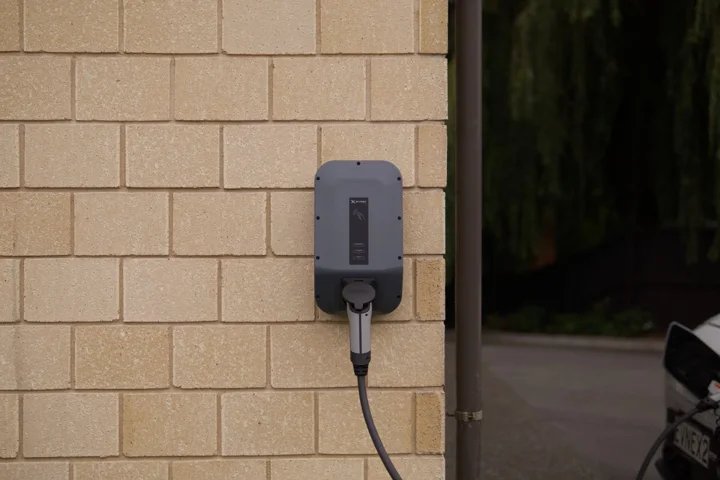
    Charging an electric car at the kerb (Rule 239)

    1. Park close to the charge point.
    2. Route the cable so it does not trail across the pavement and trip pedestrians.
    3. Display a warning sign if you can.
    4. When you finish, return cables and connectors neatly so they are not a hazard.

    These are advice in Rule 239, not MUST rules.

    Every time you leave the car (Rule 239)

    • You MUST switch off the engine, headlights and fog lights.
    • You MUST apply the handbrake before leaving the vehicle.
    • You MUST make sure you will not hit anyone when you open the door. Check for cyclists and other traffic.
    • Passengers, especially children, should get out on the kerb side.
    • Lock the car and keep valuables out of sight.

    Where you must never park: parking rules in the Highway Code.

    Who enforces parking? (decriminalised parking)

    In many areas, local councils rather than the police enforce parking rules under Decriminalised Parking Enforcement. If you want to challenge a council penalty, appeals go to the Traffic Penalty Tribunal outside London, or London Tribunals inside London. Yellow lines, red routes and loading rules: parking restrictions decoded.

    Common questions

    Is it illegal to park facing the wrong way at night in the UK?

    Yes, on a road at night, unless you are in a recognised parking space (Rule 248).

    Can I park facing the wrong way during the day?

    Rule 248 applies at night. Rule 239 still advises not to park facing against the traffic flow at any time.

    Do I need lights when parked on a 40 mph road at night?

    Yes. Over 30 mph, parking lights MUST be on (Rule 249).

    Can I run a charging cable across the pavement?

    Rule 239 says avoid trailing cables that create a trip hazard. Park as close to the charge point as you can.

    Which way do I turn my wheels parking downhill?

    Towards the kerb, with reverse selected (Rule 252).

    Does parking come up on the driving test?

    You may be asked to park at the side of the road, in a bay or on the right. See driving test manoeuvres.

    Related: using your car lights and driving at night. Back to the main guide: Learning to Drive in Great Britain.

    Sources

    • Department for Transport, “The Highway Code: Waiting and parking (238 to 252)” (gov.uk)