Author: Get Driving Test Ready

  • Traffic Lights, Driver Signals and Hand Signals in Ireland

    Traffic Lights, Driver Signals and Hand Signals in Ireland

    Photo: Gary Doherty / Pexels. Illustrative photograph.

    Irish traffic lights work on red, green and amber, with green filter arrows and a flashing amber at pelican crossings. Section 7 of the Rules of the Road also covers the signals drivers give with indicators, brake lights and the arm. Two hand signals are asked on the Irish driving test. This guide explains every light, when you must signal, and all 7 hand signals.

    Key facts

    • A green light is not a right of way. It means you may go on with caution if the way is clear.
    • On amber you must stop, unless you are so close that stopping would be dangerous.
    • Failing to obey traffic lights: 3 penalty points on payment of the fixed charge, 5 on conviction.
    • You must signal before moving off, turning, changing lane, overtaking, slowing down or stopping.
    • The driving test includes 2 hand signal questions, done at the desk.

    What each traffic light means in Ireland

    Light What you must do
    Red Stop. Do not go past the stop line, or past the light if there is no line
    Amber Stop at the line, unless you are so close when it appears that stopping would be dangerous
    Green Go on if the way is clear. Take special care when turning and give way to pedestrians crossing
    Green arrow (filter) You may go in the direction of the arrow if safe, even if a red light is also showing
    Flashing amber arrow pointing left You may go past the light, but first give way to traffic already coming through the junction
    Flashing amber at a pelican crossing Yield to pedestrians on the crossing. Go only when it is clear
    Four traffic light heads showing red, amber, green and a green filter arrow beside a red light, with what a driver must do at each.
    What each traffic light means for drivers in Ireland. Illustrative diagram, not to scale.

    Approach every set of lights at a speed that lets you stop if the amber appears.

    Reading arrows and turning across cycle tracks

    • A green arrow covers only the direction it points. A left arrow does not let you go straight ahead.
    • At a junction with several sets of lights, follow the signal for your lane. Don’t move off because the next lane starts moving.
    • A flashing amber arrow is not a protected turn. Before turning across a cycle track, look back along it for a cyclist on the way, not just at the point where your paths cross.
    • Green still means wait if people are crossing your exit, or the road beyond is queued and you would be left blocking the junction.

    If the lights are not working

    If the lights at a junction are out of order, stop at the stop line first. Then go only when it is safe, giving way to traffic that has right of way, and take extra care because other drivers may be unsure who goes first. If a Garda is directing traffic, follow their signals.

    Turning right at lights with a right filter arrow

    On green, drive into the junction without blocking oncoming traffic, then finish the turn when safe. Wait for the filter arrow only if you are already in the junction and turning before it appears would be dangerous. Where there is a right-turn box marked on the road, wait inside it. See Irish road markings.

    Cycle track lights

    • A red cyclist light means the cyclist must stop.
    • A green cyclist light means the cyclist may go if it does not endanger others.
    • A flashing green or amber cyclist light means the cyclist may not cross unless they were already crossing on a steady green.

    Cyclists must obey ordinary traffic lights too. See sharing the road with cyclists.

    Lane control lights

    On national roads, motorways and in tunnels, a green down arrow means the lane is open. A red X means the lane is closed and you must not pass. A green diagonal arrow means move into that lane. See Irish road signs explained.

    When must you signal?

    You must signal clearly and in good time before:

    • moving off
    • turning left or right
    • changing lanes
    • overtaking
    • slowing down
    • stopping

    A signal shows what you intend. It never gives you right of way. Before any manoeuvre, take extra care when changing lane, turning across oncoming traffic, entering or leaving a roundabout, and driving or reversing into a parking space.

    If you think your indicators or brake lights are not giving an adequate signal, add a clear hand signal. Then have them repaired.

    The 7 hand signals in the Rules of the Road

    All are given with the right arm. The same signals are used by cyclists, motorcyclists and people in charge of horse-drawn vehicles, and by drivers of farm machinery without indicators.

    A car seen from behind with the driver's right arm out of the window giving three signals: arm level to move out or turn right, arm circling anticlockwise to turn left, and arm moving up and down to slow or stop.
    Hand signals to traffic behind, given with the right arm. Illustrative diagram, not to scale.

    To traffic behind you

    Meaning How to give it
    I am going to move out or turn right Right arm straight out of the window, level
    I am going to turn left Right arm out of the window, rotated in an anti-clockwise circle
    I am going to slow down or stop Right arm out of the window, palm down, moved slowly up and down

    To a Garda on point duty or oncoming traffic

    Meaning How to give it
    I want to turn right Right arm out of the window, pointing right
    I want to turn left Right forearm and hand across the inside of the windscreen, fingers pointing left
    I want to go straight on Right hand raised inside the windscreen, palm facing forward
    I want to slow down or stop Right arm out of the window, moved up and down

    When a hand signal helps

    The Rules of the Road gives these examples, and says learners should be guided by their ADI:

    • turning right just after moving out to pass stationary traffic on the left
    • showing oncoming traffic that you are giving way at a pedestrian crossing
    • when another road user may not be able to see your indicators
    • when you think your indicators are not working

    Hand signals on the Irish driving test

    Under the RSA’s 2025 procedures, the oral part has 14 questions. Two are hand signals, done at the desk before the drive. If 3 or more oral questions, including hand signals, are wrong or unanswered, a Grade 2 fault is recorded. Practise all 7 sitting in the driver’s seat. See pre-test checks.

    Penalties

    Offence Points on payment Points on conviction Fixed charge
    Failing to obey traffic lights 3 5 €80
    Failing to give appropriate signals not in points schedule not in points schedule €60

    Full list in penalty points in Ireland.

    Common questions

    Can I go through an amber light in Ireland?

    Only if you are so close to the line when it changes that stopping would be dangerous. Otherwise you must stop.

    Can I turn left on red in Ireland?

    No, unless a green filter arrow pointing left is lit, or a flashing amber left arrow lets you go after giving way.

    Does indicating give me right of way?

    No. A signal only shows what you intend to do.

    Do I still need to know hand signals if my car has indicators?

    Yes. They are tested on the driving test and in the Rules of the Road, and you need them if your indicators fail.

    Which arm do I use for hand signals?

    Your right arm, out of the driver’s window or across the windscreen.

    Related: junctions in Ireland, pedestrians and crossings, Garda signals and emergency vehicles. Back to learning to drive in Ireland.

    Sources

    • Road Safety Authority, “Rules of the Road”, Section 7 Traffic lights and signals (Revision 5, hosted on garda.ie)
    • Road Safety Authority, “Standard procedures and requirements for conducting driving tests 2025” (rsa.ie)
    • Road Safety Authority, “RSA driver tester marking guidelines” (rsa.ie)
    • Law Reform Commission, Road Traffic Act 2002, First Schedule, revised (revisedacts.lawreform.ie)
    • Irish Statute Book, “S.I. No. 526 of 2022, Road Traffic Act 2010 (Part 3) (Fixed Charge Offences) Regulations 2022” (irishstatutebook.ie)
    • Road Safety Authority, “Rules of the Road”, current edition reflecting the law at 1 March 2025, printed page 109 (traffic lights out of order) (rsa.ie)
  • Irish Road Markings: Yellow Lines, White Lines and Yellow Boxes

    Irish Road Markings: Yellow Lines, White Lines and Yellow Boxes

    Photo: Adrien Olichon / Pexels. Illustrative photograph.

    In Ireland, road markings carry the same legal weight as upright signs, so you must obey them. A double yellow line means no parking at any time. A single yellow line means no parking during the times shown on a nearby plate. You must not enter a yellow box junction unless you can clear it without stopping. This guide covers every common marking in the Rules of the Road, including what each white line lets you do.

    Key facts

    • Continuous white centre line (single or double): keep to the left of it, except in an emergency or for access.
    • Crossing a continuous white line: 3 penalty points on payment of the fixed charge, 5 on conviction.
    • Yellow box: do not enter unless your exit is clear. At a road junction you may wait in it to turn right, as long as you do not block traffic with right of way. There is no such exception on railway or tram tracks.
    • Do not park within 15 m before or 5 m after a pedestrian crossing or traffic lights, or within 5 m of a junction unless spaces are marked.
    • A broken yellow edge line marks a hard shoulder, which is normally for pedestrians and cyclists.

    White lines along the centre of the road

    Marking Meaning
    Single or double continuous white line All traffic must keep left of the line, except in an emergency or for access. No parking beside it
    Short broken white line Divides opposing lanes. Cross only when safe
    Longer white warning lines A hazard is ahead: limited view, a junction, a roundabout, a hill, a crest, a bend or a continuous line
    Double broken white lines A continuous line is a short distance ahead. Cross only when safe
    Broken line beside a continuous line Obey the line nearest to you
    Hatched markings (diagonal stripes) Separate traffic or guide merging and diverging traffic. You must not enter the hatched area

    For using these lines when passing, see overtaking rules in Ireland.

    Lines across the road at junctions

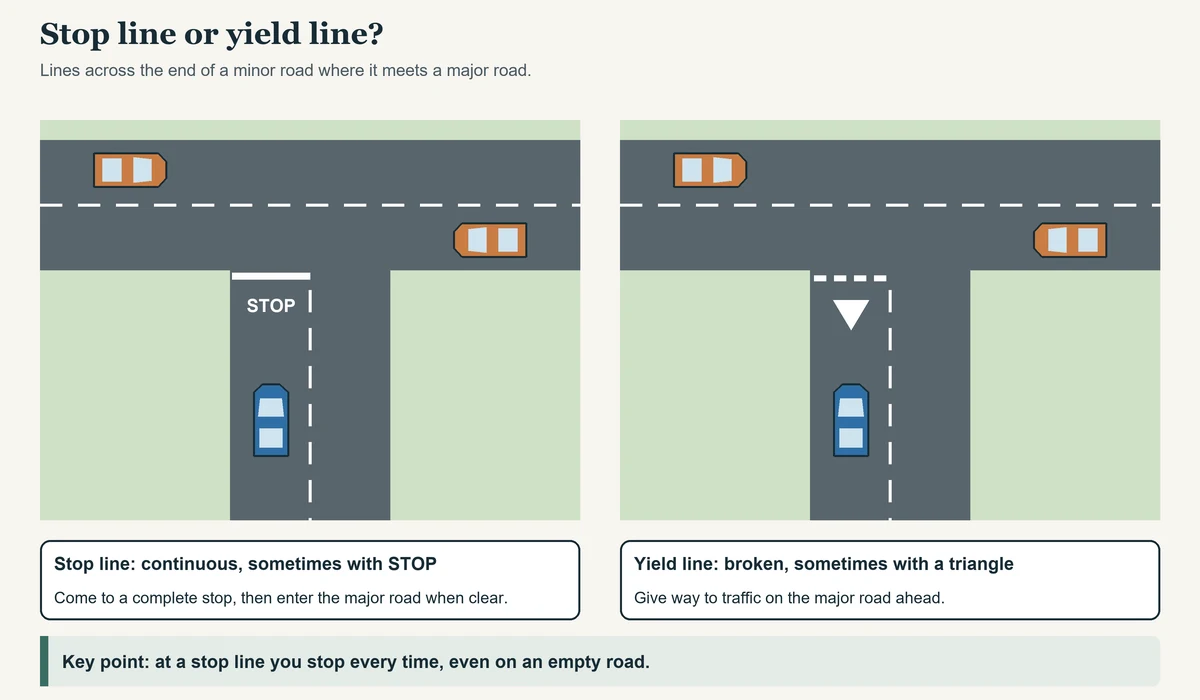
    • Stop line (continuous white line, sometimes with STOP): come to a complete stop before entering the major road.
    • Yield line (broken white line, sometimes with a white triangle): give way to traffic on the major road ahead.
    • Advanced stop line for cyclists: at traffic lights, stop at the first white line you reach and keep out of the cyclist area. Give cyclists time and space to move off on green.
    • Right-turn box (white arrow in a white-edged box): position here to turn right at traffic lights. Do not enter it on red. Wait in it until oncoming traffic lets you turn.
    • No Entry markings at the wrong end of a one-way street: do not pass.
    Two T junctions compared: a continuous stop line with STOP where you must stop completely, and a broken yield line with a triangle where you give way to traffic on the major road.
    Stop line and yield line at the end of a minor road. Illustrative diagram, not to scale.

    More on junctions in junctions in Ireland.

    Yellow box junctions

    A yellow box is a pattern of criss-cross yellow lines at a junction. You must not enter it unless you can leave it without stopping.

    Exception: if you are turning right, you may wait inside the box for a gap in oncoming traffic. Do not do this if it would block other traffic that has right of way.

    Yellow boxes are also used at railway level crossings and tram crossings. Never enter one there unless you can clear it without stopping, and never stop on the tracks.

    Entering a yellow box against the rules is a fixed charge offence (€60 under S.I. No. 526 of 2022).

    Yellow lines at the edge of the road

    Marking Meaning
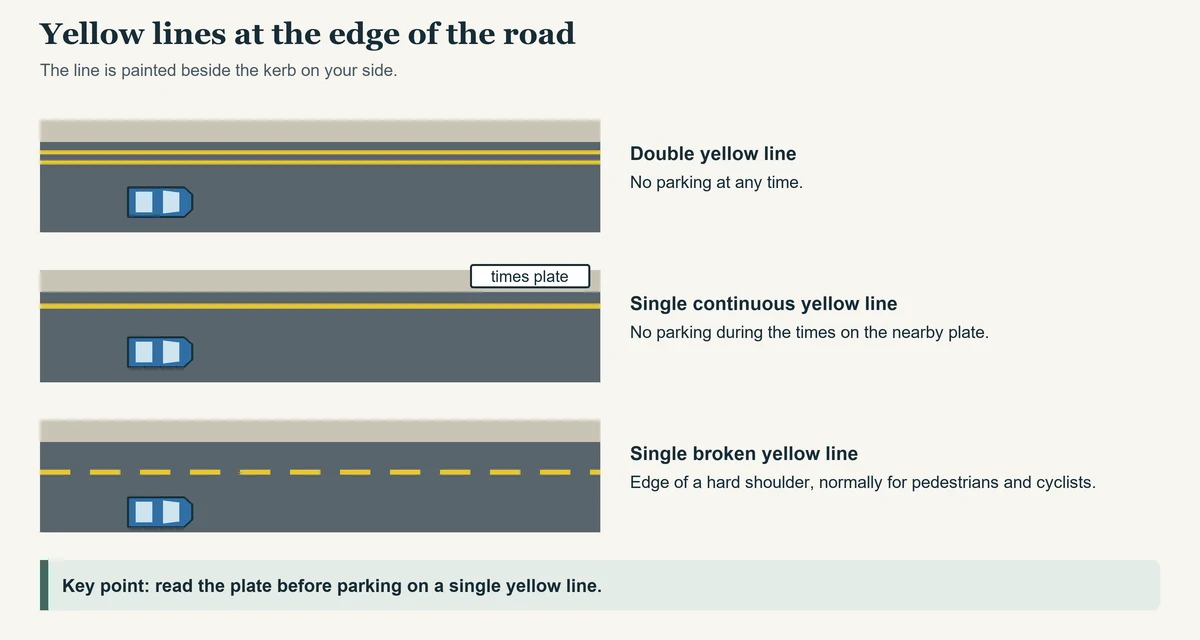
    Double yellow line No parking at any time
    Single continuous yellow line No parking during the times shown on the nearby information plate
    Single broken yellow line Edge of a hard shoulder, normally for pedestrians and cyclists. You may pull in briefly to let a vehicle overtake if the shoulder is clear and no junctions or entrances are near
    Yellow zig-zags with “SCHOOL KEEP CLEAR” Do not stop or park
    Three road edges: a double yellow line meaning no parking at any time, a single yellow line with a times plate, and a broken yellow line marking a hard shoulder.
    Yellow edge lines and what each one means. Illustrative diagram, not to scale.

    Motorway hard shoulders have different rules. See motorways and tunnels.

    Markings for crossings, buses and loading

    • Zig-zag lines (white or yellow) on either side of zebra, pelican and pedestrian light crossings: do not park or overtake within them.
    • Bus lane: a continuous white line with “Lána Bus” and an upright blue sign. Keep out during the hours on the plate. A contra-flow bus lane is generally for buses only, day and night.
    • BUS or TAXIS painted in a marked area: bus stop or taxi rank. Do not stop there.
    • LOADING repeated across a bay: goods vehicles loading or unloading, for a maximum of 30 minutes.
    • Disabled parking bays: only for vehicles displaying a valid disabled person’s parking permit.

    Parking details in parking rules in Ireland. Bus lane rules in bus lanes, Luas trams and light rail.

    Penalties for ignoring markings

    Offence Points on payment Points on conviction Fixed charge
    Crossing a continuous white line 3 5 €80
    Failure to stop at a stop sign or stop line 3 5 €80
    Failure to yield at a yield sign or yield line 3 5 €80
    Entering a hatched area 1 3 €80
    Not complying with traffic lane markings 1 3 €60
    Entering a yellow box against the rules not in points schedule not in points schedule €60

    See penalty points in Ireland.

    Common questions

    Can I park on a single yellow line in Ireland?

    Only outside the times shown on the nearby information plate.

    Can I stop in a yellow box to turn right?

    Yes, while waiting for a gap in oncoming traffic, as long as you are not blocking traffic that has right of way.

    Can I cross a solid white line to get into a driveway?

    Yes. Crossing for access is allowed, as is crossing in an emergency.

    Can I drive in the hard shoulder on a normal road?

    Only briefly, to let a vehicle behind overtake, and only if no pedestrians or cyclists are using it and no junctions or entrances are near.

    What does a white arrow in a box at traffic lights mean?

    It is a right-turn waiting box. Move into it on green and wait there until oncoming traffic clears.

    Related: Irish road signs explained, traffic lights and signals, pedestrians and crossings. Back to learning to drive in Ireland.

    Sources

    • Road Safety Authority, “Rules of the Road”, Section 6 Traffic signs and road markings, Section 9 Junctions and roundabouts and Section 10 Parking (Revision 5, hosted on garda.ie)
    • Law Reform Commission, Road Traffic Act 2002, First Schedule, revised (revisedacts.lawreform.ie)
    • Irish Statute Book, “S.I. No. 526 of 2022, Road Traffic Act 2010 (Part 3) (Fixed Charge Offences) Regulations 2022” (irishstatutebook.ie)
  • Overtaking Rules in Ireland: Safe Passing and When It Is Illegal

    Overtaking Rules in Ireland: Safe Passing and When It Is Illegal

    Photo: Tanita Lupa / Pexels. Illustrative photograph.

    In Ireland you normally overtake on the right, only when the road ahead is clear enough to pass and get back in without forcing anyone to move. You must never overtake near a junction, a crossing, a bend, a hill or a continuous white line. This guide covers the rules from the Rules of the Road, the penalties, and the line markings that decide whether you can pull out.

    Key facts

    • Overtake on the right. Overtaking on the left is allowed only in 3 situations.
    • You must not break the speed limit, even while overtaking.
    • Crossing a continuous white line: 3 penalty points on payment of the fixed charge, 5 on conviction.
    • Overtaking where it is prohibited: 3 points on payment, 5 on conviction. Overtaking a cyclist where it is prohibited carries the same points.
    • A “LONG VEHICLE” sign means the vehicle is at least 13 metres long.

    When must you not overtake in Ireland?

    The Rules of the Road says you must not overtake when:

    • you are at or near a pelican crossing, a zebra crossing or pedestrian lights
    • a traffic sign or road marking prohibits it
    • you are approaching a junction
    • you are approaching a corner, a bend, a dip, a hump-back bridge or the brow of a hill
    • you are on a narrow road
    • you are in the left lane of a dual carriageway or motorway and traffic is moving at normal speed
    • it would cause danger or inconvenience to another road user at any time

    When can you overtake on the left?

    1. The driver in front has moved out and signalled to turn right, and you are going straight ahead.
    2. You have signalled that you are turning left.
    3. Traffic in both lanes is moving slowly and the left lane is moving faster, for example in stop-start traffic.

    White lines: can I cross them to overtake?

    Centre line Can you cross it to overtake?
    Single or double continuous white line No. Keep to the left of it, except in an emergency or for access
    Continuous line on your side, broken on the other No. Obey the line nearest to you
    Broken line on your side, continuous on the other Yes, if it is safe. Obey the line nearest to you
    Short broken white line Yes, only if it is safe
    Longer warning lines These warn of a hazard ahead, such as a bend, a junction or a continuous line. Think twice
    Double broken white lines These warn of a continuous line a short distance ahead. Cross only if it is safe
    Hatched markings Do not enter the hatched area
    Six road strips showing centre line types and whether a driver on the left may cross each one to overtake: continuous lines no, broken on your side yes if safe, hatched markings do not enter.
    Which centre lines you may cross to overtake in Ireland. Illustrative diagram, not to scale.

    More in Irish road markings.

    How to overtake safely, step by step

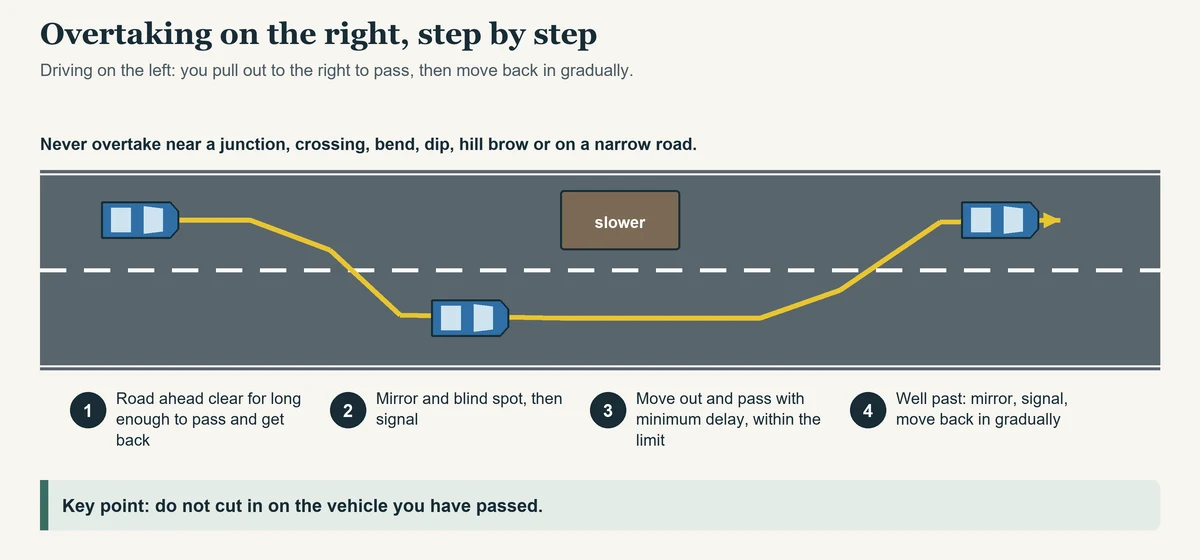
    1. Make sure the road ahead is clear for long enough to pass and get back to the left without forcing anyone to move.
    2. Do not follow another overtaking vehicle out. Give way to faster traffic already overtaking you.
    3. Check your mirror and your blind spot for anything coming up behind.
    4. Signal in good time, move out when it is safe, and accelerate past with minimum delay. Stay within the speed limit.
    5. When you are well past, check the mirror, signal and move back in gradually. Do not cut in on the vehicle you have passed.
    A blue car pulls out to the right to pass a slower vehicle, then moves back to the left, with four numbered steps from checking the road ahead to moving back in gradually.
    Overtaking on the right in four steps, without cutting in. Illustrative diagram, not to scale.

    Leave extra room to pass cyclists, as they may need to move out to avoid uneven road surfaces. See sharing the road with cyclists in Ireland.

    Being overtaken

    • Keep the same speed, unless that becomes unsafe.
    • Keep as far left as is safe.
    • Do not accelerate.
    • Be ready in case the other vehicle cuts back in suddenly.

    On a road with a single broken yellow line, you may pull briefly into the hard shoulder to let a vehicle pass. Only do this if no pedestrians or cyclists are using it and there are no junctions or entrances nearby.

    2+1 roads

    A 2+1 road has two lanes in one direction and one lane in the other. The two-lane section alternates roughly every 2 km. Overtake only in the two-lane section. Where a central barrier is fitted, you cannot overtake in the one-lane section.

    Penalties

    Offence Points on payment Points on conviction Fixed charge
    Overtaking in prohibited circumstances 3 5 €80
    Overtaking a cyclist in prohibited circumstances 3 5 €120
    Crossing a continuous white line 3 5 €80
    Entering a hatched area 1 3 €80

    Learner and novice drivers are disqualified at 7 points, so two overtaking offences put you close. See penalty points in Ireland.

    Common questions

    Can a learner overtake in Ireland?

    Yes, under the same rules as every other driver.

    Can I break the speed limit to overtake?

    No. If you cannot pass within the limit, do not pass.

    Can I cross a solid white line to pass a tractor or cyclist?

    The Rules of the Road allows crossing a continuous line only in an emergency or for access. Wait for a broken line.

    Is undertaking on a motorway legal?

    Only in the situations above, such as slow-moving queues where the left lane is moving faster. In normal flow you must not overtake from the left lane.

    What should I do if someone is tailgating me on a narrow road?

    Keep a steady speed and, where there is a broken yellow line and the hard shoulder is clear, pull in briefly to let them pass.

    Related: good driving practice in Ireland, speed limits in Ireland, motorways and tunnels, tractors and rural roads. Back to learning to drive in Ireland.

    Sources

    • Road Safety Authority, “Rules of the Road”, Section 5 Good driving practice and Section 6 Traffic signs and road markings (Revision 5, hosted on garda.ie)
    • Law Reform Commission, Road Traffic Act 2002, First Schedule, revised (revisedacts.lawreform.ie)
    • Irish Statute Book, “S.I. No. 526 of 2022, Road Traffic Act 2010 (Part 3) (Fixed Charge Offences) Regulations 2022” (irishstatutebook.ie)
  • Seat Belts and Child Car Seats in Ireland: Law and Penalty Points

    Seat Belts and Child Car Seats in Ireland: Law and Penalty Points

    Photo: Luke Miller / Pexels. Illustrative photograph.

    In Ireland, everyone in a car must wear a seat belt where one is fitted. As the driver, you are legally responsible for every passenger under 17. Children under 150 cm or 36 kg must use a child seat, booster seat or booster cushion that suits their height and weight. This guide sets out the law, the penalty points and the questions learners and new drivers ask.

    Key facts

    • Driver not wearing a seat belt: 3 penalty points on payment of the fixed charge, 5 on conviction.
    • Driver allowing a passenger under 17 to travel unbelted, or a child without the right restraint: 3 points on payment, 5 on conviction.
    • Fixed charge for these offences: €120 (S.I. No. 526 of 2022).
    • Never put a rear-facing child seat in a front seat with an active airbag.
    • Child seats sold in Ireland must carry an E mark and meet UN Regulation 129. An R44 seat bought before 1 September 2024 can still be used.

    Who must wear a seat belt?

    Everyone, in every seat with a belt. The Rules of the Road lists only these exceptions:

    • people who wear a disabled person’s belt
    • people with a doctor’s certificate saying they should not wear one on medical grounds
    • driving instructors and driver testers during a lesson or a test
    • Gardaí and Defence Forces members on duty

    Learner drivers and their accompanying drivers are not exempt. Only the ADI giving a lesson is.

    What the driver is responsible for

    It is an offence for the driver to allow:

    1. a person under 17 to sit in a seat without wearing a seat belt
    2. a child under 3 to travel without an appropriate child restraint
    3. a child over 3 to travel without an appropriate child restraint
    4. a child to be placed in a rear-facing child restraint in a seat protected by an active frontal airbag

    For passengers under 17, the offence is the driver’s and the points go on the driver’s licence.

    Child car seat law in Ireland

    Child Rule
    Under 3 Must not travel in a car or goods vehicle (other than a taxi) unless in the correct child seat
    3 or over, under 150 cm or 36 kg Must use the correct child seat, booster seat or booster cushion. The Rules of the Road says this is generally children up to 11 or 12
    Over 3, car with no seat belts fitted Must travel in a rear seat
    150 cm or taller and 36 kg or more Adult seat belt

    Choosing and fitting a seat

    • Pick the seat to suit the child’s height and weight, not their age.
    • Look for the E mark and R129 approval.
    • Fit it exactly as the manufacturer says. The RSA advises the back seat is safer.
    • The RSA recommends against buying or using a second-hand seat.
    • Use the seat on every journey, however short.

    Fitting the seat: quick checks

    A seat that feels solid can still be fitted wrongly. Using the seat’s own fitting instructions and the car handbook, check:

    • the child is inside the seat’s height and weight range
    • it faces the right way for that child
    • the belt goes through the correct guides, or the ISOFIX connectors are locked
    • any support leg or top tether is fitted as the instructions say
    • the car handbook allows that seat in that seating position

    Check the fit and the harness before every journey. If you move a seat to a different position, for example into the front to make room for luggage, run the checks again, including whether the front airbag is switched off. The RSA’s Check It Fits service can look over a fitted seat if you are unsure.

    Penalties at a glance

    Offence Points on payment Points on conviction Fixed charge
    Driver not wearing a seat belt 3 5 €120
    Passenger under 17 not wearing a belt 3 5 €120
    Child under 3 without an appropriate restraint 3 5 €120
    Child over 3 without an appropriate restraint 3 5 €120
    Rear-facing seat in front of an active airbag 3 5 €120

    For learner and novice drivers, a disqualification starts at 7 points, not 12. Two seat belt offences paid by fixed charge already add up to 6. See penalty points in Ireland.

    Common questions

    Does my driving instructor have to wear a seat belt?

    No. ADIs are exempt during a lesson, and driver testers during a test. Your accompanying driver on a practice drive is not exempt.

    Can a child sit in the front seat in Ireland?

    The Rules of the Road sets no separate age for the front seat. It does ban a rear-facing seat in front of an active airbag. A child under 150 cm or 36 kg still needs the right restraint wherever they sit, and the RSA says the back seat is safer.

    Who gets the points if my 16 year old brother is not belted in?

    You do, as the driver. The law makes the driver responsible for all passengers under 17.

    Are taxis different?

    Yes. The child seat rules apply to cars and goods vehicles other than taxis. Seat belts must still be worn where fitted.

    Can I still use an old R44 car seat?

    Yes, if you bought it before 1 September 2024 and it suits the child. R44 seats can no longer be sold in the EU.

    Could this come up in the theory or driving test?

    Seat belts and child restraints are part of the Rules of the Road, so they can appear in the theory test. Before moving off on the driving test, you are expected to check everyone is belted in. See Irish theory test topics.

    Related: vehicle safety checks in Ireland, good driving practice. Back to learning to drive in Ireland.

    Sources

    • Road Safety Authority, “Rules of the Road”, Section 4 Vehicle safety (Revision 5, hosted on garda.ie)
    • Road Safety Authority, “Child car seats” and “Child safety in cars” (rsa.ie)
    • Road Safety Authority, “Child safety in cars frequently asked questions” (rsa.ie)
    • Law Reform Commission, Road Traffic Act 2002, First Schedule, revised (revisedacts.lawreform.ie)
    • Irish Statute Book, “S.I. No. 526 of 2022, Road Traffic Act 2010 (Part 3) (Fixed Charge Offences) Regulations 2022” (irishstatutebook.ie)
    • Road Safety Authority, “Check It Fits” child car seat checking service (rsa.ie)
  • Irish Driving Test Marking: Grade 1, 2 and 3 Faults Explained

    Irish Driving Test Marking: Grade 1, 2 and 3 Faults Explained

    Photo: kaboompics.com / Pexels. Illustrative photograph.

    The Irish driving test is marked using three grades of fault: Grade 1, Grade 2 and Grade 3. Your result depends only on Grade 2 and Grade 3 faults. One Grade 3 fault fails you. So do too many Grade 2 faults, whether in one line, under one heading or across the whole test. Here is how the RSA driver tester’s marking works and how to read your report.

    How do you fail the Irish driving test?

    Under the RSA driver tester marking guidelines, you fail if you get any one of these:

    Fail trigger Example
    1 or more Grade 3 faults Driving through a red light, or forcing a cyclist to brake hard
    4 Grade 2 faults for the same aspect (one line on the sheet) Four serious mirror faults when changing lane
    6 or more Grade 2 faults under the same heading Six serious faults spread across the lines of one heading, such as position
    9 or more Grade 2 faults in total Nine serious faults anywhere on the test

    The RSA’s 2025 standard procedures describe the same thresholds as “Grade 3 X 1, Grade 2 X 4 in a single line or Grade 2 X 9”.

    What the three grades mean

    • Grade 1: a minor fault. It is recorded on your report but does not count towards any fail threshold.
    • Grade 2: a serious fault.
    • Grade 3: a dangerous or potentially dangerous fault, or a total disregard of traffic controls.

    Very minor lapses that the guidelines do not treat as serious are not recorded at all.

    What the tester marks you on

    The Rules of the Road lists the areas your drive is assessed under:

    • positioning the car correctly and in good time
    • taking proper observation
    • reacting promptly and properly to hazards
    • using mirrors properly, in good time and before signalling
    • allowing enough clearance to pedestrians, cyclists and other traffic
    • giving correct signals in good time
    • making reasonable progress without undue hesitancy, for example when moving off, at roundabouts and when changing lanes
    • using the controls properly
    • adjusting speed appropriately
    • complying with traffic controls such as lights, signs and road markings
    • yielding right of way
    • reversing, the turnabout and parking

    Within each heading the guidelines break things down further. For example, “Position” is split into turning right, turning left, stopping and following. Only one position fault is recorded for each complete manoeuvre.

    Faults before you drive

    • Rules of the Road questions and hand signals: 3 or more not answered or answered wrongly is a Grade 2 fault.
    • Technical checks: not being able to lift or secure the bonnet is a Grade 1 fault in itself.

    Details in pre-test checks.

    How the manoeuvres are marked

    • The tester waits until you finish the reverse or the turnabout before recording anything.
    • Only one fault is recorded under each aspect of the manoeuvre.
    • Steering while the car is stopped is not a fault.
    • Handbrake faults are recorded only where not applying it has consequences, such as rolling back on a hill.

    Worn or faded road markings are taken into account when the tester decides whether a fault applies.

    Worked example

    A learner’s report shows:

    • 11 Grade 1 faults
    • 3 Grade 2 faults for mirrors when changing lane
    • 2 Grade 2 faults for progress at junctions
    • 2 Grade 2 faults for road position when turning right
    • no Grade 3 faults

    Result: pass. That is 7 Grade 2 faults in total, under 9. No single line has 4. The Grade 1 faults do not count. One more mirror fault on that line would have been a fail.

    After the test

    You get your result and a report of your faults by email. Go through it with your ADI and practise the lines with the most Grade 2 marks. If you think the test was not conducted properly, you can appeal to the District Court. If the court agrees, it can direct the RSA to give you a free retest.

    Common questions

    How many Grade 2 faults can you get and still pass in Ireland?

    Up to 8 in total, provided no single line has 4 and no heading has 6 or more.

    Do Grade 1 faults matter?

    Not for the result. They are worth fixing, because a habit marked Grade 1 can easily become a Grade 2 on another day.

    What counts as a Grade 3 fault?

    Anything dangerous or potentially dangerous, or a total disregard of traffic controls such as a red light or stop sign.

    Does stalling fail you?

    Not automatically. It depends on the grade the tester gives it, which depends on what happened as a result.

    Can I see my marking sheet?

    Yes. Your result email includes a report of the faults recorded.

    Related: common reasons for failing, test manoeuvres, the test explained. Back to learning to drive in Ireland.

    Sources

    • Road Safety Authority, “RSA driver tester marking guidelines” (rsa.ie)
    • Road Safety Authority, “Standard procedures and requirements for conducting driving tests 2025” (rsa.ie)
    • Road Safety Authority, “Driving test terms and conditions” (rsa.ie)
    • Road Safety Authority, “Rules of the Road”, Section 3 The driving test (Revision 5, hosted on garda.ie)
  • Irish Driving Test Manoeuvres: Reverse Around a Corner and More

    Irish Driving Test Manoeuvres: Reverse Around a Corner and More

    Photo: Joaquin Carfagna / Pexels. Illustrative photograph.

    The Irish car driving test includes three set manoeuvres: reversing around a corner, a turnabout and a hill start. You will also move off from the kerb several times. This guide explains how the RSA driver tester sets up each one, what they mark, and the mistakes that cost faults.

    Key facts

    • For a car (category B), you do one reverse around a corner. The tester decides whether it is to the left or the right.
    • A turnabout and a hill start are both carried out on every car test.
    • The tester marks a manoeuvre only after you finish it. Only one fault can be recorded under each aspect of that manoeuvre.
    • Turning the steering wheel while the car is stopped (“dry steering”) is not recorded as a fault in the turnabout.
    • If you refuse to attempt the reverse or the turnabout, the test is stopped and you get no result. You have to reapply on MyRoadSafety.

    Reverse around a corner

    How the tester sets it up

    The tester asks you to stop before a junction and shows you the road to reverse into. You reverse around the corner, keeping reasonably close to the kerb, until the tester tells you that is far enough. The tester gets out of the car to watch this manoeuvre.

    Top view of a car stopped on the left past a side road, then reversing round the corner close to the kerb and straightening up in the minor road, with four numbered steps.
    Reversing around a corner to the left on the Irish test. Illustrative diagram, not to scale.

    Step by step

    1. Pull up on the left, past the side road, at a safe distance from the corner.
    2. Check all round, including both blind spots, before you start.
    3. Reverse slowly, using clutch control (or a gentle foot on the brake in an automatic).
    4. Look mainly out of the rear window, with frequent checks all round, especially as the front of the car swings out into the main road.
    5. Follow the kerb around the corner, keeping close to it without touching it.
    6. If a car, cyclist or pedestrian comes, stop and let them pass. Continue only when safe.
    7. Straighten up and keep reversing in a straight line until the tester says stop.

    The rule behind it

    The Rules of the Road says you may reverse from a major road into a minor road, far enough to take up the correct position on the left when you rejoin the major road. You must never reverse from a minor road onto a major road.

    Turnabout

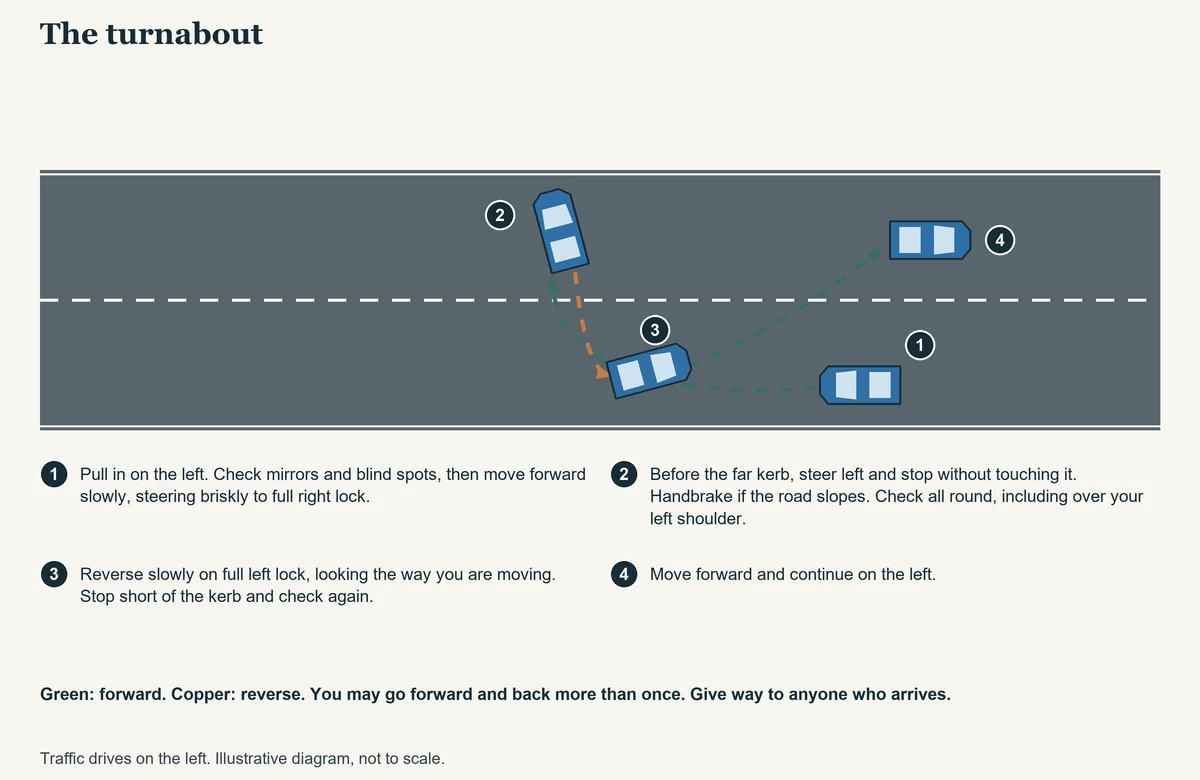
    The tester asks you to pull in on the left, then turn the car around to face the opposite direction. You may go forward and back more than once if you need to.

    Top view of a car turning around in the road: forward on full right lock towards the far kerb, reverse on full left lock, then forward to continue on the left.
    The turnabout, forward and back, ending on the left. Illustrative diagram, not to scale.
    1. Check mirrors and blind spots before moving off from the kerb.
    2. Move forward slowly, steering briskly to full right lock.
    3. Before you reach the far kerb, steer left and stop without touching it.
    4. Secure the car with the handbrake if the road slopes. Check all round again, including over your left shoulder.
    5. Reverse slowly, steering to full left lock, looking in the direction you are moving.
    6. Stop short of the kerb, check again, then move forward and continue on the left.

    Give way to any road user who arrives at any point. Pausing for traffic is good observation, not a fault.

    Hill start

    A hill start must be carried out on the test. The tester will ask you to pull in and stop on a hill on the left.

    1. Stop on the left and apply the handbrake.
    2. Check mirrors, signal if needed and check your right blind spot.
    3. Find the biting point, add a little more power, then release the handbrake smoothly.
    4. Move off without rolling back and without stalling.

    The marking guidelines allow a handbrake fault where it is not applied on a slope, or not applied when stopped for a while, and only where this has consequences such as the car rolling back or forward.

    Moving off

    You move off from the kerb many times during the test, and the tester marks progress and observation each time. The Rules of the Road sets out the checks:

    • doors, bonnet and boot closed
    • seat, head restraint and mirrors adjusted
    • everyone’s seat belt fastened
    • mirrors and the blind spot over your shoulder
    • signal when needed, and give way to traffic and pedestrians

    Once the way is clear, move out and get up to the normal safe and legal speed of the traffic. Waiting too long for a gap when the road is clear can be marked as a progress fault. See good driving practice in Ireland.

    What gets marked: quick reference

    Manoeuvre Watch out for
    Reverse around a corner Weak observation behind and to the sides, swinging wide, hitting or mounting the kerb, poor speed control, not reacting to other road users
    Turnabout Touching the kerb, poor all-round observation before each direction change, not giving way
    Hill start Rolling back, stalling, handbrake not applied or not released properly
    Moving off Missing the blind spot check, signal not given, undue hesitancy

    Faults are graded 1, 2 or 3. One Grade 3 fault, 4 Grade 2 faults in a single line, or 9 Grade 2 faults in total fails the test. See Irish driving test marking.

    Common questions

    Is it a left or a right reverse on the Irish car test?

    It is the tester’s choice. Practise both until each feels routine.

    Can I stop during the reverse?

    Yes. Stopping to let a car or pedestrian pass is correct. Faults come from not seeing them, not from waiting.

    How many goes do I get at the turnabout?

    You may go forward and back more than once. Use as many moves as you need to do it safely.

    Is touching the kerb an automatic fail?

    No single rule says so. The tester grades the fault by its seriousness. Mounting the kerb or hitting it hard is likely to be marked more severely than a light touch.

    Is there parking on the Irish test?

    Parking is listed as one of the things assessed on the drive, along with reversing and the turnabout.

    What if I refuse to do a manoeuvre?

    Refusing the reverse or the turnabout ends the test with no result. You have to reapply.

    Related: reversing, U turns and towing, pre-test checks, common reasons for failing, the test explained. Back to learning to drive in Ireland.

    Sources

    • Road Safety Authority, “Standard procedures and requirements for conducting driving tests 2025” (rsa.ie)
    • Road Safety Authority, “RSA driver tester marking guidelines” (rsa.ie)
    • Road Safety Authority, “Preparing for your test: driving test eligibility” (rsa.ie)
    • Road Safety Authority, “Rules of the Road”, Sections 3 and 5 (Revision 5, hosted on garda.ie)
  • Irish Driving Test Pre Test Checks: Questions and Car Checks

    Irish Driving Test Pre Test Checks: Questions and Car Checks

    Photo: Tim Mossholder / Unsplash. Illustrative photograph.

    Before you drive a metre on the Irish driving test, the RSA driver tester checks your knowledge at the desk and at the car. You answer Rules of the Road questions, identify road signs, show hand signals, and explain how you would check 3 parts of the car picked at random. This checklist covers each part and what costs you a fault.

    Key facts

    • The oral part has 14 questions under the RSA’s 2025 standard procedures: 6 verbal questions on the Rules of the Road, 6 road signs and 2 hand signals.
    • Hand signals are done at the desk.
    • If 3 or more questions, including hand signals, are not answered or are answered wrongly, the tester records a Grade 2 fault.
    • Technical checks: the tester picks 3 items at random and you explain how you would check each one.
    • You open and close the bonnet yourself for oil, coolant or washer fluid. Not being able to lift or secure the bonnet counts as a fault.

    Part 1: Rules of the Road questions

    The RSA’s procedures list the topics testers draw on for every test category. Expect questions on:

    • pedestrian crossings
    • traffic lights
    • road markings
    • right of way
    • road signs
    • dipping your headlights

    If you cannot answer, the tester moves on to the next question. You can ask for a question to be repeated if you did not hear or understand it.

    How to prepare

    • Learn the meaning of every sign in the Rules of the Road, not just the common ones. See Irish road signs explained.
    • Know what each line on the road means: continuous and broken white lines, yellow lines, yield and stop lines, and yellow boxes. See Irish road markings.
    • Be able to explain the full traffic light sequence, filter arrows and the flashing amber at a pelican crossing.
    • Answer in your own words. A short, correct answer is all that is needed.

    Part 2: Hand signals

    The 2 hand signal questions come from the signals shown in Section 7 of the Rules of the Road. Learn all 7. They are always given with the right arm.

    Signal Who it is for What you do
    I am going to move out or turn right Traffic behind Right arm straight out of the window, level
    I am going to turn left Traffic behind Right arm out of the window, moved in an anti-clockwise circle
    I am going to slow down or stop Traffic behind Right arm out of the window, palm down, moved up and down
    I want to turn right Garda on point duty or oncoming traffic Right arm out of the window, pointing to the right
    I want to turn left Garda on point duty or oncoming traffic Right forearm and hand inside the windscreen, fingers pointing left
    I want to go straight on Garda on point duty or oncoming traffic Right hand raised inside the windscreen, palm facing forward
    I want to slow down or stop Garda on point duty or oncoming traffic Right arm out of the window, moved up and down

    Practise in a parked car so the signal is clear and steady. More detail in traffic lights, driver signals and hand signals.

    Part 3: Technical checks on the test car

    The tester picks 3 of these at random. For each one, explain how you would check it.

    Item What a good answer covers
    Tyres Tread above the legal minimum of 1.6 mm for a car; no cuts, bulges or uneven wear; correct pressure from the handbook, checked when cold
    Lights Switch on and walk round, or use a reflection or a helper; both rear brake lights must work for the test to go ahead
    Reflectors Present, clean and not broken
    Indicators Switch on hazards or each indicator and walk round to check front, rear and side repeaters
    Engine oil Open the bonnet, pull the dipstick, wipe, reinsert and read: the level should sit between the minimum and maximum marks
    Coolant Check the level against the marks on the coolant tank under the bonnet; only check when the engine is cold
    Windscreen washer Open the bonnet, find the washer reservoir and check the level; do not confuse it with the coolant tank
    Steering Check for excessive free play in the wheel and that the car does not pull to one side
    Brakes Test the footbrake gently as you move off; it should not feel spongy or pull; the handbrake should hold the car
    Horn Press it briefly to check it works (where it is lawful to sound it)

    Ask your ADI to show you where everything is under the bonnet of the car you will use on the day. Car layouts differ, and the tester will ask you to open and close the bonnet yourself.

    Part 4: Secondary controls

    You may also be asked to work controls such as the wipers and washers, demisters, rear window heater, lights, fans and air vents. Know where they are before test day, especially in a borrowed car.

    Pre-test check: your 2 minute list

    1. Recite the 6 obligatory topics and one rule from each.
    2. Name 10 random signs from the Rules of the Road without looking.
    3. Do all 7 hand signals in the driver’s seat.
    4. Open the bonnet and point to the dipstick, coolant tank and washer reservoir.
    5. Find the demister, rear heater, fog light and hazard switches.

    Common questions

    How many questions are asked before the Irish driving test?

    Under the RSA’s 2025 standard procedures, 14: 6 verbal questions, 6 road signs and 2 hand signals.

    How many can I get wrong?

    Getting 2 wrong is not recorded as a Grade 2 fault. Three or more wrong or unanswered, including hand signals, means a Grade 2 fault. One Grade 2 fault does not fail you on its own. See how the test is marked.

    Do I physically do the hand signals or just describe them?

    The RSA’s terms describe the hand signals as conducted at the desk. Be ready to show them with your right arm and say what each one means.

    Do I have to open the bonnet?

    Yes, if oil, coolant or washer fluid comes up. Being unable to lift or secure the bonnet is itself recorded as a fault, so practise on the test car.

    Can I bring an interpreter?

    The RSA’s terms refer to interpreters for the hand signals at the desk. Check the current driving test terms and conditions with the RSA before booking.

    Related: the Irish driving test explained, test manoeuvres, your car for the test. Back to learning to drive in Ireland.

    Sources

    • Road Safety Authority, “Standard procedures and requirements for conducting driving tests 2025” (rsa.ie)
    • Road Safety Authority, “Standard procedures for conducting driving tests 2017” (rsa.ie)
    • Road Safety Authority, “RSA driver tester marking guidelines” (rsa.ie)
    • Road Safety Authority, “Driving test terms and conditions” (rsa.ie)
    • Road Safety Authority, “Prepare your car, light van and trailer for the driving test” (rsa.ie)
    • Road Safety Authority, “Rules of the Road”, Section 7 Traffic lights and signals (Revision 5, hosted on garda.ie)
  • Irish Driving Test Explained: Check In to Result

    Irish Driving Test Explained: Check In to Result

    Photo: Joaquin Carfagna / Pexels. Illustrative photograph.

    The Irish car driving test costs €85 as of November 2026. It starts with document checks, then Rules of the Road questions and hand signals, technical checks and secondary controls, and then a drive of about 8 km on public roads. This guide takes you through test day in order, so you know what the RSA driver tester will ask and what can stop your test going ahead.

    Key facts

    • Fee: €85 for categories A, A1, A2, AM, B, BE and W.
    • Eligibility: a current learner permit for the category, held for at least 6 months, and all 12 EDT lessons completed.
    • Since 9 March 2026 you must show a valid insurance certificate for the test car.
    • The drive covers roughly 8 km in a variety of road and traffic conditions. The Rules of the Road says the car test lasts about 40 minutes. Allow more time at the centre.
    • If you pass, you get a Certificate of Competency. Exchange it for a full licence within 2 years.

    Before test day: applying and booking

    1. Apply and pay on MyRoadSafety with a Visa or Mastercard debit or credit card. You can also apply by post.
    2. Wait for an invitation to book. When you get one, you have 10 days to choose an appointment.
    3. You can only book once your first permit has been valid for 6 months and all 12 EDT lessons show on your record.
    4. Manage changes under “My bookings”. Changing or cancelling within 10 days of the test means losing the fee. Check the current terms for how many reschedules are allowed.

    More detail: booking the Irish driving test.

    What to bring and what the car needs

    • Your current Irish learner permit for the right category.
    • A valid Certificate of Motor Insurance covering you in the test car. Digital copies are generally accepted for cars. If your name is not on the certificate, also bring a letter or email on headed paper from the insurer confirming you are insured to drive that car. Other people’s details on it can be covered.
    • Motor tax, NCT and insurance discs displayed (all must be valid).
    • L plates on the front and rear.
    • Tyres above the legal minimum tread of 1.6 mm. No space-saver spare fitted.
    • Working wipers and washer fluid. Working front passenger seat belt, head restraint and doors.
    • No dashboard warning lights showing a fault.
    • A qualified accompanying driver for the trip to and from the centre.

    The test will not go ahead, and you lose the fee, if you are late, the car is missing the right discs or L plates, or the car is not roadworthy or suitable. See your car for the Irish driving test.

    What happens during the Irish driving test?

    1. Check-in and permit check

    The tester checks your learner permit is yours, current and for the right category, and checks your insurance evidence. If the insurance evidence is not valid, the test does not go ahead.

    2. Rules of the Road questions and hand signals

    At the desk the tester asks questions on the Rules of the Road, including road signs, and checks you know the hand signals. If 3 or more questions are unanswered or wrong, including hand signals, a Grade 2 fault is recorded. You can ask for a question to be repeated if it is unclear.

    3. Technical checks

    The tester picks 3 items at random and asks you to explain how you would check each one. The list includes tyres, lights, reflectors, indicators, engine oil, coolant, windscreen washer, steering, brakes and horn. For oil, coolant or washer fluid, you open and close the bonnet yourself.

    4. Secondary controls and in-car checks

    You may be asked to work controls such as wipers and washers, demisters, rear window heater, lights, fans and air vents. Adjust your seat, seat belt, head restraint and mirrors, and make sure the doors are closed.

    5. The drive

    About 8 km of varied roads and traffic. It includes reversing around a corner, a turnabout, a hill start and parking. The tester assesses, among other things:

    • Road position and observation
    • Mirrors and signals, in good time
    • Reacting to hazards
    • Clearance for pedestrians, cyclists and other traffic
    • Reasonable progress without undue hesitancy
    • Speed, traffic controls and yielding right of way
    • Use of the controls

    See the test manoeuvres and pre-test checks in detail.

    6. Result

    Faults are graded 1, 2 or 3. See how the test is marked.

    • Pass: you get a Certificate of Competency. Apply to the NDLS for your full licence, online or in person, within 2 years of the certificate date. Until then you are not fully licensed, so learner rules still apply.
    • Fail: you get a detailed report of your faults. Go through it with your ADI and reapply.
    • Appeal: if you believe the test was not conducted properly, you can appeal to the District Court. If the court agrees, it can direct the RSA to give you a free retest.

    Common questions

    How much is the driving test in Ireland?

    €85 for a car, as of November 2026.

    Can I use a car I am not named on the insurance for?

    Only if you also bring a letter or email on headed paper from the insurer confirming you are insured to drive it.

    What hand signals do I need to know?

    The tester checks you understand the signals in the Rules of the Road.

    Can I drive home alone after passing?

    No. A Certificate of Competency is not a licence. Learner rules apply until you receive your full licence.

    What happens if the RSA cancels my test?

    If the RSA cancels, for example because of weather or tester absence, you keep your fee and your place.

    Back to learning to drive in Ireland: the full guide.

    Sources

    • Road Safety Authority, “Preparing for your test: driving test eligibility” (rsa.ie)
    • Road Safety Authority, “Driving test terms and conditions” (rsa.ie)
    • Road Safety Authority, “How to apply for and book your driving test” (rsa.ie)
    • Road Safety Authority, “New insurance rules for driving tests” (rsa.ie)
    • Road Safety Authority, “Prepare your car, light van and trailer for the driving test” (rsa.ie)
    • Road Safety Authority, “Checklist for your practical driving test” (rsa.ie)
    • Road Safety Authority, “Standard procedures and requirements for conducting driving tests 2025” (rsa.ie)
    • Road Safety Authority, “RSA driver tester marking guidelines” (rsa.ie)
    • Road Safety Authority, “Rules of the Road” (Revision 5, hosted on garda.ie)
  • N Plates in Ireland: The Two Year Novice Driver Rules

    N Plates in Ireland: The Two Year Novice Driver Rules

    Photo: Andrea Piacquadio / Pexels. Illustrative photograph.

    After passing the driving test in Ireland, you are a novice driver for 2 years from the date you receive your first full licence, and you must display N plates for that whole time. This explainer covers where the plates go, what novices cannot do, the lower penalty point and alcohol limits, and the fine for not displaying them, as of November 2026.

    Key facts

    • Novice period: 2 years from the date of your first full driving licence.
    • N plates on the front and rear of any vehicle you drive in that period.
    • Not displaying N plates: €120 fixed charge and 2 penalty points (4 points on conviction in court).
    • You cannot accompany or sponsor a learner driver during the novice period.
    • Alcohol limit: 20 mg per 100 ml of blood, the same as for learners.
    • Disqualification at 7 penalty points in 3 years, if your first learner permit was issued on or after 1 August 2014.
    Simplified front and rear views of a car, each showing a square N plate below the bonnet or boot.
    Novice drivers in Ireland display N plates on the front and rear. Simplified illustration, not the official plate design.

    When do the N plates go on?

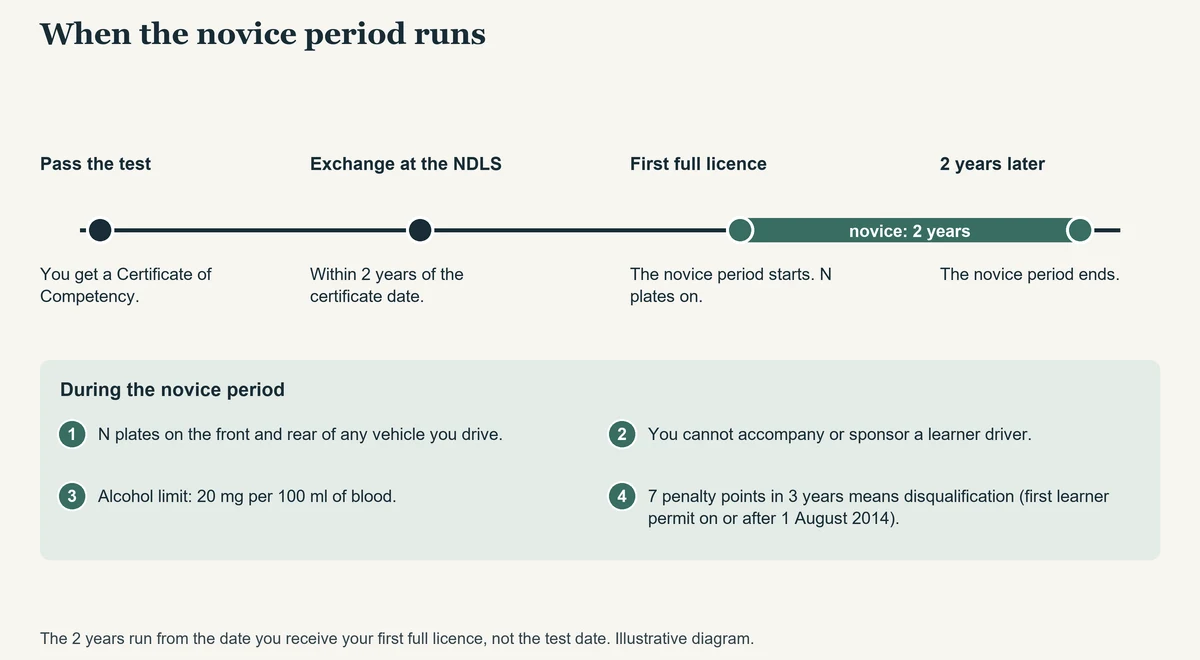
    The 2 years run from the date you receive your first full licence, not from the test date. Passing gives you a Certificate of Competency. You exchange it at the NDLS for a full licence, and you must do this within 2 years of the certificate date. See after you pass in Ireland.

    Timeline from passing the test and getting a Certificate of Competency, to exchanging it at the NDLS, to the first full licence date when the 2 year novice period starts, with the main novice rules listed below.
    The 2 year novice period starts on the date of your first full licence, not the test date. Illustrative diagram.

    Learner vs novice: what changes

    Rule Learner (L plates) Novice (N plates)
    Accompanying driver needed Yes, always No
    Motorways Not allowed Allowed
    Can accompany a learner No No, for 2 years in that category
    Alcohol limit 20 mg/100 ml blood 20 mg/100 ml blood
    Penalty points before a ban 7 7
    Plates L front and rear N front and rear

    For your first motorway drives, see motorways and tunnels for new drivers.

    What is the fine for not displaying N plates?

    Payment Amount
    Within 28 days €120 and 2 points
    In the next 28 days €180 and 2 points
    Convicted in court 4 points and a fine set by the court

    Road traffic fixed charges doubled from 27 October 2022, which is why some older sources still quote €60. These points count towards the 7 point threshold below. See penalty points in Ireland.

    The 7 point threshold

    Fully licensed drivers are disqualified for 6 months at 12 penalty points in 3 years. For learners and novices whose first learner permit was issued on or after 1 August 2014, the threshold is 7. At 2 points each, a few N plate offences alone can bring you close to a ban.

    Drink driving as a novice

    The limit is 20 mg of alcohol per 100 ml of blood. A novice found between 20 mg and 80 mg can face a 3-month disqualification and a €200 fine. In practice, the RSA’s advice is never to drink and drive. See drink-driving limits for learners and novices.

    Does the novice period start again for a new category?

    No. The novice period applies only once. If you get a full licence for another category during your first 2 years, you must display N plates on that vehicle too. If you get a new category after the 2 years are up, you are not a novice for it.

    Common questions

    How long do you have N plates in Ireland?

    Two years from the date you receive your first full driving licence.

    Can I drive on the motorway with N plates?

    Yes. The motorway ban applies to learner permit holders, not novices.

    Do I need N plates when driving someone else’s car?

    Yes. The plates must be displayed on any vehicle you drive during your novice period.

    Can I supervise my younger brother on his L plates?

    Not until you have held a full licence in that category for 2 continuous years.

    I held a full licence abroad. Am I a novice in Ireland?

    The rule applies to first-time holders of a full licence. If you exchanged a foreign licence, check your status with the RSA.

    Back to learning to drive in Ireland: the full guide. See also who can accompany a learner.

    Sources

    • Road Safety Authority, “Novice plates or N-plates” (rsa.ie)
    • Road Safety Authority, “Driving offences incurring penalty points” (rsa.ie)
    • Road Safety Authority, “The penalty points system in Ireland” (rsa.ie)
    • Road Safety Authority, “After you pass your RSA driving test” (rsa.ie)
    • Irish Statute Book, “Road Traffic Act 2014” (irishstatutebook.ie)
    • Road Safety Authority, “Rules of the Road” (Revision 5, hosted on garda.ie)
  • EDT Lesson by Lesson: What Each of the 12 Irish Lessons Covers

    EDT Lesson by Lesson: What Each of the 12 Irish Lessons Covers

    Photo: Anna Lupa / Pexels. Illustrative photograph.

    This is a lesson-by-lesson map of Ireland’s 12 Essential Driver Training (EDT) lessons for car learners. For each lesson it gives the RSA title, what the lesson focuses on, and which parts of the Rules of the Road to practise with your sponsor afterwards. Your ADI works from the RSA’s EDT syllabus, which sets out the expected outcomes for every lesson.

    The order rule

    • Lesson 1 first.
    • Lessons 2 to 8 in any order.
    • Lessons 9 to 12 in any order, after 2 to 8 are complete.
    • The RSA recommends about 2 weeks between lessons.

    Lessons 1 to 4: the foundations

    Lesson 1: Car controls and safety checks

    Covers the primary and secondary controls, vehicle safety and roadworthiness. Your ADI makes sure you can carry out pre-start checks. Practise starting and stopping beforehand if you can.

    Practise after: checking tyres, lights, mirrors and fluids, and using the wipers, demisters, rear window heater and lights. These come up in the test’s technical checks. See vehicle safety checks.

    Lesson 2: Correct positioning 1

    Keeping the car in the right place on the road in normal conditions.

    Practise after: road position, moving off and changing lanes. See good driving practice in Ireland.

    Lesson 3: Changing direction 1

    Turning at junctions and changing direction safely.

    Practise after: mirror, signal, position at simple junctions. See junctions in Ireland.

    Lesson 4: Progression management

    Speed management. The official outcomes cover controlling your speed smoothly, keeping to the limit, choosing a lower speed when conditions need it, how weather, road surface and load change stopping distances, and the dangers of speeding and harsh braking. On the test, making steady progress without undue hesitancy is also assessed.

    Practise after: smooth speed control, checking stopping distances in different conditions and moving off without hesitation.

    Lessons 5 to 8: more traffic, more hazards

    Lesson 5: Correct positioning 2 (more complex situations)

    Builds on lesson 2 in busier conditions, including traffic lanes and stopping in traffic. The aim is to keep a safe position consistently while keeping a safe braking distance.

    Practise after: lane discipline on multi-lane roads and the two second rule.

    Lesson 6: Anticipation and reaction

    Scanning for hazards and responding in good time, with the right speed and gear, a safe gap and correct braking. Expect varied roads: junctions, streets with parked cars, busy pedestrian areas, roads with many warning signs, and roads with poor visibility.

    Practise after: commentary driving, saying aloud the hazards you see. See hazard perception for Irish learners.

    Lesson 7: Sharing the road

    Driving around pedestrians, cyclists, motorcyclists and other road users.

    Practise after: giving cyclists room and approaching crossings.

    Lesson 8: Driving safely through traffic

    Handling heavier traffic in towns and on busier roads.

    Practise after: busier routes at quieter times first, then build up.

    Lessons 9 to 12: complex driving

    Lesson 9: Changing direction 2 (more complex situations)

    Changing direction in more complex situations than lesson 3.

    Practise after: multi-lane roundabouts and yellow box junctions.

    Lesson 10: Speed management

    Choosing a safe speed for the road and conditions, within the limit.

    Practise after: spotting speed limit changes on rural and urban roads.

    Lesson 11: Driving calmly

    Staying calm and avoiding aggressive driving.

    Practise after: the Rules of the Road section on tiredness and road rage.

    Lesson 12: Night driving

    Driving in darkness.

    Practise after: dipping headlights and judging speed and distance at night. The RSA also advises practising at night before your test.

    Which lessons are in reduced EDT?

    Lessons 1, 5, 6, 7, 9 and 10. Reduced EDT is only for eligible holders of a foreign licence. See EDT and reduced EDT.

    Common questions

    Can I take lesson 12 before lesson 5?

    No. Lessons 9 to 12 come after lessons 2 to 8 are complete.

    What if I am not ready for the next lesson?

    Take extra non-EDT lessons or more practice with your sponsor. The RSA expects you to take whatever extra lessons you need.

    Where are the full lesson outcomes?

    In the RSA’s EDT syllabus and learner information booklet, both on rsa.ie. Your ADI works from them.

    Does lesson 12 have to happen in the dark?

    The lesson is titled night driving. Talk to your ADI about booking it at a suitable time of year and day.

    Are motorways part of EDT?

    No. Learner permit holders must not drive on motorways.

    Back to learning to drive in Ireland: the full guide.

    Sources

    • Road Safety Authority, “Car driving lessons (EDT)” (rsa.ie)
    • Road Safety Authority, “Reduced Essential Driver Training information booklet” (rsa.ie)
    • Road Safety Authority, “Essential Driver Training (EDT) Learner Logbook” (rsa.ie)
    • Road Safety Authority, “Learner Driver Training Syllabus Category B: Car and Light Van” (rsa.ie)
    • Road Safety Authority, “FAQs for car learner drivers” (rsa.ie)
    • Road Safety Authority, “Preparing for your test” (rsa.ie)
    • Road Safety Authority, “Rules of the Road” (Revision 5, hosted on garda.ie)