Author: Get Driving Test Ready

  • Booking the Irish Driving Test: MyRoadSafety, Fees, Cancellations

    Booking the Irish Driving Test: MyRoadSafety, Fees, Cancellations

    Photo: Yan Krukau / Pexels. Illustrative photograph.

    You book the Irish driving test online through MyRoadSafety, the RSA’s customer portal. First you apply and pay, then you wait for an invitation to pick a date. This guide covers who can apply, the steps, the €85 fee, the reschedule and cancellation rules that cost people their fee, and how waiting times work, as of November 2026.

    Key facts

    • Apply on MyRoadSafety with a verified MyGovID, or by registering your details with the RSA. A postal application form also exists.
    • Test fee: €85 (check the current fee on rsa.ie before paying).
    • You need your driver number: field 4(d) on your learner permit.
    • Tests cannot be booked by phone or email.
    • Reschedule or cancel more than 10 days before the test. Inside 10 days, or on a third reschedule, you lose the fee.
    • You cannot reschedule within 2 days of the appointment.

    Can I apply for the driving test yet?

    To sit a category B test you must:

    Applying early puts you on the list sooner, but only accept a date you will be ready for.

    How to book the driving test in Ireland, step by step

    1. Log in to MyRoadSafety. Use a verified MyGovID (this needs a Public Services Card) or register your details with the RSA.
    2. Apply for a driving test. Choose the category and your preferred test centre, and enter your driver number from 4(d) on your learner permit.
    3. Add special accommodation if you need it. Select “Add special accommodation” to tell the RSA about any needs.
    4. Pay the fee. €85 by card.
    5. Wait for your invitation. When dates open at your centre, the RSA invites you to book an appointment. If your centre has no dates, you can join the waiting list or check availability at other centres.
    6. Book your slot from the invitation and read the appointment notice. It lists everything you must bring and the vehicle rules for the day.

    Reschedule and cancellation rules

    Situation What happens to your fee
    Reschedule more than 10 days before the test (1st or 2nd time) Kept
    Reschedule a 3rd time Lost. You pay for a new test
    Reschedule or cancel within 10 days of the test Lost
    Within 2 days of the test Rescheduling is not possible
    You do not attend Lost

    Changes are made in MyRoadSafety under “My bookings”. The RSA may refund at its discretion in some cases, for example if you are emigrating. Ask before assuming.

    Ways to lose your fee on the day

    The Rules of the Road says the test is cancelled and you lose the fee if:

    • you are late (be at the centre at least 10 minutes early)
    • the car does not show the correct discs or L plates
    • the car is not roadworthy
    • you do not have the correct vehicle for the test category

    Since 9 March 2026 you must also show a valid certificate of motor insurance for the test car. See the Irish driving test explained.

    How long are driving test waiting times in Ireland?

    They vary a lot between centres and change month to month. The RSA publishes current waiting times for each test centre on rsa.ie. Before you apply:

    • compare the centres you could reach
    • remember you must bring a suitable car to whichever centre you choose, at least 10 minutes early
    • plan EDT so you finish it before your likely invitation

    Common questions

    Can my instructor book the test for me?

    The application is made through your own MyRoadSafety account, using your driver number. Your instructor can help you through it.

    Can I change test centre after applying?

    The RSA lets you view availability at other centres when yours has no dates. Check MyRoadSafety for the current option to move.

    Do I need to have finished EDT before applying?

    You must have completed EDT before you sit the test. Many learners apply while they are still doing lessons so they are on the list sooner.

    What if I am sick on the day?

    Inside 10 days you normally lose the fee. Contact the RSA through MyRoadSafety, since refunds are at its discretion.

    How much is a retest?

    Each new application costs the test fee again, €85 as of November 2026.

    Can I book by phone?

    No. Tests cannot be scheduled over the phone or by email.

    Back to learning to drive in Ireland. Related: common reasons for failing, pre-test checks.

    Sources

    • Road Safety Authority, “How to apply” for the driving test (rsa.ie)
    • Road Safety Authority, “Driving test terms and conditions” (rsa.ie)
    • Road Safety Authority, Help and support, “How do I apply for a driving test and add myself to the waiting list” (rsa.ie)
    • Road Safety Authority, Help and support, “I need to cancel my test” (rsa.ie)
    • Road Safety Authority, “Driving test centres” (rsa.ie)
    • Road Safety Authority, “Rules of the Road”, Section 3 The driving test (Revision 5, hosted on garda.ie)
  • Common Reasons for Failing the Irish Driving Test

    Common Reasons for Failing the Irish Driving Test

    Photo: Harry Tucker / Pexels. Illustrative photograph.

    Most people who fail the Irish driving test fail on observation: not looking properly when moving off, at junctions, at roundabouts and when changing lanes. The RSA also names poor anticipation, road position, progress, and mirror and signal use. This guide takes each one and shows what the tester sees and how to fix it before your test.

    Key facts

    • The RSA lists inadequate observation (moving off, junctions, roundabouts, changing lanes) as the most common reason candidates are unsuccessful.
    • One Grade 3 (dangerous or potentially dangerous) fault is enough to fail.
    • Repeated Grade 2 faults on the same item also fail you. See Irish driving test marking.
    • If you fail, you get a detailed report of your faults by email. Go through it with your ADI.

    What the RSA tester assesses

    The Rules of the Road lists the headings your drive is judged under:

    • positioning the vehicle correctly and in good time
    • taking proper observation
    • reacting promptly and properly to hazards
    • using mirrors properly, in good time and before signalling
    • allowing enough clearance to pedestrians, cyclists and other traffic
    • giving correct signals in good time
    • keeping reasonable progress and avoiding undue hesitancy
    • using the vehicle controls properly
    • adjusting speed
    • obeying traffic lights, signs and road markings
    • yielding right of way
    • reversing, turnabout and parking

    The most common reasons for failing, and how to fix each one

    Reason What the tester sees The fix
    Observation moving off Pulling out after a mirror check only, missing the blind spot Mirrors, signal if needed, then look over your right shoulder every time you move off from the kerb
    Observation at junctions Emerging without looking both ways properly, or looking but not seeing a cyclist Slow early, look right, left and right again, and keep looking as you emerge. Creep forward where the view is blocked
    Observation at roundabouts Entering with traffic approaching from the right, or not checking mirrors before changing lane or exiting Yield to traffic from the right, check the left mirror before your exit
    Observation changing lanes Moving across with no blind spot check Mirror, signal, quick sideways glance, then move only if the lane is clear
    Anticipation Late reaction to a car pulling out, a bus moving off or a pedestrian stepping out Scan well ahead, cover the brake near hazards, ask “what could happen next?”
    Road position Too close to the centre line, drifting, or cutting corners turning right Keep left, far enough out to stay off any cycle lane. Approach right turns just left of the centre
    Progress Waiting at a junction or roundabout when it was safe to go, or driving well under the limit Go when the gap is safe. Undue hesitancy is marked as a fault, the same as rushing
    Mirrors Signalling or braking before checking the mirror Mirror before you signal, change speed or change direction
    Signals Late, missing, misleading or left flashing Signal in good time, cancel after the turn, and do not signal too early for a turn past a side road

    Faults that end up as Grade 3

    A fault is graded as dangerous or potentially dangerous when it puts you or another road user at risk. Faults that often lead to this:

    • emerging so another driver has to brake or swerve
    • failing to yield at a Stop or Yield sign
    • going through a red light or crossing a continuous white line
    • passing a cyclist too closely

    A practice plan for the last month

    1. Ask your ADI for a mock test using the RSA headings above.
    2. Practise moving off again and again in one session, saying each check out loud.
    3. Pick a route with busy junctions and roundabouts, and drive it with your sponsor until your observations are automatic.
    4. Practise the manoeuvres until each is controlled and observed. See Irish driving test manoeuvres.
    5. Learn the pre-test checks and hand signals so you do not start the test with faults. See pre-test checks.

    Common questions

    What is the number one reason for failing the driving test in Ireland?

    Inadequate observation, according to the RSA. It covers moving off, junctions, roundabouts and changing lanes.

    Can I fail for driving too slowly?

    Yes. “Maintaining reasonable progress and avoiding undue hesitancy” is an assessed heading, so repeated hesitancy can add up to a fail.

    Can I fail before I start driving?

    The test does not go ahead if the car is wrong, unroadworthy or missing the right discs or L plates. You lose the fee. Wrong answers to the oral questions are also marked.

    Does stalling fail you?

    Not on its own. It becomes a problem if it causes danger, such as stalling while emerging into traffic, or if it keeps happening.

    Can I appeal a fail?

    If you believe the test was not conducted properly or fairly, you can appeal to the District Court. The court can refuse the appeal or, if it finds the test was not properly conducted, direct the RSA to give you a free retest.

    How soon can I resit?

    You can apply again straight away. You keep the same learner permit rules while you wait. See booking the Irish driving test.

    Back to learning to drive in Ireland and the Irish driving test explained. Related: junctions, roundabouts, good driving practice.

    Sources

    • Road Safety Authority, “Repeating your test” (rsa.ie)
    • Road Safety Authority, “Making your mark: marking guidelines for the driving test” (rsa.ie)
    • Road Safety Authority, “Rules of the Road”, Section 3 The driving test, Section 5 Good driving practice and Section 9 Junctions and roundabouts (Revision 5, hosted on garda.ie)
  • Six Month Rule and L Plates in Ireland: What Learners Must Know

    Six Month Rule and L Plates in Ireland: What Learners Must Know

    Photo: Mario Spencer / Pexels. Illustrative photograph.

    In Ireland, if this is your first learner permit for a car, you must have held it for at least 6 months on the day of your driving test. Until you hold a full licence you must also display L plates front and rear and keep off motorways. This guide covers the six month rule, who is exempt, the legal L plate specification and the other learner conditions, as of November 2026.

    Key facts

    • First-time learner permit holders in categories AM, A1, A2, A, B and W cannot sit a driving test until 6 months after the permit start date.
    • The rule is about the test date. You can apply for the test before the 6 months are up.
    • L plates: a red letter L at least 15 cm high on a white background, displayed front and rear.
    • No L plates: €120 fixed charge and 2 penalty points (4 on conviction).
    • Learners must not drive on a motorway, tow a trailer (car, bus or truck permits) or carry passengers for payment.

    What is the six month rule in Ireland?

    The Rules of the Road says a first-time learner permit holder in categories A, A2, A1, B, AM or W is not allowed to take a driving test for 6 months after the start date of the permit. To sit the test you must have held a valid learner permit for at least 6 months on the day of the test. The RSA says the reason is experience: the longer a learner drives under supervision, the less likely they are to crash.

    “First time” means one of these:

    • you have never held a learner permit in that category, or
    • your last learner permit in that category expired 2 years or more ago. From 1 November 2026 a permit like that cannot be renewed: you start again and the new permit counts as a first permit.

    For category B you must also have finished all 12 Essential Driver Training lessons before the test. Six months is a minimum. Most learners need longer to get through EDT and enough practice.

    Who is exempt from the six month rule?

    • Category BE (car and trailer) learners.
    • Motorcyclists moving up a category who have held the lower category (A1 or A2) for at least 2 years.
    • Holders of a current full licence in the same category from another country for more than 6 months. They must send the RSA their original licence and a letter of entitlement from that country’s licensing authority.

    Worked example

    Aoife’s first car learner permit starts on 10 January. The earliest she can sit the test is 10 July. She can apply for the test in January, so she is on the list while she completes EDT. See booking the Irish driving test.

    L plates in Ireland: the legal specification

    The Road Traffic (Licensing of Drivers) Regulations 2006 (as amended in 2007) say a learner driving a category B vehicle must display:

    • rectangular plates or signs bearing the letter “L”
    • the letter not less than 15 centimetres high
    • in red on a white ground
    • in clearly visible vertical positions to the front and rear of the vehicle
    Learner category Where the L goes
    B (car), BE, C, C1, D, D1 and their trailer categories Plates on the front and rear of the vehicle
    AM, A1, A2, A (moped and motorcycle) On a yellow fluorescent tabard worn over your clothes, front and back of your torso, letter at least 15 cm high
    W (work vehicle, tractor) Not required

    Practical points:

    • Do not fix plates where they block your view through the windscreen or rear window.
    • The plates must be clearly visible, so replace faded or curled ones.
    • At the driving test, missing or incorrect L plates mean the test does not go ahead and you lose the fee. See your car for the Irish driving test.

    What happens if a learner drives without L plates?

    Failing to display an L plate or tabard is a fixed charge offence: €120 and 2 penalty points if you pay, or 4 points if convicted in court (as of November 2026). Learners are banned at 7 points, so this matters. See penalty points in Ireland.

    Other conditions every Irish learner must follow

    Condition What it means for a car learner
    Accompanied at all times By someone who has held a full licence in the same category for 2 continuous years. See accompanying a learner driver.
    L plates Front and rear, as above
    No motorways Driving on a motorway on a learner permit is an offence. See motorways and tunnels in Ireland.
    No trailers Category B, C, C1, D and D1 learners must not tow
    No paid passengers You must not carry any passenger for payment or reward
    Carry your permit Have your learner permit with you whenever you drive
    Alcohol The lower 20 mg limit applies to learners

    Common questions

    Does the six month rule start from the theory test or the permit?

    From the start date of your first learner permit. The theory test date does not count.

    Can I book my test before the 6 months are up?

    You can apply. The test itself must fall on or after the date you have held the permit for 6 months.

    Does the six month rule apply to my second learner permit?

    No. It applies only to a first-time learner permit in the category. An ordinary renewal does not restart the 6 months. If your previous permit in that category expired 2 years or more ago, you must start again under the rules from 1 November 2026, the new permit counts as a first permit and the 6 months apply again.

    Do I have to take the L plates off when my parent drives the car?

    The law sets out what a learner must display. It does not require a full licence holder to remove them. Taking them off when you are not driving avoids confusing other drivers.

    Can I use magnetic L plates?

    Yes, if they meet the specification and stay clearly visible front and rear. Check them before every drive, because they can fall off.

    Can a learner drive on a dual carriageway?

    The ban is on motorways. Dual carriageways are not motorways, but take them only when you and your accompanying driver are confident.

    Back to learning to drive in Ireland. Next: learner permit rules from November 2026.

    Sources

    • Road Safety Authority, “Rules of the Road”, Section 1 Six month rule, Section 2 The learner driver and Section 3 The driving test (Revision 5, hosted on garda.ie)
    • Irish Statute Book, “S.I. No. 537/2006, Road Traffic (Licensing of Drivers) Regulations 2006” (irishstatutebook.ie)
    • Irish Statute Book, “S.I. No. 719/2007, Road Traffic (Licensing of Learner Drivers) Regulations 2007” (irishstatutebook.ie)
    • Irish Statute Book, “S.I. No. 227/2024, Road Traffic Act 2010 (Part 3) (Fixed Charge Offences) Regulations 2024” (irishstatutebook.ie)
    • Law Reform Commission, “Road Traffic Act 2002”, First Schedule, revised (revisedacts.lawreform.ie)
    • Road Safety Authority, “Learner permit” (rsa.ie)
    • National Driver Licence Service, “Frequently Asked Questions”, learner permit questions (ndls.ie)
  • Irish Theory Test Topics: What the Question Bank Covers

    Irish Theory Test Topics: What the Question Bank Covers

    Photo: Julio Lopez / Pexels. Illustrative photograph.

    The Irish Driver Theory Test for cars (category BW) draws 40 questions at random from the official RSA question bank, and you need 35 correct to pass. The RSA says the test covers the Rules of the Road, risk perception, eco-driving, hazard awareness and safe driving behaviour. This guide explains how the question bank is organised, which Rules of the Road topics to revise, and where each one is covered on this site.

    Key facts

    • Car and bike tests (BW and AM): 40 questions, 35 to pass, 45 minutes. Fee €45 as of November 2026.
    • The BW test covers cars, work vehicles and land tractors (licence categories B, BE and W).
    • Questions are chosen at random from the question bank for the relevant test sections.
    • The official question bank is published as “The Official Driver Theory Test Questions and Answers”, May 2024 edition, and in the official learning app.
    • After the test your score report shows which category areas you got right or wrong.

    For booking, ID, the minimum age of 15 and results, see the Irish driver theory test.

    What does the Irish theory test cover?

    The RSA lists five areas:

    Area What it means in practice
    Rules of the Road Signs, markings, right of way, speed limits, motorways, parking, licensing law, penalties
    Risk perception Spotting what could go wrong before it happens: children near parked cars, cyclists, bends, junctions
    Eco-driving Driving smoothly and efficiently to cut fuel use and emissions
    Hazard awareness Weather, night driving, tiredness, alcohol and drugs, vehicle defects
    Safe driving behaviour Attitude, sharing the road with vulnerable users, distraction, following distance

    The official question book and app group questions into sections, and the app lets you practise by section or category. The exact section names are in the official materials, which are sold by Prometric on behalf of the RSA. Theorytest.ie warns that unofficial apps and sites do not contain the official questions.

    Rules of the Road topics to revise

    The Rules of the Road is the RSA’s handbook for all road users. Use it alongside the official questions. Each topic below links to a guide.

    Licensing and the law

    The vehicle

    Signs, signals and markings

    Driving on the road

    Hazards, risk and behaviour

    Other road users

    Numbers worth memorising

    Questions often turn on a figure. These come from the Rules of the Road and current law:

    Fact Figure
    Motorway / national / regional / rural local road default limit 120 / 100 / 80 / 60 km/h
    Speed limit when towing 80 km/h
    Minimum gap in traffic 2 seconds (double it in the wet)
    Total stopping distance at 100 km/h, dry (RSA minimum) 70 metres
    Gap in a tunnel for a car 50 metres
    Alcohol limit, learner and novice 20 mg per 100 ml blood
    Penalty points ban, learner and novice 7 points in 3 years
    Penalty points ban, full licence 12 points in 3 years
    Accompanying driver Full licence in the same category for 2 years

    How to revise with the question bank

    1. Get the official materials (book, app or online portal) from theorytest.ie. Questions were updated in May 2024, so older copies are out of date.
    2. Work through one section at a time and read the explanation for every wrong answer.
    3. For any topic you keep getting wrong, read that part of the Rules of the Road or the guide linked above.
    4. Take full sample tests under time: 40 questions in 45 minutes.
    5. If you fail, use the score report to see which areas to work on before rebooking.

    Common questions

    Are the real theory test questions published in Ireland?

    The official question bank is published in the RSA’s official book and app, sold through theorytest.ie. The test picks 40 at random.

    Is the Rules of the Road enough to pass?

    Theorytest.ie recommends using the official revision material to prepare, with the Rules of the Road as an additional resource.

    Is there a hazard perception clip test in Ireland?

    No separate clip test. Risk perception and hazard awareness are tested through the multiple-choice questions. See hazard perception for Irish learners.

    Do the questions change?

    Yes. The bank was last updated with the May 2024 edition. Theorytest.ie says the number of questions in the test did not change.

    Can I see which questions I got wrong?

    No. You get a score report by category area, not by question, because those exact questions are unlikely to appear again.

    Related: the Irish driver theory test, Essential Driver Training (EDT), the Irish driving test explained. Back to learning to drive in Ireland.

    Sources

    • Prometric Ireland for the RSA, “Frequently Asked Questions (FAQs)” (theorytest.ie)
    • Prometric Ireland for the RSA, “Official Driver Theory Test Revision Material” (theorytest.ie)
    • Prometric Ireland for the RSA, “Book your Theory Test: Car or Bike” and “Learning App” (theorytest.ie)
    • Road Safety Authority, “About the driver theory test” (rsa.ie, search-result text only)
    • Road Safety Authority, “Rules of the Road”, Sections 8, 11 and 15 (Revision 5, hosted on garda.ie)
    • Law Reform Commission, “Road Traffic Act 2010”, section 4, revised (revisedacts.lawreform.ie)
    • Department of Transport, “Speed limits on rural and local roads change from 80km/h to 60km/h” (gov.ie)
  • Sharing the Road With Cyclists in Ireland: Passing Distances

    Sharing the Road With Cyclists in Ireland: Passing Distances

    Photo: Jonathan Borba / Pexels. Illustrative photograph.

    When you pass a cyclist in Ireland, the RSA says to leave at least 1 metre where the speed limit is 50 km/h or less, and at least 1.5 metres where it is above 50 km/h. In law, overtaking a cyclist in a way that endangers or inconveniences them is an offence: €120 and 3 penalty points. This guide covers passing distances, cycle tracks, junctions, doors and the rules cyclists themselves must follow.

    Key facts

    • RSA passing guidance: at least 1 m at 50 km/h or under, at least 1.5 m above 50 km/h.
    • Do not squeeze past if there is oncoming traffic or you cannot see clearly ahead. Wait.
    • Overtaking a cyclist or e-scooter user in prohibited circumstances: €120 and 3 points (5 on conviction), as of November 2026.
    • A cycle track with a continuous white line is mandatory: cars must not drive along it or park in it, and may cross it only to get into or out of a place beside it.
    • Driving on a cycle track: €60 and 1 point. Parking in one: €80.

    How much space should I give a cyclist in Ireland?

    Speed limit Minimum clearance recommended by the RSA
    50 km/h or less 1 metre
    Over 50 km/h 1.5 metres
    Two road views of a car passing a cyclist: at least 1 metre where the speed limit is 50 km/h or less, and at least 1.5 metres where it is over 50 km/h.
    RSA guidance on passing distance for cyclists. Illustrative diagram, not to scale.

    These distances are RSA guidance. The law itself says you must not overtake if it would endanger or inconvenience a cyclist or e-scooter user. Leave extra room:

    • in wet, windy or icy conditions
    • when a cyclist is moving off, as they may wobble until they pick up speed
    • where the road surface is poor, because cyclists may have to swerve round potholes

    Never cut in after passing. If you cannot leave the space, stay back until you can. If your left turn is only a few metres beyond a cyclist, don’t overtake: stay behind and turn once they have passed the junction. More in overtaking rules in Ireland.

    Cycle tracks: mandatory and non-mandatory

    Type How to spot it What drivers may do
    Mandatory cycle track Continuous white line on the right-hand side, with a cycle track sign Do not drive into or across it, except to enter or leave a property or side road. Never park in it.
    Non-mandatory cycle track Broken white line on the right-hand side You may cross it. You may only park in it to load or unload goods, for up to 30 minutes, when there is nowhere else to park. Do not obstruct cyclists, and do not use it for waiting or ordinary parking.
    Two cycle tracks beside a road: one with a continuous white line, which drivers must not drive into or park in, and one with a broken line, which drivers may cross.
    How to tell a mandatory cycle track from a non-mandatory one. Illustrative diagram, not to scale.

    Cycle tracks apply 24 hours a day unless an information plate shows set hours. A cycle track can also be part of a footpath or a separate path. Some are two-way, so check both directions before crossing one at a driveway or junction.

    Where a cycle track has set hours, a vehicle parked there outside those hours must be moved before the next period of operation begins, unless it is loading or unloading goods under the 30 minute exception. Never park in a mandatory cycle track while it is in operation.

    Where to watch for cyclists

    • Turning left: check your left mirror and blind spot for cyclists on your inside. Do not overtake a cyclist just before a left turn: they may be going straight on.
    • Turning right: watch for cyclists coming up the centre of the road, or in a cycle or bus lane on the far side of the road you are crossing.
    • Junctions and roundabouts: cyclists may stay in the left lane of a roundabout while going round. See roundabouts in Ireland.
    • Where cycle tracks end or join the road: cyclists may be coming off the track into your lane.
    • Changing lanes and reversing: check mirrors and blind spots.
    • Opening your door: check mirrors for cyclists and motorcyclists before you open a door, and give them room to pass.

    At junctions with an advanced stop line for cyclists, let cyclists move off ahead of you. See Irish road markings.

    What rules must cyclists follow?

    Knowing the cyclist’s rules helps you predict what they will do. Under the Rules of the Road cyclists must:

    • obey traffic lights, signs and road markings, including at pedestrian and level crossings
    • show a white or yellow front light and a red rear light at night
    • not cycle on footpaths (except a cycle track on a footpath), on motorways, or against the flow on one-way streets unless signs show a contraflow route for cyclists
    • cycle in single file in heavy traffic or when overtaking other traffic, and no more than two abreast, except when overtaking other cyclists or e-moped riders where it is safe
    • use hand signals

    Cyclists, e-scooter and e-moped riders may overtake on the left when traffic to their right is stopped or moving more slowly, but not past a vehicle signalling left that they can expect to turn, or one stopped to let passengers on or off or to load or unload. Expect riders to filter past queues on your left, and check your left mirror again if you have been waiting to turn.

    Penalties for drivers

    Offence Points on payment Points on conviction Fixed charge
    Overtaking a cyclist or e-scooter user in prohibited circumstances 3 5 €120
    Driving on or across a cycle track (other than for access) 1 3 €60
    Parking in a cycle track None listed None listed €80

    Fixed charges as of November 2026. See penalty points in Ireland.

    Common questions

    Is the 1.5 metre passing distance the law in Ireland?

    The 1 m and 1.5 m figures are RSA guidance. The legal offence is overtaking a cyclist when it would endanger or inconvenience them, which carries 3 penalty points.

    Can I cross a solid white line to pass a cyclist?

    The Rules of the Road allows crossing a continuous white line only in an emergency or for access. If you cannot pass safely, wait behind.

    Can I park in a cycle lane to drop someone off?

    Not in a mandatory cycle track. In a non-mandatory track (broken white line) a vehicle may stop only to load or unload goods, for up to 30 minutes. Otherwise, parking in a cycle track carries an €80 fixed charge.

    Why do cyclists ride away from the kerb?

    Often to avoid potholes and a poor road surface, which the Rules of the Road tells drivers to expect. Give them the space the RSA recommends.

    Do I need to watch for e-scooters too?

    Yes. E-scooter users can use cycle tracks, and the overtaking offence covers them. See motorcyclists, e-scooters and other road users.

    Related: junctions in Ireland, bus lanes and Luas, pedestrians and crossings. Back to learning to drive in Ireland.

    Sources

    • Road Safety Authority, “Cyclists campaign” (rsa.ie, search-result text only)
    • Law Reform Commission, “S.I. No. 182/1997, Road Traffic (Traffic and Parking) Regulations 1997”, articles 5, 10, 14 and 47, revised to S.I. No. 473/2025 (revisedacts.lawreform.ie)
    • Road Safety Authority, “Rules of the Road”, Section 17 Rules for cyclists and Section 19 Respecting other road users (Revision 5, hosted on garda.ie)
    • Irish Statute Book, “S.I. No. 222/2024, Road Traffic (Traffic and Parking) (Amendment) Regulations 2024” (irishstatutebook.ie)
    • Irish Statute Book, “S.I. No. 227/2024, Road Traffic Act 2010 (Part 3) (Fixed Charge Offences) Regulations 2024” (irishstatutebook.ie)
    • Law Reform Commission, “Road Traffic Act 2002”, First Schedule, revised (revisedacts.lawreform.ie)
    • Road Safety Authority, “Rules of the Road”, current edition reflecting the law at 1 March 2025, printed pages 210 to 211 (cycle tracks) (rsa.ie)
    • Irish Statute Book, “S.I. No. 274/1998, Road Traffic (Traffic and Parking) (Amendment) Regulations 1998”, article 5 (loading in a cycle track) (irishstatutebook.ie)
  • Penalty Points in Ireland: Offence List, Fixed Charges and Bans

    Penalty Points in Ireland: Offence List, Fixed Charges and Bans

    Photo: Michael Arlotto / Pexels. Illustrative photograph.

    In Ireland, penalty points stay on your licence record for 3 years. Reach 12 points in that time and you are banned from driving for 6 months. For learner and novice drivers whose first learner permit was issued on or after 1 August 2014, the ban comes at 7 points. This guide lists the offences, points and fixed charges as of November 2026, explains how the fixed charge system works, and covers court-only offences.

    Key facts

    • Full licence: 12 points in 3 years = 6-month ban.
    • Learner or novice (first permit from 1 August 2014): 7 points in 3 years = 6-month ban.
    • Most offences carry fewer points if you pay the fixed charge than if you are convicted in court.
    • Fixed charges run from €40 to €200. Speeding is €160 and 3 points.
    • Drink driving does not carry points. It means a disqualification.

    How many penalty points before a ban in Ireland?

    Driver Points that trigger a ban Ban
    Full licence holder 12 or more within 3 years 6 months
    Learner permit holder 7 or more within 3 years 6 months
    Novice (first 2 years after the first full licence) 7 or more within 3 years 6 months

    When the ban starts you get a notice with the date, and you must send your licence or permit to the NDLS within 14 days. Not surrendering it, and driving while banned, are both offences. When the ban ends, the points that caused it are removed from your record.

    The learner threshold is reached quickly. Two speeding offences (3 points each) plus one L plate offence (2 points) make 8 points, which means a ban. See the six month rule and L plates.

    How the fixed charge system works

    1. You get a fixed charge notice by post.
    2. Pay within 28 days at the standard amount.
    3. If you miss that, you have a further 28 days to pay 50% more.
    4. If you still do not pay, you get a court summons. You can still pay double the standard amount up to 7 days before the court date.
    5. Penalty points go on your record 28 days after the notification that follows payment, or after a conviction.

    If a camera records your car, the registered owner gets the notice. If someone else was driving, the owner must give the driver’s name and address within 28 days, or is treated as the driver.

    Fixed charge amounts (as of November 2026)

    Fixed charge Examples
    €200 Misusing a disabled person’s parking bay with a permit that is not for that person; overweight vehicles
    €160 Speeding; driving too fast for the conditions; learner driving unaccompanied; not stopping for a school warden
    €150 Parking in a disabled bay without a permit
    €120 Holding a phone; seat belt and child seat offences; no L plates; no N plates; overtaking a cyclist dangerously
    €80 Red lights, Stop and Yield signs, white lines, hatched areas, dangerous overtaking, worn tyres, dangerous parking, parking in a bus lane or cycle track
    €60 No NCT, junction rules, lane markings, yellow box, U-turns, bus lane driving, signals
    €40 Most parking offences, stopping or parking on a motorway

    Penalty points offences for car drivers

    Speed, phones, belts and plates

    Offence Points on payment Points on conviction Fixed charge
    Exceeding a speed limit 3 5 €160
    Driving too fast to stop within the distance you can see is clear 3 5 €160
    Holding a mobile phone while driving 3 5 €120
    Driver not wearing a seat belt 3 5 €120
    Allowing a passenger under 17 without a belt or child restraint 3 5 €120
    Child not in an appropriate child restraint 3 5 €120
    Rear-facing child seat in front of an active airbag 3 5 €120
    Learner driving unaccompanied 2 4 €160
    Learner not displaying L plates 2 4 €120
    Novice not displaying N plates 2 4 €120

    Junctions, signs, lights and lines

    Offence Points on payment Points on conviction Fixed charge
    Failing to obey traffic lights 3 5 €80
    Failing to obey lights at a level crossing or swing bridge 2 5 €80
    Failing to stop at a Stop sign or stop line 3 5 €80
    Failing to yield at a Yield sign or yield line 3 5 €80
    Failing to yield right of way 2 4 €80
    Crossing a continuous white line 3 5 €80
    Entering a hatched area 1 3 €80
    Failing to obey traffic lane markings 1 3 €60
    Junction rules 1 3 €60
    Not turning left onto a roundabout 1 3 €60
    Mini-roundabout rules 1 3 €60
    Failing to obey mandatory signs (keep left, turn left and so on) 2 4 €60
    Failing to obey prohibitory signs (no right turn and so on) 1 3 €60
    Passing a no entry sign or no entry line 1 3 €60
    Ignoring a Garda’s signal 1 3 €80

    Road position, overtaking and manoeuvres

    Offence Points on payment Points on conviction Fixed charge
    Overtaking in prohibited circumstances 3 5 €80
    Overtaking a cyclist or e-scooter user in prohibited circumstances 3 5 €120
    Failing to drive on the left 2 4 €60
    Driving along or across a median strip 2 4 €60
    Breaking a U-turn ban 2 4 €60
    Reversing rules 1 3 €60
    Driving on a footpath 1 3 €60
    Driving on a cycle track 1 3 €60
    Driving without reasonable consideration 2 4 €80
    Parking in a dangerous position 3 5 €80

    Motorways

    Offence Points on payment Points on conviction Fixed charge
    Driving against the traffic flow 2 4 €80
    Driving on a part that is not the carriageway, such as the hard shoulder 1 3 €80
    Restricted vehicle (for example towing) in the outside lane 1 3 €80

    The car and your documents

    Offence Points on payment Points on conviction Fixed charge
    Using a car without an NCT certificate 3 5 €60
    Defective or worn tyres 2 4 €80
    Not producing a licence to a Garda 1 3 Not found
    Driving without a licence 2 5 Not found
    Failing to stop for a Garda 2 5 €80
    Not stopping for a school warden 2 5 €160
    Inadequate brakes, mirrors, wipers, windscreen or view of the road 1 3 Not found

    “Not found” means no fixed charge for that offence appeared in the 2024 fixed charge regulations. Check with the Gardaí or RSA if you receive a notice.

    Court-only offences

    Some offences have no fixed charge. You go to court, and points are added only on conviction:

    Offence Points on conviction
    Careless driving 5
    Driving without insurance 5
    Breach of duties after a crash 5
    Driving a dangerously defective vehicle 5
    Driving a vehicle before fixing a dangerous defect 3
    Driving when unfit to drive 3

    A court can also ban you for any offence involving a vehicle, and some convictions, such as drink driving, dangerous driving and leaving the scene of a crash, bring a ban regardless of your points. See drink driving limits in Ireland and what to do at the scene of a crash.

    Common questions

    How long do penalty points last in Ireland?

    3 years from the date they are added to your record.

    Do learner drivers get penalty points?

    Yes. The system covers learner permit holders, and their ban threshold is 7 points.

    What happens to my points when I pass my test?

    Points stay on your record for their full 3 years. As a novice your threshold is still 7.

    Can I pay a fixed charge late?

    Yes, in the second 28 days at 50% more. After that, at double the amount up to 7 days before your court date.

    Do I get points for a parking ticket?

    Most parking offences carry a fixed charge only. Parking in a dangerous position carries 3 points on payment.

    Can I get points for driving unaccompanied as a learner?

    Yes: 2 points and €160, or 4 points on conviction. See accompanying a learner driver in Ireland.

    Related: speed limits in Ireland, N plates in Ireland, seat belts and child car seats, tax, insurance and the NCT, parking rules in Ireland. Back to learning to drive in Ireland.

    Sources

    • Law Reform Commission, “Road Traffic Act 2002”, sections 2 and 3 and First Schedule, revised to 31 March 2025 (revisedacts.lawreform.ie)
    • Irish Statute Book, “S.I. No. 227/2024, Road Traffic Act 2010 (Part 3) (Fixed Charge Offences) Regulations 2024” (irishstatutebook.ie)
    • Law Reform Commission, “Road Traffic Act 2010”, Part 3 Fixed charge offences, revised to 1 January 2026 (revisedacts.lawreform.ie)
    • Road Safety Authority, “Rules of the Road”, Section 15 Penalty points, fixed charges and driving bans (Revision 5, hosted on garda.ie)
  • What to Do at the Scene of a Crash in Ireland: Your Legal Duties

    What to Do at the Scene of a Crash in Ireland: Your Legal Duties

    Photo: Roger Brown / Pexels. Illustrative photograph.

    If you are involved in a crash in Ireland you must, by law, stop, stay at the scene for a reasonable time, offer help to anyone injured, and give your details to a Garda or to the other people involved. If someone is injured, the crash must be reported to the Gardaí. This checklist covers your legal duties, what to do if you come across a crash, and the penalties for leaving the scene.

    Key facts

    • The duties apply whenever a vehicle is involved in injury to a person or damage to property in a public place, even if you were not at fault.
    • Injury to anyone other than you: report it to the Gardaí as soon as possible, unless you already gave your details to a Garda at the scene.
    • Where a crash involves a death, or an injury needing medical help at the scene or in hospital, Gardaí must normally breath test the drivers. The exceptions are where the Garda thinks the driver should be arrested, or where the Garda or attending medical staff think a test would harm the driver’s health.
    • Emergency services: 999 or 112.
    • Failing to stop or remain where someone was injured, to escape liability, can mean up to 7 years in prison (10 years if the person dies).

    Your legal duties after a crash: checklist

    1. Stop. If your vehicle is still moving after the collision, you must stop.
    2. Offer help. If anyone is injured or appears to need assistance, you must offer it. Call 999 or 112.
    3. Stay. Keep the vehicle at or near the scene for a reasonable time.
    4. Make the scene safe. Hazard lights on. If vehicles block the road or are a danger, mark the road and move the vehicles as soon as possible, without walking into live traffic.
    5. Give your details to a Garda if asked (see the list below). If no Garda is there, give them on request to the injured person (or whoever is looking after them), or to the owner or person in charge of damaged property. Only if none of them is there can an independent witness ask for them.
    6. Report it. If someone other than you was injured, report the crash to the Gardaí as soon as possible, going to the nearest Garda station if needed. Giving your details to the injured person does not replace this report.

    What details must I give?

    • your name and address
    • the address where the vehicle is kept
    • the name and address of the vehicle’s owner
    • the registration number
    • evidence of insurance, such as the name of your insurer or your insurance disc or certificate

    Damage only: what if no one is hurt?

    Situation What you must do
    A Garda is nearby Report it to the Garda.
    No Garda, but the property owner is there Give your details to the owner or person in charge of the property.
    Neither is available (for example a parked car or a wall) Give all the relevant details at a Garda station as soon as reasonably possible.

    Warning other traffic

    • Use hazard warning lights. Ask other road users to help warn traffic if needed.
    • Place a reflective warning triangle far enough back to give approaching traffic warning, but only if you can do it without walking into danger. Near a bend, warn traffic from both directions.
    • Never place a triangle on a motorway, or anywhere it would be unsafe.
    • Wear a high-visibility vest and use a torch at night. The Rules of the Road advises carrying at least two vests and a torch.
    • Be careful approaching any crashed vehicle: leaking fuel is dangerous.
    • If it is safe, take photos of the scene and the damage.

    On a motorway, follow breaking down on an Irish motorway instead: if it is safe to get out, get behind the barrier, and do not use triangles.

    If you arrive at the scene of a crash

    Do Don’t
    Stay calm and assess the situation Panic
    Park safely out of the way, engine off, handbrake on Get injured yourself
    Switch on hazard and parking lights Stay if enough people are already helping and the scene is under control
    Use a warning triangle if you have one (not on a motorway) Move an injured person unless there is a risk of fire or of the vehicle turning over
    Call 999 or 112 Try to lift a car off someone without help
    Get bystanders to warn traffic from both directions, making sure they can be seen at night Remove an injured motorcyclist’s helmet
    Keep injured people warm with coats or rugs Give an injured person anything to eat or drink
    Make sure you and others are safe Let anyone smoke at or near the scene

    Crashes involving dangerous goods

    If a vehicle carrying fuel, chemicals or acid is involved:

    • keep well clear, and stay where the wind is not blowing from the crash towards you
    • warn other road users
    • when you call for help, describe any hazard labels you can see from a safe distance; do not go closer to read them
    • leave any rescue to the emergency services

    Penalties for breaching your duties

    Situation Maximum penalty
    Breach of duties, property damage only €1,000 fine and/or 3 months in prison
    Breach of duties where a person was injured €2,000 fine and/or 6 months in prison
    Leaving to escape liability, knowing the injured person needed medical help On indictment: €10,000 fine and/or 7 years in prison
    Leaving to escape liability, knowing the person is dead, or knowing they are injured and being reckless as to whether they die, where death results On indictment: €20,000 fine and/or 10 years in prison

    A conviction for breach of the crash duties carries 5 penalty points, unless it is one where the court must make a consequential disqualification order: those cases get the ban, not the points. If you were the driver and failed to stop, offer assistance or stay where someone was injured, the court must ban you for at least 4 years on a first offence under section 106 and at least 6 years for a repeat offence. You will normally also need a certificate of competency (and sometimes fitness) before you can drive again, unless the court accepts a special reason. Separately, learner and novice drivers are banned at 7 points. See penalty points in Ireland.

    Common questions

    Do I have to call the Gardaí after a minor crash in Ireland?

    If no one is hurt and you exchange details with the other driver or owner, you do not have to report it. If anyone other than you is injured, you must report it. If you damage unattended property and cannot find the owner, report it at a Garda station.

    I hit a parked car and no one is around. What do I do?

    Give your details at a Garda station as soon as reasonably possible. Driving off without doing so is an offence.

    Should I move my car after a crash?

    If vehicles are blocking the road or are a danger, mark the road and move them as soon as possible. Taking photos first helps record the scene.

    Will I be breathalysed after a crash?

    Usually yes, if someone died or was injured and needs medical help at the scene or in hospital. Gardaí must breath test the drivers unless the Garda thinks the driver should be arrested, or the Garda or attending medical staff think a test would harm the driver’s health. They can also test drivers after other crashes. See drink driving limits in Ireland.

    Does my accompanying driver have to give details too?

    The legal duties fall on the driver. If the driver is killed or incapacitated, the person in charge of the vehicle must give the information.

    Related: Garda signals and emergency vehicles, tax, insurance and the NCT, motorways and tunnels. Back to learning to drive in Ireland.

    Sources

    • Law Reform Commission, “Road Traffic Act 1961”, section 106 Duties on occurrence of accident, revised (revisedacts.lawreform.ie)
    • Law Reform Commission, “Road Traffic Act 2010”, section 65 (consequential disqualification orders), revised (revisedacts.lawreform.ie)
    • Law Reform Commission, “Road Traffic Act 1961”, section 26 Consequential disqualification orders, revised (revisedacts.lawreform.ie)
    • Law Reform Commission, “Road Traffic Act 2010”, section 9 Preliminary testing, revised (revisedacts.lawreform.ie)
    • Law Reform Commission, “Road Traffic Act 2002”, First Schedule, revised (revisedacts.lawreform.ie)
    • Road Safety Authority, “Rules of the Road”, Section 14 Correct behaviour at the scene of an accident (Revision 5, hosted on garda.ie)
  • Drink Driving Limits in Ireland: Learner, Novice and Full Licence

    Drink Driving Limits in Ireland: Learner, Novice and Full Licence

    Photo: Oleksandr Kobuta / Pexels. Illustrative photograph.

    The drink driving limit in Ireland is 20 mg of alcohol per 100 ml of blood for learner, novice and professional drivers, and 50 mg for other drivers. For a learner or novice, the lower limit can be reached with very little alcohol, and being caught means at least a 3-month driving ban. This guide sets out the limits, the bans, drug driving rules and what happens if you are stopped.

    Key facts

    • Learner, novice (first 2 years of a first licence) and professional drivers: 20 mg per 100 ml blood (9 microgrammes per 100 ml of breath).
    • All other drivers: 50 mg per 100 ml blood (22 microgrammes per 100 ml of breath).
    • Learner or novice over 20 mg but not over 80 mg: €200 fixed penalty and a 3-month ban.
    • Drink driving is not dealt with by penalty points. It means a disqualification.
    • Refusing to give a breath, blood or urine sample at a Garda station: minimum 4-year ban for a first offence.

    What is the drink driving limit in Ireland?

    Measure Learner, novice and professional drivers Other drivers
    Blood (per 100 ml) 20 mg 50 mg
    Urine (per 100 ml) 27 mg 67 mg
    Breath (per 100 ml) 9 microgrammes 22 microgrammes

    The law calls the lower-limit group “specified persons”. It covers:

    • learner permit holders
    • drivers within 2 years of getting their first full licence for that category (novices)
    • drivers of trucks, buses and similar vehicles (categories C, C1, D, D1, EB, EC, EC1, ED, ED1, W) while driving those vehicles
    • taxi and other small public service vehicle drivers while working
    • anyone without a licence for the vehicle they are driving

    There is no reliable way to know how many drinks put you over 20 mg. The Rules of the Road’s only advice is never to drink and drive.

    What happens if a learner or novice is over the limit?

    Blood alcohol Outcome for a learner or novice
    Over 20 mg, not over 80 mg Fixed penalty notice: €200 and a 3-month disqualification (if eligible, see below)
    Over 80 mg Court. Disqualification of at least 1 year (first offence) and a fine

    What happens to other drivers?

    Blood alcohol Fixed penalty route If it goes to court (first offence / second or later)
    Over 50 mg, not over 80 mg €200 and a 3-month ban At least 6 months / 1 year
    Over 80 mg, not over 100 mg €400 and a 6-month ban At least 1 year / 2 years
    Over 100 mg, not over 150 mg Court only At least 2 years / 4 years
    Over 150 mg Court only At least 3 years / 6 years

    The fixed penalty route is not available if you were already disqualified or had no licence at the time, or if you used a drink driving fixed penalty in the previous 3 years. Then the case goes to court. Figures are from the Road Traffic Act 2010 as revised to 1 January 2026.

    Drug driving in Ireland

    It is an offence to drive under the influence of any intoxicant, including prescribed and over-the-counter medicines, to the point where you cannot properly control the vehicle. Separately, it is an offence to drive with any of these drugs in your blood at or above these levels, whether or not you seem impaired:

    Drug Level in whole blood
    Cannabis (THC) 1 ng/ml
    Cannabis (THC-COOH) 5 ng/ml
    Cocaine 10 ng/ml
    Cocaine (benzoylecgonine) 50 ng/ml
    Heroin (6-acetylmorphine) 5 ng/ml

    A person with a valid medical exemption certificate for a prescribed cannabis medicine is exempt from the cannabis levels, but not from the impairment offence. Gardaí can take a mouth swab (oral fluid) test at the roadside or at a checkpoint, and can ask you to do impairment tests such as walk and turn or one leg stand. Refusing is an offence. If a medicine might make you drowsy, check with your doctor or pharmacist before driving.

    Being stopped by the Gardaí

    • Gardaí can breath test any driver at a checkpoint without needing a reason.
    • Drivers involved in a crash where someone is injured must be tested.
    • Fail the roadside test and you will be arrested and asked for an evidential breath, blood or urine sample at a Garda station.
    • Refusing to give that sample means a ban of at least 4 years for a first offence and 6 years for a second.

    The morning after

    The limit applies to the alcohol in your body when you drive, so you can still be over the limit the next morning. The law also covers alcohol that will push you over the limit within 3 hours of driving. As a learner or novice on a 20 mg limit, the safest choice is no alcohol at all before driving.

    What a ban means for a learner or novice

    • You cannot drive at all for the ban period, including with an accompanying driver.
    • Driving while disqualified is a separate offence.

    Common questions

    Can a learner driver have one drink in Ireland?

    The 20 mg limit is low enough that even one drink could put you over. There is no safe amount to rely on, so the only safe choice is none.

    Do you get penalty points for drink driving in Ireland?

    No. Every drink driving outcome is a disqualification, from 3 months on a fixed penalty up to 6 years or more in court.

    How long am I a “novice” for the alcohol limit?

    For 2 years from the date your first full licence for that category was issued.

    Can I drive after taking prescribed medicine?

    Only if it does not impair your driving. Check the label and ask your pharmacist or doctor.

    Related: tiredness, drugs and road rage, N plates in Ireland, penalty points in Ireland, what to do at the scene of a crash. Back to learning to drive in Ireland.

    Sources

    • Law Reform Commission, “Road Traffic Act 2010”, sections 3, 4, 12 and 29, revised to 1 January 2026 (revisedacts.lawreform.ie)
    • Law Reform Commission, “Road Traffic Act 2010”, section 65 (consequential disqualification orders), revised (revisedacts.lawreform.ie)
    • Irish Statute Book, “Road Traffic Act 2024”, Part 4 Intoxicated driving offences (irishstatutebook.ie)
    • Road Safety Authority, “Rules of the Road”, Section 13 Factors that affect safe driving (Revision 5, hosted on garda.ie)
  • Roundabouts in Ireland: Lanes, Signals and Exits

    Roundabouts in Ireland: Lanes, Signals and Exits

    Photo: Ollie Craig / Pexels. Illustrative photograph.

    On roundabouts in Ireland you go left (clockwise) and yield to traffic coming from your right. Use the RSA’s clock rule to pick your lane: exits from 6 to 12 o’clock usually mean the left lane, exits after 12 o’clock usually mean the right lane. Signal left after you pass the exit before yours. This guide covers lanes, signals, cyclists and the mistakes learners make most.

    Key facts

    • Yield to traffic coming from your right or already on the roundabout, and obey any lights on your approach. Keep moving if your way is clear.
    • Road markings and signs override the clock rule. Follow the arrows if there are any.
    • Signal left once you pass the exit before the one you want.
    • Going the wrong way round (not turning left onto the roundabout): €60 and 1 penalty point (3 on conviction), as of November 2026.

    Which lane do I use on a roundabout in Ireland?

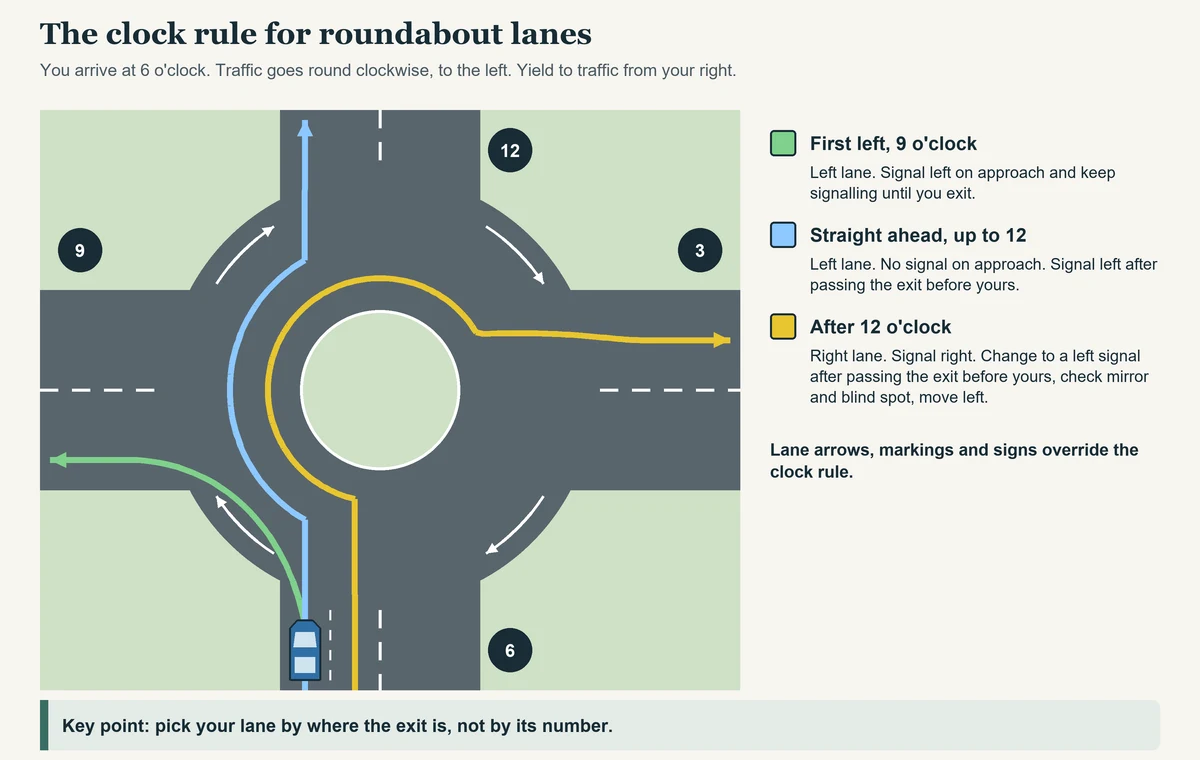
    Picture the roundabout as a clock, with you arriving at 6 o’clock.

    A roundabout drawn as a clock with the driver arriving at 6 o'clock and traffic going round clockwise. Coloured paths show the left lane for the 9 o'clock and 12 o'clock exits and the right lane for the 3 o'clock exit, with the signals for each.
    The RSA clock rule for choosing a roundabout lane. Illustrative diagram, not to scale.
    Your exit Approach lane Signal on approach Signal to leave
    First left (9 o’clock or earlier) Left Left Keep signalling left until you exit
    Straight ahead or any exit up to 12 o’clock Left None Left, after passing the exit before yours
    Any exit after 12 o’clock (right or full circle) Right Right Change to left after passing the exit before yours

    The Rules of the Road says this is a general guide. If lane arrows, markings or signs show something different, follow them.

    Step by step: taking a right-hand exit

    1. Check mirrors and get into the right-hand lane in good time.
    2. Signal right as you approach.
    3. Yield to traffic coming from your right. Go when there is a safe gap.
    4. Keep signalling right as you go round.
    5. When you pass the exit before yours, check your left mirror and blind spot, switch to a left signal and move over to the left.
    6. Leave, checking for cyclists and motorcyclists still going round.

    Going straight ahead when the left lane is jammed

    The Rules of the Road allows a different course if conditions demand it, for example a long queue in the left lane signalling left, or roadworks blocking it. You may then approach in the right lane for a straight-ahead exit. Take extra care leaving across the left lane.

    Watch out for these road users

    • Cyclists and horse riders may stay in the left lane and signal right if they are going round. Give them room and do not cut across them at an exit.
    • Long vehicles, including cars towing, may straddle lanes or take a different line. Stay out of the space they need and watch their signals.
    • Pedestrians crossing the approach and exit roads.
    • Vehicles leaving at the next exit that cross in front of you.
    • Drivers in the wrong lane or straddling lanes. Leave space.

    Cyclists are told to take extra care at exits and may wait for a long vehicle to clear the roundabout before entering. See sharing the road with cyclists in Ireland.

    Mini-roundabouts and signal-controlled roundabouts

    A mini-roundabout is a painted circle, sometimes slightly raised. Specific rules apply to mini-roundabouts, and breaking them carries a €60 fixed charge and 1 penalty point (3 on conviction). Approach slowly and yield to traffic from the right as at any roundabout. Some large roundabouts have traffic lights on the approaches or on the circle itself. Obey the lights as at any junction. See traffic lights and signals in Ireland.

    Common roundabout mistakes

    • Stopping at the give-way line for no reason when your way is clear. Check for traffic already on the roundabout, signals and people crossing, but don’t wait once it is safe to go.
    • Approaching in the wrong lane, then changing lanes on the roundabout without checking.
    • Forgetting to signal left before leaving, or signalling left too early and confusing traffic waiting to enter.
    • Leaving without a final check to the left for cyclists and motorcyclists.
    • Forcing a late lane change to reach an exit. If a car is alongside where you need to go, stay in your lane, take the exit it leads to and reroute.

    A cyclist or motorcyclist staying in the outside lane may be carrying on round, so don’t assume they are leaving at your exit.

    On the Irish driving test the tester checks that you signal correctly and in good time, and that you keep reasonable progress without undue hesitancy at roundabouts. See Irish driving test marking.

    Common questions

    Do you give way to the right on a roundabout in Ireland?

    Yes. Yield to traffic coming from your right, but keep moving if the way is clear.

    Do I signal when going straight ahead?

    Not on approach. Signal left after you pass the exit before the one you are taking.

    Which lane for the second exit?

    It depends where the exit is, not its number. If the second exit is at or before 12 o’clock, approach in the left lane. Lane arrows override this.

    Can I use the right lane to go straight ahead?

    Only where markings allow it, or where conditions such as a long left-lane queue or roadworks make the left lane impractical.

    What do I do if I miss my exit?

    On an ordinary roundabout you can go round again, signalling as before. On a spiral roundabout or where lane markings lead you off, take the exit your lane leads to and find another route. Never reverse or cut across lanes.

    Related: junctions in Ireland, Irish road markings, good driving practice in Ireland. Back to learning to drive in Ireland.

    Sources

    • Road Safety Authority, “Rules of the Road”, Section 9 Junctions and roundabouts and Section 17 Rules for cyclists (Revision 5, hosted on garda.ie)
    • Law Reform Commission, “Road Traffic Act 2002”, First Schedule, revised (revisedacts.lawreform.ie)
    • Irish Statute Book, “S.I. No. 227/2024, Road Traffic Act 2010 (Part 3) (Fixed Charge Offences) Regulations 2024” (irishstatutebook.ie)
  • Junctions in Ireland: Right of Way, Yield Signs and Turning Right

    Junctions in Ireland: Right of Way, Yield Signs and Turning Right

    Photo: Bob Jenkin / Pexels. Illustrative photograph.

    At an Irish junction, traffic going straight ahead on the major road generally has right of way, and at a junction of equal roads you give way to traffic on your right. You must stop fully at a Stop sign, even on an empty road, and slow down and give way at a Yield sign. This guide covers who goes first, how to turn right and left, crossing dual carriageways, and the penalties learners most often pick up.

    Key facts

    • Stop sign or stop line: you must come to a complete stop, every time.
    • Yield sign (Géill Slí) or yield line: slow down and stop only if you need to let traffic pass.
    • Right of way is never absolute. The Rules of the Road says you must always proceed with caution.
    • Failing to stop at a Stop sign or yield at a Yield sign: €80 and 3 penalty points (5 on conviction), as of November 2026.

    Who has right of way at a junction in Ireland?

    Situation Who goes first
    Major road meets minor road Traffic going straight ahead on the major road. Minor road traffic must yield.
    Roads of equal importance (unmarked crossroads) Traffic on your right. Let it pass before you move.
    T junction Traffic already on the road you are joining.
    You are turning right Oncoming traffic going straight through.
    You are turning right, an oncoming car is turning left into the same road The car turning left. You wait.
    Coming out of a private entrance or driveway Traffic on the public road.

    Who must you always yield to?

    • pedestrians already crossing at a junction
    • pedestrians on a zebra crossing, and on a pelican crossing while the amber light flashes
    • pedestrians and traffic when you move off from a stop sign or parking space
    • traffic already turning at the junction
    • traffic in another lane when you want to change lanes

    Watch for cyclists coming off the end of a cycle track, and for mopeds and motorcycles pulling out of side roads. They are small and easy to miss. The Rules of the Road sums up the duty as: stop, look, listen, and look again.

    Turning right at a junction, step by step

    From a major road into a minor road

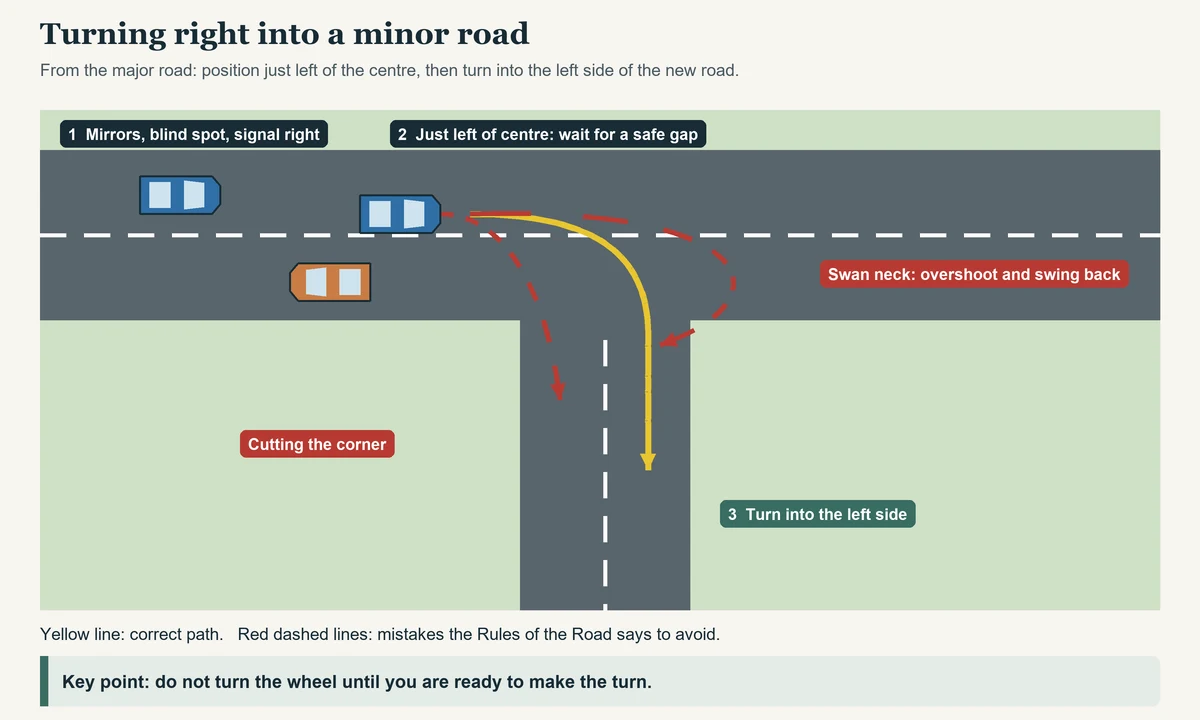
    1. Check mirrors and blind spot early. Signal right.
    2. Move to just left of the centre of the road, or into the right-turn space.
    3. Do not turn the steering wheel until you are ready to make the turn. Leave room for vehicles to pass on your left where possible.
    4. When there is a safe gap, turn into the left side of the new road.
    5. Do not cut the corner, and do not overshoot and swing back (a “swan neck”).
    A car on a major road positions just left of the centre, then turns into the left side of a minor road on its right. Red dashed paths show cutting the corner and a swan neck turn as mistakes.
    Turning right from a major road into a minor road. Illustrative diagram, not to scale.

    From a minor road onto a major road

    1. Mirrors, signal right, and position just left of the centre of your road.
    2. At a Stop or Yield sign, wait at the junction until the road is clear both ways.
    3. Pull out only into a gap in both directions, entering the left side of the major road.

    Two cars turning right at a crossroads

    If possible, pass behind each other (“back to back”). This lets both drivers see oncoming traffic. If the layout does not allow it, you may turn nearside to nearside.

    Turning right from a one-way street

    Move as close to the right-hand side as is safe. Some one-way streets allow two lanes to turn right; follow the markings.

    Turning left

    • Mirrors, signal left, slow down, and keep close to the left kerb without hitting or mounting it.
    • Check your left mirror for cyclists and motorcyclists coming up on your inside. Do not overtake a cyclist just before you turn left.
    • Use a left-turn slip lane where there is one.
    • A flashing amber left arrow lets you turn only after you give way to pedestrians and to anyone approaching on an adjacent cycle track. A clear road to your right is not enough on its own.
    • Give way to pedestrians and cyclists crossing the road you are turning into.

    Yellow box junctions

    Do not enter a yellow box unless your exit is clear. You may wait in the box to turn right if only oncoming traffic is stopping you, as long as you do not block traffic with right of way. Entering a box wrongly is a €60 fixed charge. More in Irish road markings.

    Junctions on dual carriageways

    Keep to the left lane. Use the right lane only to overtake or to turn right a short distance ahead.

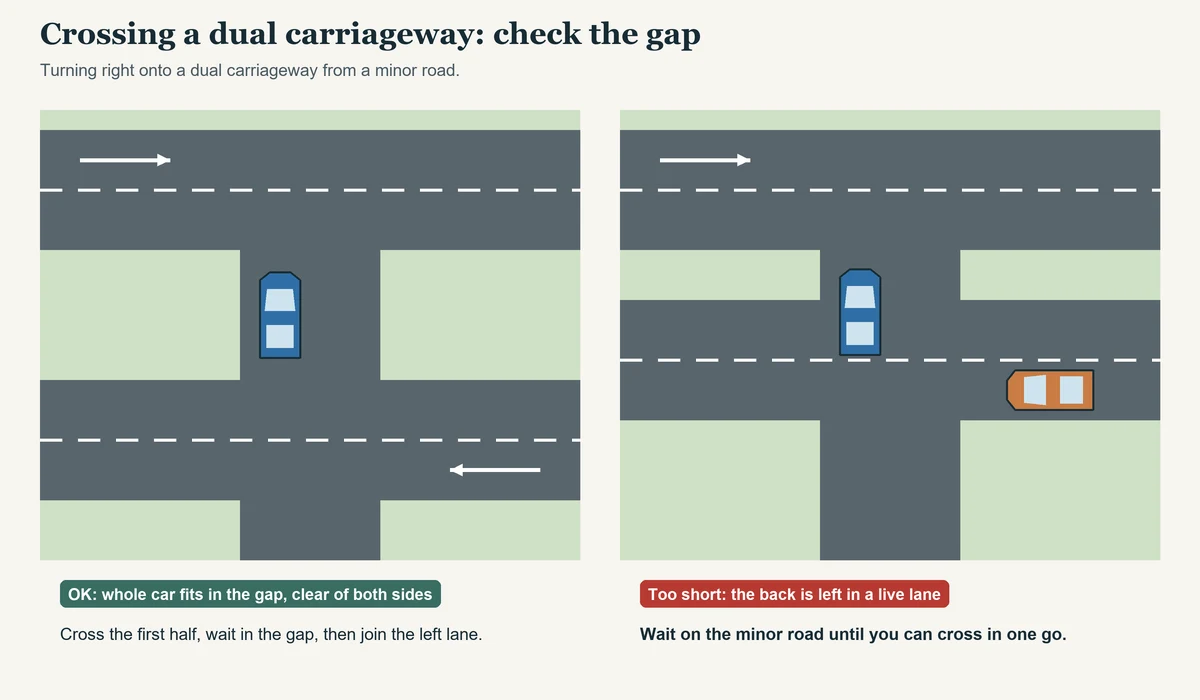
    Two views of a car crossing a dual carriageway from a minor road: on the left the central gap fits the whole car; on the right the gap is too short and the back of the car is left in a live lane.
    Check the central gap fits your whole car before crossing a dual carriageway. Illustrative diagram, not to scale.
    • Turning left on: keep close to the left, wait for a safe gap, then build up to the speed of traffic in the left lane.
    • Crossing or turning right on: first check that the gap in the central reserve can hold your whole vehicle clear of both carriageways. If it can, and it is empty, cross the first half when it is clear and wait in the gap for the second half. If the gap is too short or another vehicle is already in it, wait on the minor road until you can cross without leaving any part of your car in a live lane. Don’t squeeze in beside a waiting vehicle.
    • Turning right off: move into the right lane (or the deceleration lane), turn into the central gap, wait, then finish into the left lane of the new road.

    Long vehicles and cars towing need far more room to turn. Hang back and let them finish.

    Example: you want to turn right onto a dual carriageway. The near lanes are empty, but the central gap is shorter than your car. Pulling out now would leave your back end in a live lane while you wait for the far side, so stay at the minor road until you can make the whole move safely. A driver behind you beeping does not change that.

    Junction penalties

    Offence Points on payment Points on conviction Fixed charge
    Failing to stop at a Stop sign or stop line 3 5 €80
    Failing to yield at a Yield sign or yield line 3 5 €80
    Failing to yield right of way 2 4 €80
    Breaking the rules for driving at a junction 1 3 €60
    Entering a yellow box wrongly None listed None listed €60

    Fixed charges as of November 2026. As a learner or novice you are banned at 7 points. See penalty points in Ireland.

    Common questions

    Do I have to stop at a Stop sign if the road is clear?

    Yes. The Rules of the Road says you must stop at the sign or line even if there is no traffic. Rolling through is a 3-point offence.

    Who goes first at a crossroads with no signs?

    If the roads are of equal importance, traffic on your right has right of way. Approach slowly, because the other driver may not know the rule.

    Can I wait in a yellow box to turn right?

    Yes, if oncoming traffic is the only thing stopping you and you are not blocking traffic with right of way.

    What is a swan neck turn?

    Driving past the correct turning point and then swinging back into the side road. The Rules of the Road says not to do it.

    Do pedestrians have right of way at a junction?

    You must yield to pedestrians already crossing the road you are turning into. The Rules of the Road advises yielding to pedestrians in all cases.

    Related: roundabouts in Ireland, Irish road signs explained, traffic lights and signals, sharing the road with cyclists, common reasons for failing the Irish driving test. Back to learning to drive in Ireland.

    Sources

    • Road Safety Authority, “Rules of the Road”, Section 9 Junctions and roundabouts (Revision 5, hosted on garda.ie)
    • Law Reform Commission, “Road Traffic Act 2002”, First Schedule, revised (revisedacts.lawreform.ie)
    • Irish Statute Book, “S.I. No. 227/2024, Road Traffic Act 2010 (Part 3) (Fixed Charge Offences) Regulations 2024” (irishstatutebook.ie)
    • Law Reform Commission, “S.I. No. 182/1997, Road Traffic (Traffic and Parking) Regulations 1997”, article 30 as substituted by S.I. No. 473/2025, revised (revisedacts.lawreform.ie)