Author: Get Driving Test Ready

  • Pedestrian Crossings in Ireland: Zebra and Pelican Rules

    Pedestrian Crossings in Ireland: Zebra and Pelican Rules

    Photo: Jonathan Borba / Pexels. Illustrative photograph.

    At a zebra crossing in Ireland you must give way to pedestrians who are on it or waiting at it. At a pelican crossing, a flashing amber light means pedestrians have priority. This guide explains each type of pedestrian crossing from the driver’s side, plus school wardens, junctions and the parking and overtaking bans near crossings. It is based on the Rules of the Road, the current crossing rules, with separate penalty references below.

    Key facts

    • Zebra crossing: recognise the designated signs and markings; some crossings have no flashing yellow beacons. Yield to pedestrians waiting to cross or already crossing.
    • Pelican crossing: flashing amber after the red means give way to pedestrians still crossing. Go only when the crossing is clear.
    • Don’t overtake or park in the zig-zag area either side of a crossing.
    • Where the specified crossing or traffic-light layout has no footpath build-out, the parking restriction includes 15 metres on the approach and 5 metres beyond. Other signs, markings and obstruction rules still apply.
    • When a school warden raises the Stop sign you must stop. Failing to: €160 fixed charge and 2 penalty points (5 on conviction).

    When must a driver give way to pedestrians in Ireland?

    The Rules of the Road says you must give way to pedestrians:

    A zebra crossing seen from above with zig-zag areas on both sides, a car stopped behind the stop line, one person waiting at the kerb and one on the crossing.
    Giving way at a zebra crossing. Illustrative diagram, not to scale.
    • on or at a zebra crossing, even if they are only waiting to cross
    • on or at a pelican crossing when the amber light is flashing
    • crossing the road in front of you when you move off, for example from traffic lights or a parking space
    • at a junction, if they have already started crossing

    The traffic regulations add that when you drive out of a driveway or other place onto a public road, you yield to pedestrians as well as traffic. Failing to yield right of way carries an €80 fixed charge and 2 penalty points (4 on conviction).

    Types of pedestrian crossing in Ireland

    Crossing How to recognise it What drivers do
    Zebra Designated zebra signs and striped crossing, with or without Belisha beacons; watch for zig-zag markings Slow down and be ready to stop. Give way to anyone on it or waiting. Stop behind the stop line if there is one and don’t enter any part of the crossing.
    Pedestrian lights Traffic lights for drivers, red and green man for pedestrians, usually a push button Obey the traffic lights as normal.
    Pelican Pedestrian lights where a flashing amber follows the red Red: stop. Flashing amber: give way to pedestrians on the crossing, then go when it is clear.
    Traffic lights at a junction Ordinary junction lights, sometimes no pedestrian signals When turning on green, give way to pedestrians crossing the road you are turning into.
    Toucan Signal-controlled crossing for pedestrians and cyclists Obey your vehicle signal and watch for both walking and cycling movements. A signal for another road user is not permission for your car to go.
    Parallel or combined zebra A designated zebra layout that includes a cycle crossing, which may also be beaconless Yield to pedestrians and the specified cycle, e-moped and e-scooter users waiting or crossing. Use the designated layout; do not assume every ordinary cycle lane has the same priority.
    Courtesy crossing An uncontrolled crossing place, often raised, coloured or patterned The surface alone does not give zebra-crossing priority. Approach very slowly, observe intentions and avoid putting anyone at risk.
    Traffic island A refuge in the middle of the road The island alone does not establish crossing priority. Check the controls on each stage and watch for people waiting on the island.
    Pelican crossing lights: a red light meaning stop, followed by a flashing amber meaning give way to pedestrians still on the crossing and go only when it is clear.
    The pelican crossing light sequence for drivers. Illustrative diagram, not to scale.

    Do not wait for someone to step into your path before yielding at a designated zebra. Current regulations include waiting pedestrians and designated crossings without beacons. At a refuge, check the next stage rather than assuming that the signal or gap used for the first half also covers the second.

    At a parallel or combined crossing, check the cycle approach as well as the pedestrian kerb. A rider can reach the crossing while your car is still approaching. If traffic queues beyond it, wait until there is room for your whole vehicle beyond the crossing.

    Zebra crossings: the details that catch people out

    • A pedestrian who puts a foot on the crossing is signalling they want to cross. Stop.
    • If the zebra has a central island, each side is a separate crossing.
    • The current pedestrian rule requires use of the designated crossing rather than crossing elsewhere within 15 metres. That does not remove your duty to avoid someone who crosses in the wrong place.

    School wardens

    Adult school wardens wear a reflective hat and coat and carry a Stop sign. The law lets them stop traffic. When the sign is raised, you must stop and stay stopped until:

    1. the children have crossed
    2. the sign is lowered
    3. the warden is back on the footpath

    Junior school wardens are senior primary pupils who work in teams of six. When they signal, stay stopped until every junior warden has returned to the footpath. Never park where you block a warden’s view.

    Driving near pedestrians: what the Rules of the Road asks

    • Watch for people stepping out between parked cars, and for people walking to and from buses.
    • Give extra time to older people, people with disabilities and children.
    • Take care beside footpaths with young children, coming out of driveways, in car parks and when reversing. You can’t see a small child behind the car in your mirror. If in doubt, get out and check.
    • Take care passing a school bus where children are getting on or off.
    • On a rural road without footpaths, pedestrians should walk facing you on the right-hand side of the road, so expect them on your side.

    Put the observation into practice

    A bus hides the crossing approach. Children have just got off and one disappears behind the bus. Ease back and keep a speed that gives you time to stop if someone emerges. A gap beside the bus is not evidence that nobody is in it. Do not wave a child across another lane or a cycle track that you cannot control.

    A person pauses on a refuge. Check which stage they intend to cross and whether it has its own signals. Someone using a mobility aid may need more time or space. Stay clear of the crossing while you wait; pressure from a driver behind does not create a safe gap.

    A courtesy crossing looks like a zebra. Read the actual signs, markings and lights. Slow enough to deal with a person already crossing, even though the paving itself does not establish zebra priority. If another lane is still moving, avoid a gesture that could be mistaken for an assurance that the whole road is safe.

    If you are walking to a lesson

    Use the footpath where one is provided. Without one, keep near the right edge of the road, facing approaching traffic. On a narrow or busy road, walk in single file. Bright clothing by day, reflective clothing at night and a torch help others see you; they do not guarantee that a driver has noticed you.

    Choose a place with a clear view, away from bends, hill crests and parked vehicles. Look and listen, let approaching traffic pass and check again before crossing. Keep watching as you cross. A bus, contraflow lane, cycle track or tram route can contain a movement you did not see in the main traffic stream. Never cross directly in front of a stopped bus.

    Fixed charges and penalty points

    Offence Fixed charge Penalty points (payment / conviction)
    Failing to stop for a school warden’s Stop sign €160 2 / 5
    Failing to yield right of way €80 2 / 4
    Failing to obey traffic lights €80 3 / 5
    Driving along or across a footpath (other than to get in or out of a property) €60 1 / 3
    Parking contrary to article 36 near a crossing or traffic lights (distinct from dangerous parking) €60 No points listed for that parking entry

    For the applicable offence and current payment stages, see penalty points in Ireland and parking rules in Ireland.

    Related: junctions in Ireland, traffic lights and signals and Irish road markings. Back to learning to drive in Ireland.

    Sources

    • Road Safety Authority, “Rules of the Road”, current-linked edition reflecting law at 1 March 2025, printed pages 216 to 224; and current “Pedestrian safety” guidance (rsa.ie)
    • Law Reform Commission, revised “S.I. No. 182/1997, Road Traffic (Traffic and Parking) Regulations 1997”, articles 8, 13, 30, 36, 46 and 47C, including October 2025 amendments (revisedacts.lawreform.ie)
    • Irish Statute Book, “S.I. No. 227/2024, Road Traffic Act 2010 (Part 3) (Fixed Charge Offences) Regulations 2024” (irishstatutebook.ie)
    • Law Reform Commission, “Road Traffic Act 2002”, First Schedule, revised (revisedacts.lawreform.ie)
  • Garda Hand Signals and Emergency Vehicles in Ireland

    Garda Hand Signals and Emergency Vehicles in Ireland

    Photo: atelierbyvineeth / Pexels. Illustrative photograph.

    In Ireland a Garda directing traffic overrides the traffic lights, so you need to recognise the five Garda hand signals and know what to do when stopped at a checkpoint. This guide covers both, plus how to let an ambulance, fire engine or Garda car through safely. It follows Section 12 and Section 20 of the Rules of the Road and the current fixed charges.

    Key facts

    • Garda signals override traffic lights. If a Garda signals you to stop on a green light, you stop.
    • Failing to obey a Garda’s signal: €80 fixed charge and 1 penalty point (3 on conviction).
    • Failing to stop when a Garda requires you to: €80 and 2 penalty points (5 on conviction).
    • You must carry your driving licence or learner permit whenever you drive.
    • For emergency vehicles: pull over only where it is safe, never mount the kerb unless you absolutely have to, and never go through a red light to make room unless a Garda directs you.

    Garda hand signals in Ireland

    These are the signals set out in the Road Traffic (Traffic and Parking) Regulations 1997 for a Garda on points duty. Drivers and pedestrians must act on them.

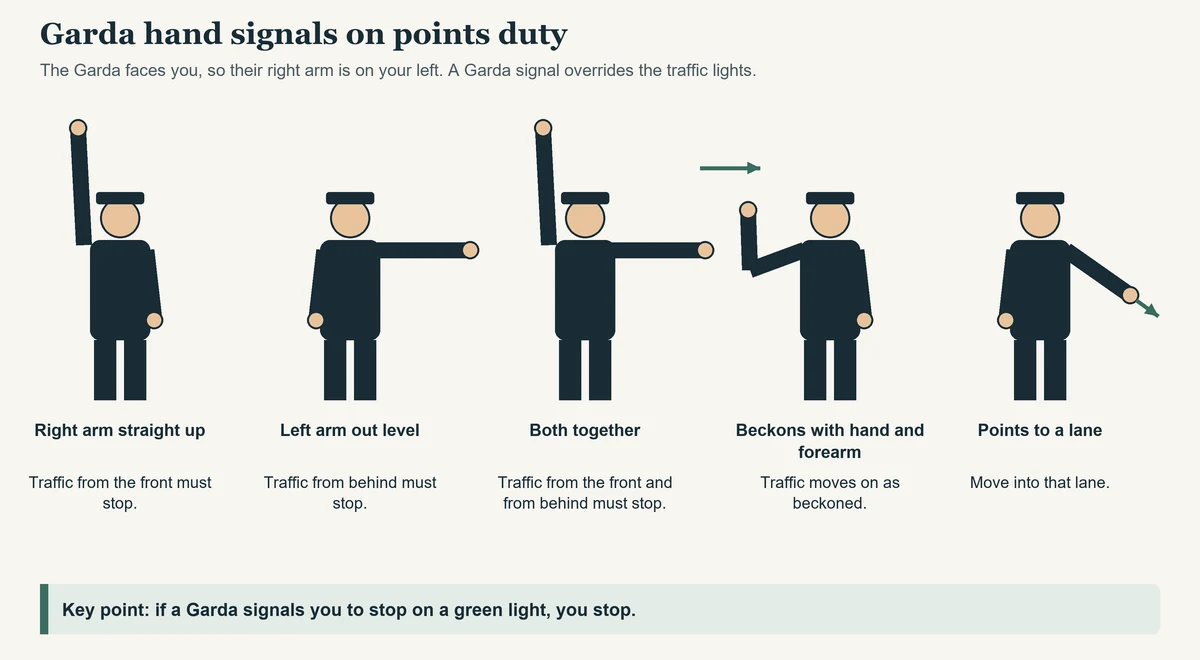
    Five figures of a Garda facing the driver: right arm up to stop traffic from the front, left arm level to stop traffic from behind, both together, beckoning to move on, and pointing to a lane.
    The five Garda hand signals on points duty. Illustrative diagram, not to scale.
    What the Garda does What it means
    Right arm raised straight up above the shoulder Traffic approaching from the front must stop.
    Left arm held out horizontally from the shoulder Traffic approaching from behind must stop.
    Right arm raised straight up and left arm held out horizontally at the same time Traffic approaching from the front and from behind must stop.
    Beckons with the hand and forearm Traffic from the front, the right or the left, or traffic already stopped, moves on as beckoned.
    Points towards a particular lane Move into that lane.

    A direction from a Garda controlling traffic also overrides the normal rules in the regulations. Ignoring a Garda’s direction carries an €80 fixed charge.

    Signalling to a Garda on points duty

    Use your indicator, or the arm signal from the regulations:

    • Straight ahead: raise your forearm and hand upwards, palm to the front.
    • Turning left (car driver): point your right forearm and hand, fingers extended, to the left.
    • Turning right: extend your right arm fully to the right, palm to the front.

    The driving test includes hand signals. See Irish driving test pre-test checks and traffic lights, driver signals and hand signals.

    What a Garda can ask you to do

    If a Garda asks, you must:

    • show your driving licence or learner permit, which you must carry whenever you drive
    • let the Garda examine the discs displayed on your windscreen
    • produce your NCT or roadworthiness certificate, where relevant, at a named Garda station within 10 days
    • produce a valid motor insurance certificate to a Garda within 10 days
    • produce the vehicle registration certificate at any reasonable time
    • stop and let the Garda check the vehicle for defects
    • give your name and address, and write your signature
    • give a roadside breath or saliva (oral fluid) sample
    • do impairment tests if a Garda suspects drug driving, telling them first about any disability or medical condition that could affect how you do them

    Checkpoints and breath tests

    Gardaí can set up mandatory testing checkpoints and require breath or saliva tests from drivers without suspecting they have been drinking or taking drugs. Refusing a breath sample, or refusing impairment tests when required, is an offence. Revenue officials can also stop and examine vehicles. For the alcohol limits that apply to learners and novices, see drink driving limits in Ireland.

    Failing to produce a licence to a Garda carries 1 penalty point (3 on conviction) under the penalty points schedule.

    What to do when an emergency vehicle approaches

    Gardaí, fire brigades and ambulances on an emergency call can be exempt from some traffic rules, as long as they don’t endanger other road users. Your job is to clear the way safely.

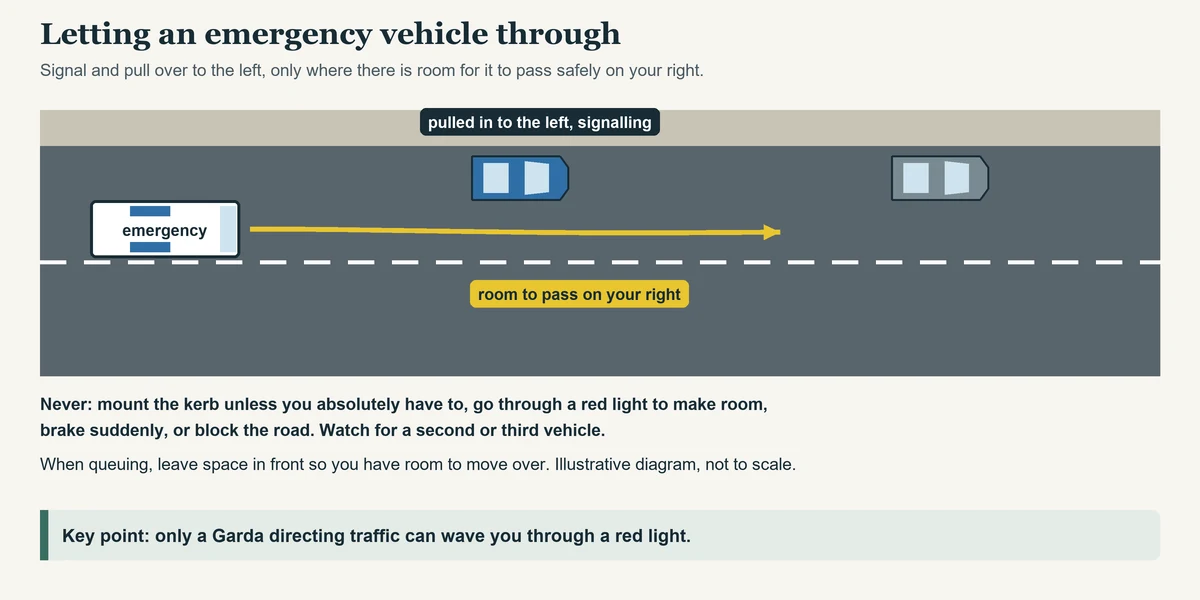
    A car pulled in to the left and signalling while an emergency vehicle passes on its right, with what not to do listed below.
    Letting an emergency vehicle pass safely. Illustrative diagram, not to scale.
    1. Stay alert. Keep in-car noise low enough to hear sirens. Expect emergency vehicles from behind or from a side road at junctions.
    2. Check all mirrors to judge the vehicle’s speed, and look for pedestrians, cyclists and motorcyclists.
    3. Signal and pull over to the left, only where there is room for the emergency vehicle to get past safely on your right.
    4. On a dual carriageway or motorway, move left when it is safe. Garda guidance says emergency vehicles usually overtake in the right-hand lane. Don’t stop in the middle of the road or on the hard shoulder unless you are told to.
    5. Stay there until it has passed. Watch for a second or third vehicle.
    6. Signal and rejoin traffic gradually when it is safe.

    When queuing, leave space in front so you have room to move over. You can’t pull in if you are boxed in nose to tail.

    Never

    • mount the kerb unless you absolutely have to, and only if you are certain no pedestrians are near
    • go through a red light or speed to make room. Stay behind the line and let the emergency driver find a way round you, unless a Garda directs you
    • brake suddenly or block the road
    • tailgate an emergency vehicle, race after it through lights, or overtake one showing flashing lights unless directed

    If a Garda motorcyclist with blue lights stops at a junction ahead of you to escort other vehicles, stop and stay there until the escorted vehicles have passed or the Garda waves you on.

    Common questions

    Can I go through a red light to let an ambulance pass?

    No. Stay behind the line and let the ambulance find a way round you. Only a Garda directing traffic can wave you through a red light.

    A Garda waves me on but the light is red. What do I do?

    Follow the Garda. A Garda’s signal overrides the traffic lights.

    Do I have to carry my licence in Ireland?

    Yes. The Rules of the Road says you must carry your licence or learner permit at all times when driving.

    What happens if I don’t stop for a Garda?

    Failing to stop when required by a Garda carries an €80 fixed charge and 2 penalty points, or 5 points on conviction, as of November 2026. See penalty points in Ireland.

    Can a Garda breath test me at a checkpoint for no reason?

    Yes, at a Mandatory Alcohol Testing checkpoint. Refusing is a criminal offence.

    What should I do if an emergency vehicle comes up behind me on a narrow road?

    Signal, then pull in where it is wide enough for it to pass safely, even if that means going a little further. Don’t stop on a bend or the brow of a hill.

    Related: what to do at the scene of a crash. Back to learning to drive in Ireland.

    Sources

    • Road Safety Authority, “Rules of the Road”, Section 1 Carrying a driving licence, Section 12 Assisting Gardaí, Section 20 Emergency services vehicles (Revision 5, hosted on garda.ie)
    • Irish Statute Book, “S.I. No. 182/1997, Road Traffic (Traffic and Parking) Regulations 1997”, articles 6 and 19 and Second Schedule Tables B and C (irishstatutebook.ie)
    • Irish Statute Book, “S.I. No. 227/2024, Road Traffic Act 2010 (Part 3) (Fixed Charge Offences) Regulations 2024”, Schedule 5 (irishstatutebook.ie)
    • Law Reform Commission, “Road Traffic Act 2002”, First Schedule, revised (revisedacts.lawreform.ie)
    • An Garda Síochána, “Roads policing message: emergency vehicles”, Crimecall, 31 March 2025 (garda.ie)
    • Law Reform Commission, “Road Traffic Act 2010”, sections 9 to 11, revised (revisedacts.lawreform.ie)
  • Parking Rules in Ireland: Clearways, Disabled Bays and No Parking

    Parking Rules in Ireland: Clearways, Disabled Bays and No Parking

    Photo: Phil Evenden / Pexels. Illustrative photograph.

    Parking rules in Ireland come from the Rules of the Road and the Road Traffic (Traffic and Parking) Regulations 1997. This guide lists where you cannot park even without a sign, explains clearways, yellow lines, disc parking and disabled bays, and gives the fixed charges as of November 2026. It is written for learners and new drivers, and the same rules come up in the theory test.

    Key facts

    • No parking within 5 metres of a junction, unless parking spaces are clearly marked.
    • No parking within 15 metres before or 5 metres after a pedestrian crossing or traffic lights.
    • Double yellow lines: no parking at any time. Single yellow line: no parking during the times on the nearby plate.
    • Clearway: no stopping or parking during the signed hours, except when queuing in traffic.
    • Parking in a disabled bay without a permit: €150 fixed charge.
    • Parking on a footpath: €80. Dangerous parking: €80 and 3 penalty points.

    How to park correctly

    • Park close to and parallel with the kerb, facing the direction of traffic, unless bays are marked out.
    • If a bay is marked, park fully inside it.
    • Handbrake on, engine off, first gear or reverse (P in an automatic).
    • Check for cyclists, motorcyclists and pedestrians before opening a door. Passengers should get out on the kerb side.
    • Lock the car. Don’t leave headlights on: use only sidelights or parking lights if you need lights.

    Where you cannot park in Ireland, even without a sign

    Even if there is no “no parking” sign or yellow line, the Rules of the Road says you must not stop or park:

    A street seen from above with red no parking zones 15 metres before and 5 metres after a pedestrian crossing, and 5 metres either side of a junction, plus a car parked parallel to the kerb facing the traffic flow.
    No parking distances near crossings, lights and junctions. Illustrative diagram, not to scale.
    • in a disabled persons parking space without a valid permit on display
    • on white or yellow zig-zag lines at a zebra, pelican or pedestrian lights crossing, or on the crossing itself
    • 15 metres before or 5 metres after a pedestrian crossing or traffic lights
    • on yellow “SCHOOL KEEP CLEAR” zig-zags
    • near the entrance or exit of a fire, ambulance or Garda station
    • in a bus stop or taxi rank (marked BUS or TAXIS)
    • beside a single or double continuous white line along the centre of the road
    • wholly or partly on a footpath, grass margin, cycle lane or track, or median strip
    • within 5 metres of a junction, unless spaces are clearly marked
    • in a casual trading area during trading hours
    • in a contra-flow bus lane at any time, or a with-flow bus lane during its hours
    • in a loading bay (marked LOADING)
    • across an entrance to a property, unless the occupier agrees
    • in a tram lane while it is in force (24 hours unless a plate says otherwise)
    • on the approach to a level crossing
    • where the kerb is lowered for wheelchair users

    You must never park at a corner, a bend, the brow of a hill, a hump-back bridge or a sharp dip, or where you block the view of a school warden. And you must not park anywhere that interferes with traffic or endangers other road users.

    Signs and lines that control parking

    Sign or marking What it means
    Double yellow lines No parking at any time on that side of the road.
    Single yellow line with plate No parking during the times shown on the plate.
    Parking permitted sign with plate Parking allowed only during the times shown, and for the length of time shown if restricted.
    Parking prohibited sign with plate No parking during the times shown.
    Clearway sign with plate No stopping or parking during the times shown, even where disc or meter parking normally applies. You may stop only while waiting in a queue of traffic.
    Disc parking sign Buy a disc for a set time and leave by the end of it. You can’t park again in the same street within one hour.
    Loading bay (LOADING) Goods vehicles loading or unloading only, for up to 30 minutes.

    For the full set of markings, see Irish road markings. For bus lanes and Luas tram lanes, see bus lanes, Luas trams and light rail.

    Disabled parking bays

    Wheelchair users need the extra-wide bay to open their door fully and transfer between wheelchair and car. Only a vehicle displaying a disabled person’s parking permit, parked for the convenience of the permit holder, may use one. Two separate fixed charges apply:

    • parking or stopping in the bay with no permit: €150
    • using a permit in the bay when it is not for the convenience of the permit holder (for example, borrowing a relative’s permit): €200

    Fixed charges for parking offences in Ireland

    As of November 2026, under the Fixed Charge Offences Regulations 2024. Paying late adds 50%, and not paying leads to court. Penalty points apply only where shown.

    Offence Fixed charge Penalty points
    Misusing a disabled permit in a disabled bay €200 None
    Parking in a disabled bay without a permit €150 None
    Parking in a dangerous position €80 3 (5 on conviction)
    Parking on a footpath, grass margin or median strip €80 None
    Parking in a signed cycle track €80 None
    Parking in a bus lane or bus-only street €80 None
    Parking in an EV charging bay when not charging €80 None
    Stopping or parking in a tram lane €60 None
    Stopping or parking in a clearway €40 None
    Stopping or parking at a school entrance €40 None
    Parking in a loading bay €40 None
    Other prohibited places (near a junction or crossing, yellow lines, bus stop and so on) €40 None
    Parking in a pedestrianised street during its hours €40 None

    A Garda decides whether parking is “dangerous”. The Rules of the Road gives the example of a car that forces a pedestrian onto the road. On top of these Garda fixed charges, councils run their own pay-and-display, clamping and towing schemes, and you pay a release fee to get a clamped or removed car back. Those fees vary by council, so check the local authority.

    Common questions

    How close to a junction can I park in Ireland?

    No closer than 5 metres, unless parking spaces are clearly marked closer.

    Can I park half on the footpath on a narrow street?

    No. Parking wholly or partly on a footpath is not allowed and carries an €80 fixed charge. If it forces pedestrians onto the road, it can be treated as dangerous parking with penalty points.

    Can I stop in a clearway to drop someone off?

    Not during its signed hours. The only stopping allowed is while you are waiting in a line of traffic.

    Can I park on a single yellow line in the evening?

    Only outside the times on the information plate nearby. Read the plate every time.

    Is parking a learner car on a footpath during a lesson allowed?

    No. Learners follow the same parking law as everyone else, and the driving test includes parking safely. See Irish driving test manoeuvres.

    Do parking fines give penalty points?

    Most parking offences don’t. Dangerous parking does: 3 points if you pay the fixed charge, 5 on conviction. See penalty points in Ireland.

    Related: pedestrian crossings and sharing the road with cyclists. Back to learning to drive in Ireland.

    Sources

    • Road Safety Authority, “Rules of the Road”, Section 10 Parking (Revision 5, hosted on garda.ie)
    • Irish Statute Book, “S.I. No. 182/1997, Road Traffic (Traffic and Parking) Regulations 1997”, articles 36 to 45 (irishstatutebook.ie)
    • Irish Statute Book, “S.I. No. 227/2024, Road Traffic Act 2010 (Part 3) (Fixed Charge Offences) Regulations 2024”, Schedules 1, 3, 5, 6 and 8 (irishstatutebook.ie)
    • Law Reform Commission, “Road Traffic Act 2002”, First Schedule, revised (revisedacts.lawreform.ie)
    • Law Reform Commission, “Road Traffic Act 2010”, Part 3 Fixed charge offences, revised (revisedacts.lawreform.ie)
  • Two Second Rule and Stopping Distances in Ireland (Metres)

    Two Second Rule and Stopping Distances in Ireland (Metres)

    Photo: Aaron King / Pexels. Illustrative photograph.

    In Ireland the two-second rule means staying at least two seconds behind the vehicle in front, and at least four seconds in the wet. This guide explains how to check the gap, gives the RSA’s minimum stopping distances in metres for dry and wet roads, and shows why speed matters so much. Learners need these figures for the Driver Theory Test and for the driving test itself.

    Key facts

    • Keep at least a 2 second gap in the dry and double it (4 seconds) in the wet.
    • Minimum stopping distance at 50 km/h: 25 m dry, 36 m wet.
    • At 100 km/h: 70 m dry, 121 m wet. At 120 km/h: 102 m dry, 169 m wet.
    • The RSA says these are absolute minimums. Real stopping distances are often much longer.
    • In a road tunnel the recommended minimum gap for a car is 50 metres.
    • Driving too fast to stop within the distance you can see to be clear is an offence: €160 fixed charge and 3 penalty points.

    How to check the two-second rule

    1. On a dry road, pick a fixed point ahead, such as a lamp post or road sign.
    2. When the back of the vehicle in front passes it, say “Only a fool breaks the two-second rule”.
    3. If you reach the point before you finish the sentence, you are too close. Ease off and drop back.
    4. In wet weather, say it twice.
    A car following another past a lamp post, with the phrase Only a fool breaks the two-second rule, and labels for at least 2 seconds in the dry and 4 in the wet.
    Checking your gap with the two-second rule. Illustrative diagram, not to scale.

    The Rules of the Road calls this gap your “safe headway”. If you tailgate and the driver in front brakes suddenly, you may not have time to react, and if you run into them you will be liable for the damage.

    Severe weather needs more than the wet-weather gap

    Four seconds is a starting point for wet roads, not a promise that you can stop on snow or ice. The current Rules of the Road says that in severe snow, fog or ice you may need to repeat the two-second phrase four or five times, which is about eight to ten seconds. Slow down as well as dropping back. If you cannot see far enough ahead to stop safely, a longer gap alone does not make your speed safe.

    The RSA also advises against using cruise control in heavy rain, hail, snow, fog or ice. Learn how to switch your car’s system off while you are parked, and control your speed yourself when conditions get worse.

    What two seconds looks like in metres

    The gap grows with speed because you cover more ground each second. Simple arithmetic gives these approximate figures:

    Speed Distance covered in 2 seconds Distance in 4 seconds (wet)
    50 km/h about 28 m about 56 m
    80 km/h about 44 m about 89 m
    100 km/h about 56 m about 111 m

    That is why counting seconds works better than guessing metres: it adjusts to your speed automatically. It does not adjust for grip or visibility, so add more time when conditions are worse.

    If another car moves into the gap you were keeping, ease off smoothly to rebuild it. Don’t brake hard or speed up to close the space.

    Stopping distances in Ireland: the RSA tables

    Total stopping distance is the distance you travel while reacting plus the distance the car needs to brake to a stop. These are the RSA’s recommended minimums for a car.

    Bar chart of RSA minimum stopping distances for a car at 30 to 120 km/h, split into reaction and braking distance, dry and wet. At 120 km/h the total is 102 m dry and 169 m wet.
    RSA minimum stopping distances for a car, dry and wet, in metres.

    Dry road

    Speed (km/h) Reaction distance (m) Braking distance (m) Total minimum stopping distance (m)
    30 6 6 12
    40 8 10 18
    50 10 15 25
    60 12 21 33
    80 16 36 52
    100 20 50 70
    120 24 78 102

    Wet road

    Speed (km/h) Reaction distance (m) Braking distance (m) Total minimum stopping distance (m)
    20 4 5 9
    30 6 10 16
    40 8 17 25
    50 10 26 36
    60 12 37 49
    70 14 50 64
    80 16 65 81
    100 20 101 121
    120 24 145 169

    Source of the tables: Transport Research Laboratory (UK) 2012 figures, as published by the RSA in the Rules of the Road.

    Three patterns worth remembering

    • Reaction distance in the tables is the speed divided by five: 50 km/h gives 10 m, 100 km/h gives 20 m.
    • Double the speed, nearly four times the braking. The RSA notes braking distance on a wet road rises from at least 26 m at 50 km/h to at least 101 m at 100 km/h.
    • Wet roads add a lot at speed. At 120 km/h the wet total is 67 m longer than the dry total.

    What makes stopping distances longer

    The Rules of the Road splits stopping into four parts:

    • Perception time: seeing a hazard and recognising it. This can be 0.25 to 0.5 seconds or more.
    • Reaction time: moving your foot from accelerator to brake. Usually 0.25 to 0.75 seconds, but it can be as long as 1.5 seconds.
    • Vehicle reaction time: depends on the condition of the car, especially the brakes.
    • Braking capability: brakes, tyre pressure and tread, vehicle weight, suspension and the road surface.

    The first two are down to you. Alcohol, drugs, tiredness and poor concentration all slow them. The RSA gives an example: a perception and reaction time of 4 seconds at 100 km/h means the car travels 110 metres before the brakes even come on. See tiredness, drugs and road rage and vehicle safety checks for tyres and brakes.

    Speed and pedestrians

    The Rules of the Road quotes RoSPA (UK) figures for a pedestrian hit by a car:

    Impact speed Pedestrians killed
    60 km/h 9 out of 10
    50 km/h 5 out of 10
    30 km/h 1 out of 10

    The law: stopping within the distance you can see

    Under the Road Traffic (Traffic and Parking) Regulations 1997, you must not drive faster than lets you stop within the distance you can see to be clear. As of November 2026 this offence carries a €160 fixed charge and 3 penalty points, or 5 points on conviction. The Rules of the Road also says you must stop on the correct side of the road, in a controlled way, without risk to anyone. Don’t overcorrect by crawling: driving so slowly that you hold up traffic can provoke dangerous overtaking. But never let an impatient driver behind push you above a speed that is safe for what you can see. See speed limits in Ireland.

    Common questions

    Is the two-second rule the law in Ireland?

    The two-second rule itself is RSA guidance. The law is that you must be able to stop within the distance you can see to be clear, and tailgating makes that impossible.

    What gap should I leave on a motorway?

    Still at least two seconds in the dry and four in the wet. In tunnels the recommended minimum gap is 50 metres for a car and 100 metres for other vehicles. See motorways and tunnels.

    Do I need to learn the stopping distance tables for the theory test?

    Stopping distances are part of the Rules of the Road, which the theory test questions are based on. See Irish theory test topics.

    What is the stopping distance at 80 km/h?

    At least 52 metres on a dry road and 81 metres on a wet road.

    Someone is tailgating me. What should I do?

    Increase the gap in front of you so you can brake more gently if needed. That gives the driver behind more time to react.

    Does the driving test check following distance?

    The Rules of the Road lists the headings the test assesses, including allowing sufficient clearance to other traffic, reacting promptly to hazards and adjusting speed appropriately. Sitting too close to the car in front touches all three. See common reasons for failing the Irish driving test.

    Back to learning to drive in Ireland.

    Sources

    • Road Safety Authority, “Rules of the Road”, Section 8 Driving safely in traffic: the two-second rule, and Stopping distance for cars, Tables 5 and 6; Section 11 Tunnels (Revision 5, hosted on garda.ie)
    • Irish Statute Book, “S.I. No. 182/1997, Road Traffic (Traffic and Parking) Regulations 1997”, article 7 (irishstatutebook.ie)
    • Irish Statute Book, “S.I. No. 227/2024, Road Traffic Act 2010 (Part 3) (Fixed Charge Offences) Regulations 2024” (irishstatutebook.ie)
    • Law Reform Commission, “Road Traffic Act 2002”, First Schedule, revised (revisedacts.lawreform.ie)
    • Road Safety Authority, “Rules of the Road”, current edition reflecting the law at 1 March 2025, printed pages 115 to 116 (following distance in bad weather and cruise control) (rsa.ie)
  • Bus Lanes, Luas Trams and Light Rail: Rules in Ireland

    Bus Lanes, Luas Trams and Light Rail: Rules in Ireland

    Photo: Donovan Kelly / Pexels. Illustrative photograph.

    In Ireland you must not drive a car in a bus lane during its hours of operation, and never in a contra-flow bus lane. Tram lanes, used by the Luas in Dublin, are for trams while they are in force: the regulations allow a car in one only for a few narrow purposes, and TFI Luas tells motorists road vehicles are not allowed in them. Follow the signs and markings at each location. This guide explains the signs and markings, who may use bus lanes, the exceptions for getting in and out of premises, how to drive near trams, and the fines, as of November 2026.

    Key facts

    • Bus lanes are marked by a blue and white upright sign, a continuous white line and the words “Lána Bus” on the road.
    • The information plate shows the hours. Bus lanes normally run 7am to 7pm or at peak times. Outside those hours all traffic may use a with-flow bus lane.
    • Contra-flow bus lanes are for buses (and permitted cyclists) at all times.
    • Driving in a bus lane: €60 fixed charge. Parking in one: €80.
    • Tram lanes operate 24 hours unless a plate shows other times.

    Who can use a bus lane in Ireland?

    During its hours of operation, a with-flow bus lane may be entered only by:

    • large public service vehicles (buses)
    • pedal cycles
    • L1e-A e-mopeds (pedal-assisted only, with the motor cutting out at 25 km/h) and electric scooters; throttle-powered and L1e-B e-mopeds are not included
    • taxis and wheelchair accessible taxis being used in the course of business

    A private car may cross a with-flow or contra-flow bus lane only to:

    • get into or out of premises or property next to the bus lane, or
    • get into or out of a road inset next to the bus lane to load or unload goods.

    With-flow, contra-flow and bus-only streets

    Type What it is Can a car use it?
    With-flow bus lane Runs the same direction as the traffic beside it, usually on the left (near side), sometimes on the right (off side) Only outside the hours on the information plate
    Contra-flow bus lane Runs against the traffic beside it No, day or night
    Bus-only street A whole street reserved for buses Only for access to a building or side road

    If a Yield sign appears at the end of a bus lane, the bus must give way as it merges back into traffic.

    Reading the information plate

    The white plate with the blue bus lane sign shows when the lane is reserved for buses. Hours differ from street to street, so read every plate rather than assume 7am to 7pm.

    Trams and the Luas: signs and rules for drivers

    Sign or marking What it means
    Blue tram lane sign (left or right) A tram lane runs beside your lane. Do not drive in it while it is in force (see the narrow exceptions below)
    No Entry with plate “Except Trams” Street for trams only. No other traffic
    No Entry with plate “Except Trams and Access” You may enter only to get into or out of a building
    “LÁNA TRAM” on the road A section of road shared by trams and vehicles
    Warning sign: tramway crossing ahead Pedestrians may be crossing the tracks
    Warning sign: overhead electric cables Tram wires above. Take care with high loads

    When may a car enter a tram lane?

    A tram lane is marked by the blue tram lane sign and a continuous white line, and the information plate shows when it is in force. During those times, the 2003 tram regulations (S.I. No. 98/2003, article 8) say you must not enter it with any vehicle other than a tram, with only these exceptions:

    • crossing it solely to get into or out of premises or property next to it
    • crossing it solely to get into or out of a road next to it
    • crossing it solely to get into or out of a road inset next to it to load or unload goods
    • entering it solely to overtake another vehicle

    These are narrow exceptions, not a second traffic lane. You may not drive along it, stop or park in it, or use it for any other reason. TFI Luas’s own advice to motorists is that road vehicles are not allowed in tram lanes, which are for trams only. If you are not sure an exception applies, stay out, and check with the Department of Transport or your ADI.

    Driving safely near trams

    • Trams have their own light signals. Do not follow a tram through a traffic light junction unless permitted.
    • Obey the traffic lights at tram junctions and keep yellow boxes completely clear.
    • Do not stop or park in a tram lane while it is in force.
    • Watch for pedestrians crossing at tram stops and crossing points.
    • Give cyclists room near tram tracks: rails are slippery and wheels can catch in the grooves.
    • Never touch overhead wires, even indirectly with a long load.
    • Before crossing the tracks, make sure there is room for your whole car beyond them and beyond any yellow box. Luas advises leaving space for the traffic in front to clear the tramway first.
    • Never tailgate a tram. It may stop at a platform or junction and cannot steer round a car.
    • Leave extra stopping distance in wet or icy weather, so you are not braking hard on the rails.
    • On a shared tramway, check the signs and markings first. Luas’s own advice is that if you are not completely sure you can drive there, don’t.
    • If you miss a turn, carry on and find a legal route. Don’t reverse or U turn across the tracks.

    Example: a tram goes but your light stays red

    You are stopped beside a tram. Its signal changes and it moves off. Your light is still red, so you stay put. When your own light turns green, check there is space beyond the tracks before you go.

    Cycle tracks: crossing without cutting in

    Don’t drive along or park on a cycle track. Where you need to cross one, for example to turn into a driveway or side road:

    • check your mirror and blind spot early, then again just before you turn, as a cyclist behind can be alongside within seconds
    • look both ways on two-way and shared tracks, where pedestrians and riders move at different speeds
    • wait outside the track until it is clear, rather than nosing in to claim your place
    • don’t stop across the track while you wait for a gate or a gap in traffic

    Your indicator tells riders what you plan to do. It does not give you priority over them.

    Fines for bus lane and tram lane offences

    Offence Fixed charge
    Driving in a bus lane or on a bus-only street €60
    Parking in a bus lane or on a bus-only street €80
    Entering a tram lane with a vehicle other than a tram €60
    Stopping or parking in a tram lane €60
    Entering a tram-only street €40

    Fixed charges as of November 2026. Parking in a contra-flow bus lane is banned at all times, and in a with-flow lane during its hours. See parking rules in Ireland.

    Common questions

    Can I drive in a bus lane in Ireland outside its hours?

    Yes, in a with-flow bus lane outside the times on the information plate. Never in a contra-flow bus lane.

    Can I use a bus lane to turn left?

    The regulations list two reasons a car may cross a bus lane: to enter or leave premises next to it, or a loading inset. At junctions, follow the road markings and signs, and ask your ADI how local layouts work.

    Are taxis allowed in bus lanes?

    Yes, in with-flow bus lanes, when used in the course of business. Not in contra-flow lanes.

    Can I drive in a bus lane as a learner during the test?

    No. The same rules apply to every driver, and the tester marks failing to obey signs and road markings as a fault.

    Can I drive on the Luas tracks?

    Where LÁNA TRAM marks a shared section, trams and vehicles use the same road, so take extra care. Keep out of a marked tram lane while it is in force, apart from the narrow crossing and overtaking exceptions above, and never drive on a tram-only street unless its plate says “Except Trams and Access” and you need access.

    Back to learning to drive in Ireland. Related: Irish road signs, road markings, level crossings, cyclists.

    Sources

    • Road Safety Authority, “Rules of the Road”, Section 6 Buses, trams, rail and light rail signs, Section 10 Parking and Section 19 Respecting other road users (Revision 5, hosted on garda.ie)
    • TFI Luas, “Safe Driving Around Luas” (luas.ie), read November 2026
    • Irish Statute Book, “S.I. No. 98/2003, Road Traffic (Traffic and Parking) (Amendment) Regulations 2003”, articles 8 to 10 tram lanes and tram-only streets (irishstatutebook.ie)
    • Irish Statute Book, “S.I. No. 332/2012, Road Traffic (Traffic and Parking) (Amendment) (No. 2) Regulations 2012”, article 32 Bus lanes (irishstatutebook.ie)
    • Irish Statute Book, “S.I. No. 222/2024, Road Traffic (Traffic and Parking) (Amendment) Regulations 2024” (irishstatutebook.ie)
    • Law Reform Commission, revised “S.I. No. 182/1997, Road Traffic (Traffic and Parking) Regulations 1997”, article 32 as substituted by S.I. No. 473/2025, revised to 13 October 2026 (revisedacts.lawreform.ie)
    • Irish Statute Book, “S.I. No. 227/2024, Road Traffic Act 2010 (Part 3) (Fixed Charge Offences) Regulations 2024” (irishstatutebook.ie)
    • Road Safety Authority, “E-bikes and e-mopeds” (powered personal transportation) (rsa.ie)
  • Good Driving Practice in Ireland: Moving Off, Position, Lanes

    Good Driving Practice in Ireland: Moving Off, Position, Lanes

    Photo: Oleksandr Kobuta / Pexels. Illustrative photograph.

    Good driving practice in Ireland starts with the basics the Rules of the Road sets out in Section 5: moving off safely, keeping the right road position on the left, changing lanes without cutting anyone up, and slowing or stopping at the side of the road. These are also the skills the driving test marks most often. Each routine is below as a step-by-step list.

    Key facts

    • You must drive on the left-hand side of the road in Ireland. Failing to keep left is a €60 fixed charge and 2 penalty points (4 on conviction), as of November 2026.
    • When moving off from the kerb you must signal and give way to other traffic and pedestrians.
    • When changing lanes you must give way to traffic already in the lane you are moving into.
    • Signalling does not give you the right of way.

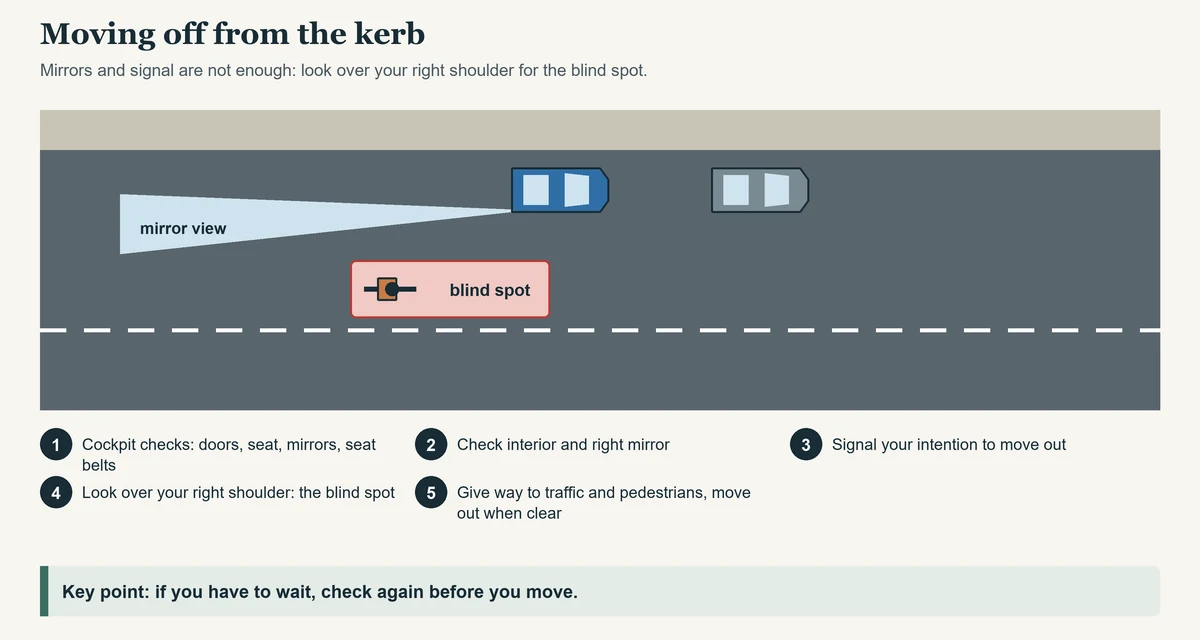
    Moving off: the routine

    1. Cockpit checks: doors, bonnet and boot closed; seat and head restraint adjusted; mirrors clean and adjusted; every seat belt fastened.
    2. Mirrors: check the interior and right mirror.
    3. Signal your intention to move out.
    4. Blind spot: look over your right shoulder. Traffic, cyclists and pedestrians can be beside the car where the mirrors do not show.
    5. Give way to traffic and pedestrians, then move out when clear.
    6. Build speed to the normal safe and legal flow of traffic.
    A car parked at the left kerb with its mirror view behind and a blind spot beside the rear where a cyclist is hidden, with the five steps for moving off.
    Why you check over your right shoulder before moving off. Illustrative diagram, not to scale.

    If you have to wait after checking, check again before you move: a cyclist or pedestrian may have come into the space. Missing the blind spot check when moving off is one of the RSA’s most common reasons for failing. See common reasons for failing.

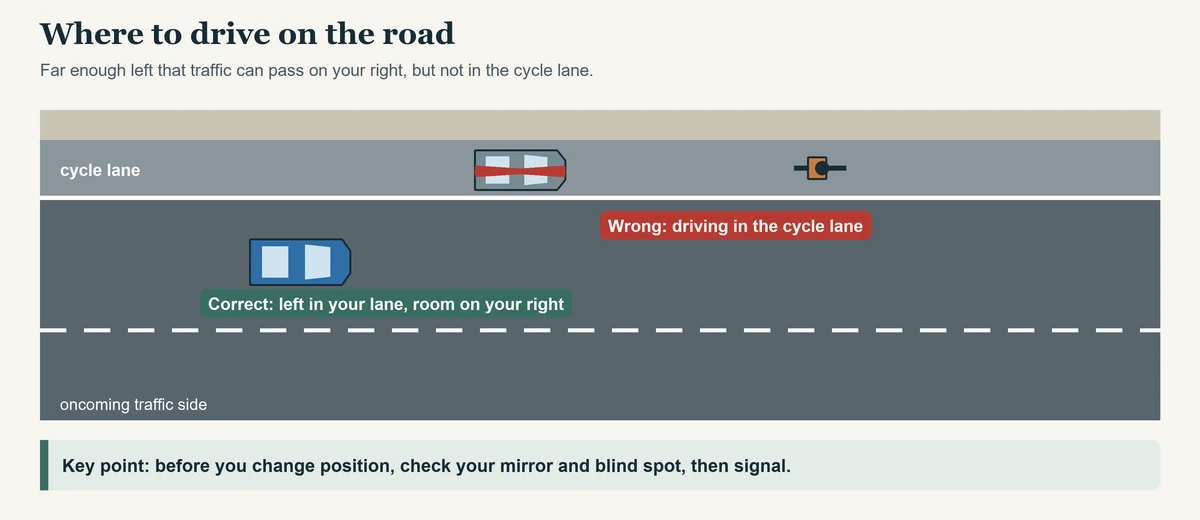
    What is the correct road position in Ireland?

    Drive far enough to the left that traffic can safely pass or overtake on your right, but not so far left that you drive in a cycle lane or block or endanger cyclists or pedestrians.

    A car driving on the left of its lane with room to be passed on the right, and a crossed out car driving in the cycle lane.
    Correct road position: on the left, but not in the cycle lane. Illustrative diagram, not to scale.

    Before you change position, for example to overtake, turn right or pass parked cars, cyclists, horse riders or pedestrians:

    1. Make sure it is safe.
    2. Check your mirror for vehicles coming up on your right, and check your blind spot.
    3. Signal clearly and in good time, then move.

    Buses, schools and cyclists

    • Let signalling buses back into traffic after they pick up or drop off passengers.
    • Near schools and bus stops, watch for pedestrians and children and be ready to stop.
    • At an advanced stop line, let cyclists move off ahead of you.
    • Turning left, watch for cyclists and mopeds near the kerb. Do not overtake a cyclist just before you turn left.
    • The RSA advises leaving at least 1 metre when passing a cyclist where the speed limit is 50 km/h or less, and at least 1.5 metres where it is above 50 km/h. See sharing the road with cyclists.

    How to change lanes safely

    1. Only change lanes for a good reason.
    2. Check your mirrors in plenty of time.
    3. At speed, take a quick sideways glance to check for a vehicle that has dropped out of mirror view.
    4. Signal, then move when it is clear and safe. Give way to traffic already in the lane.
    5. Approaching a junction, follow lane arrows and signs. They tell you which direction traffic in that lane must take.

    Slowing down or stopping at the side of the road

    1. Check your mirror to make sure you can slow and stop safely.
    2. Signal that you are pulling in.
    3. Your brake lights show you are slowing. If you think they may not be seen or are not working, use the slowing-down arm signal (right arm moved up and down outside the window). Get faulty brake lights fixed straight away.
    4. Use a lay-by if there is one, or stop close to the left-hand edge.
    5. Do not leave headlights on when stopped. Use sidelights or parking lights if you need lights.

    Scenario: pulling out from a parked position on a busy street

    You are parked on the left with a car parked ahead. A cyclist is coming up behind. Mirror, signal, blind spot: you see the cyclist, so you wait with the signal on and let them pass. Check again, then move out, leaving room past the parked car before returning to your normal position. Moving out in front of the cyclist would force them to react, which the tester marks as a fault.

    Common questions

    What does the Rules of the Road say about keeping left?

    You must drive on the left-hand side of the road, far enough left for others to pass on your right, but not in a cycle lane.

    Do I always have to signal when moving off?

    Yes. The Rules of the Road says you must signal and give way when moving off from the kerb. The signal never replaces looking.

    Can I overtake on the left?

    Only in limited cases, such as when the driver in front is turning right. See overtaking rules in Ireland.

    What is a blind spot check?

    A look over your shoulder to see the area your mirrors do not cover. Do it before moving off and changing lanes.

    Where am I allowed to reverse or make a U turn?

    See reversing, U turns and towing in Ireland.

    Back to learning to drive in Ireland. Related: junctions, signals and hand signals.

    Sources

    • Road Safety Authority, “Rules of the Road”, Section 1 (message to overseas drivers) and Section 5 Good driving practice (Revision 5, hosted on garda.ie)
    • Road Safety Authority, “Repeating your test” (rsa.ie)
    • Irish Statute Book, “S.I. No. 227/2024, Road Traffic Act 2010 (Part 3) (Fixed Charge Offences) Regulations 2024” (irishstatutebook.ie)
    • Law Reform Commission, “Road Traffic Act 2002”, First Schedule, revised (revisedacts.lawreform.ie)
    • Road Safety Authority, “Cyclists campaign” (rsa.ie)
  • Vehicle Safety Checks in Ireland: Tyres, Lights and Mirrors

    Vehicle Safety Checks in Ireland: Tyres, Lights and Mirrors

    Photo: Leiada Krözjhen / Unsplash. Illustrative photograph.

    In Ireland the driver is responsible for making sure the car is roadworthy, and it is an offence to drive an unsafe vehicle on a public road. This checklist follows Section 4 of the Rules of the Road: tyres, lights and reflectors, windscreens, mirrors, roof racks and registration plates. Use it weekly, and the day before your driving test.

    Key facts

    • Minimum tyre tread: 1.6 mm across the main treads (1 mm for motorcycles and vintage vehicles).
    • Defective or worn tyres: €80 fixed charge and 2 penalty points (4 on conviction), as of November 2026.
    • Fog lights only in dense fog or falling snow.
    • Windscreens on vehicles registered since January 1986 must be laminated glass.
    • Registration plates: plain black characters on a plain white reflective background, no italics or shadows.

    What must I check regularly?

    The Rules of the Road says you must make sure these are checked regularly: steering, brakes, front and rear lamps, indicators, reflectors, rear view mirrors, safety belts, speedometer, tyres, windscreen wipers, horn and silencer.

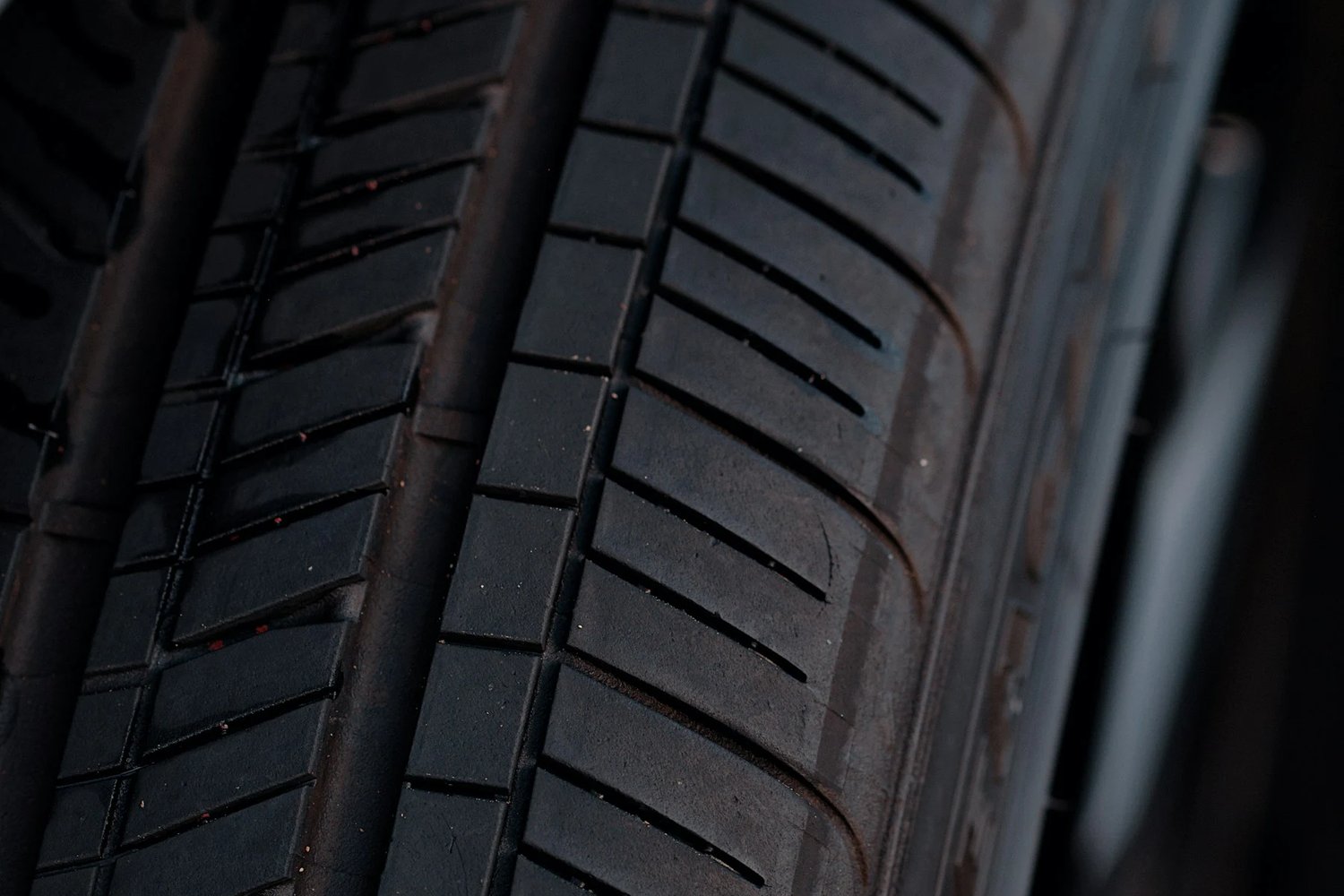
    Tyres

    Check Standard
    Tread depth At least 1.6 mm over the main treads. Replace before you reach it
    Pressure Every tyre, including the spare, to the manufacturer’s figure
    Damage No cuts, cracks or bulges, which can cause a blow-out
    Matching Tyres must be the same on any axle. Do not mix radial and cross ply on one axle
    Replacements New, e-marked tyres from a reputable dealer. Avoid second-hand tyres
    Space saver spare Only to finish the journey or get to a tyre dealer, under the speed stamped on it

    Not accepted on the driving test: a space saver fitted to the car. See your car for the Irish driving test.

    Lights and reflectors

    Front Rear
    Two headlights (white or yellow) Two red tail lights
    Two white sidelights Two red brake lights
    Amber indicators Two red reflectors
    Number plate lighting
    Amber indicators
    • Reversing lights must be white or yellow.
    • Use fog lights only in dense fog or falling snow, and switch them off when it clears.
    • You must not fit blue or red flashing lights. Flashing lights other than indicators are for the Gardai, ambulances and other designated vehicles.
    • Get professional advice before modifying lights, and tell your insurer: some modifications can invalidate your policy.
    • Keep lights, reflectors and number plate lights clean.

    Quick check: switch on the lights and hazards and walk round. For brake lights, ask someone to press the pedal, or reverse up to a wall or garage door and look in the mirror.

    Windscreens and wipers

    • Laminated glass is required on vehicles registered since January 1986, and on any replacement windscreen on older cars.
    • Keep wiper blades in good condition and the washer fluid topped up.
    • Keep the windscreen and windows clean and free of clutter.

    Mirrors

    • Your car must give you a view behind and to each side, through mirrors or an approved digital camera system that replaces them. A reversing camera or parking sensor is not a replacement for mirrors. Keep mirrors, camera lenses and screens clean, and learn where their blind spots are.
    • Keep them clean, undamaged and correctly positioned.
    • You must use them before signalling, moving off, changing lanes, overtaking, slowing, stopping, turning and opening doors.

    Roof racks, roof boxes and bike racks

    • Fit the rack or box securely.
    • The load must not block your view in any direction.
    • Never overload it, or load it so it could fall off or make the car unstable.
    • Check it is mounted and the load secured before you set off. The same applies to roof and rear bike racks.

    Registration plates

    • Plain black characters on a plain white reflective background, in one of the legal formats for vehicles registered since 1 January 1991.
    • No italics or shadows. Keep them clean and readable.
    • You must not interfere with a registration plate.

    Other safety responsibilities

    The Rules of the Road says the driver must keep the vehicle in good working order and have these checked regularly, not just the items above:

    • Brakes and steering: the two systems you rely on most to avoid a crash.
    • Horn: it must work.
    • Speedometer: you cannot keep to the limit without one that works.
    • Silencer (exhaust): part of the regular checks.
    • Indicators, safety belts and windscreen wipers: also on the must-check list.
    • Loads: anything on a roof rack or in a roof box must be completely secured before you set off, must not block your view, must not overload the rack and must not be able to fall off.

    The same section adds two duties to passengers: never leave infants or young children alone in a car, even briefly, and never leave animals alone in a vehicle. It also covers phones. Under section 3 of the Road Traffic Act 2006 you must not hold a mobile phone while driving in a public place, and holding includes supporting it with another part of your body, such as between your ear and shoulder. The law gives a defence if you were calling the emergency services or dealing with a genuine emergency, but that is not general permission to handle a phone. Even hands-free, a call can distract you, so the safest choice is to let calls wait until you have stopped somewhere safe and legal. Holding a phone is a penalty point offence (see penalty points in Ireland). Avoid headphones or loud entertainment systems that stop you hearing sirens or horns. Towing a trailer brings its own rules: see reversing, U-turns and towing in Ireland.

    Electric cars and driver assistance

    If you practise in an electric car, learn how to charge it and how to use the charging point safely, following the car and charger instructions. If a cable, plug or charger looks damaged, do not use it. Know how the car shows that it is ready to move, and how its controls differ from the car you usually drive.

    Find out which driver assistance features your car has, and what their warnings mean, before you set off. A parking alert, lane warning or automatic braking does not replace your own observation, steering and braking. Ask your instructor to explain any unfamiliar controls while you are parked, and keep an observation routine that works when a feature is switched off or not working.

    Useful to keep in the car

    The RSA suggests a first aid kit, at least one high-vis vest or jacket, at least one red warning triangle, and a torch.

    Common questions

    What is the legal tyre tread depth in Ireland?

    1.6 mm over the main treads for most vehicles. 1 mm for motorcycles and vintage vehicles.

    What are the penalties for bald tyres?

    €80 fixed charge and 2 penalty points on payment, 4 on conviction (as of November 2026).

    Can I drive with one brake light out?

    No. Two working red brake lights are required, and the test will not go ahead with a brake light out.

    When can I use fog lights?

    Only in dense fog or falling snow.

    Which technical checks come up on the driving test?

    The tester asks you to demonstrate checks on items such as tyres, lights, reflectors, indicators, oil, coolant, washer fluid, steering, brakes and horn. See pre-test checks.

    Back to learning to drive in Ireland. Related: tax, insurance and the NCT, seat belts and child car seats, driving at night.

    Sources

    • Road Safety Authority, “Rules of the Road”, Section 4 Vehicle safety and Section 3 The driving test (Revision 5, hosted on garda.ie)
    • Irish Statute Book, “S.I. No. 227/2024, Road Traffic Act 2010 (Part 3) (Fixed Charge Offences) Regulations 2024” (irishstatutebook.ie)
    • Law Reform Commission, “Road Traffic Act 2002”, First Schedule, revised (revisedacts.lawreform.ie)
    • Law Reform Commission, Revised Acts, Road Traffic Act 2006, section 3 (revisedacts.lawreform.ie)
    • Road Safety Authority, “Rules of the Road”, current edition reflecting the law at 1 March 2025, printed pages 40 (electric vehicles and driver assistance) and 44 (mirrors and approved camera systems) (rsa.ie)
  • Tax, Insurance and the NCT: Driving Legally in Ireland

    Tax, Insurance and the NCT: Driving Legally in Ireland

    Photo: RDNE Stock project / Pexels. Illustrative photograph.

    To drive legally in Ireland you need a valid licence or learner permit on you, a taxed and insured car with the discs displayed, and an NCT certificate once the car is 4 years old. This guide covers each requirement, the NCT age rules, and the fines and points for getting them wrong, as of November 2026.

    The legal checklist before every drive

    The Rules of the Road says you must be able to answer yes to each of these:

    1. Am I carrying my driving licence or learner permit?
    2. Is the car taxed, with the tax disc on the windscreen?
    3. Is the insurance valid and does it cover me?
    4. Is the insurance disc on the windscreen?
    5. If I am a novice, are N plates front and rear? (Learners: L plates.)
    6. Is the car roadworthy, with a current NCT disc if it is over 4 years old?

    Carrying your licence or learner permit

    You must carry your driving licence or learner permit with you at all times when driving, in every category. Failing to produce a licence to a Garda carries 1 penalty point on payment, 3 on conviction. Driving without a licence carries 2 points on payment and 5 on conviction.

    Motor tax

    Every motor vehicle must be taxed before it goes on the road, and the tax disc must be displayed. Not displaying a tax disc is a €60 fixed charge offence.

    A Bill introduced in 2026 (the National Vehicle and Driver File, Road Traffic and Roads Bill 2026, Bill No. 83 of 2026) proposes ending the paper motor tax disc. Until it becomes law, keep displaying the disc.

    Insurance

    • Every driver must be insured to drive the vehicle in a public place.
    • Driving without insurance is a serious offence. It goes to court and carries 5 penalty points on conviction.
    • You must tell your insurer relevant information before you drive, such as important changes in your medical fitness to drive.
    • Display a current insurance disc. Not displaying it is a €60 fixed charge offence.
    • Trailers must be covered by third party insurance, whether towed or parked in a public place, even though they carry no disc.

    Learners: you must be named on, or covered by, the policy for the car you drive, and for the test you must show the insurance certificate. See learner driver insurance in Ireland.

    When does a car need an NCT in Ireland?

    Car age (from first registration) NCT rule
    Under 4 years No NCT needed
    4 years First NCT due
    4 to 10 years Every 2 years
    Over 10 years Every year
    • The test is due on the anniversary of the car’s first registration.
    • Display the NCT disc on the windscreen.
    • You can choose voluntary early testing more than 90 days before the due date.
    • Older classic cars can have different rules. Check your car’s due date on the NCTS website using the registration number.

    Using a car without a valid NCT certificate: €60 fixed charge and 3 penalty points (5 on conviction).

    Commercial vehicles, such as goods vehicles, buses and ambulances over a year old, take the Commercial Vehicle Roadworthiness (CVR) test every year instead.

    Fines and points at a glance

    Offence Fixed charge Points (payment / conviction)
    No tax disc displayed €60 None listed
    No insurance disc displayed €60 None listed
    No NCT certificate €60 3 / 5
    No insurance Court only 5 on conviction
    Driving without a licence None listed 2 / 5
    Failing to produce a licence to a Garda None listed 1 / 3

    As of November 2026. “None listed” means no fixed charge for that offence appears in the 2024 fixed charge regulations. Learners and novices are banned at 7 points. See penalty points in Ireland.

    Common questions

    Can I drive a car that is not taxed if it is insured?

    No. A vehicle must be taxed before it is taken on the road.

    Does a learner need the NCT disc on the test car?

    Yes, if the car is old enough to need an NCT. A missing or out-of-date disc means the test does not go ahead. See your car for the Irish driving test.

    Is the paper tax disc gone?

    Not yet. A 2026 Bill proposes removing it, but until it is law you must display the disc.

    When is the first NCT on a new car?

    When the car is 4 years old, on the anniversary of its first registration.

    Do I need to carry my licence or is a photo enough?

    The Rules of the Road says you must carry your driving licence or learner permit at all times when driving.

    Back to learning to drive in Ireland. Related: vehicle safety checks, N plates.

    Sources

    • Road Safety Authority, “Rules of the Road”, Section 1 Carrying a licence, Driving legally, Tax, Insurance and National car test (Revision 5, hosted on garda.ie)
    • Irish Statute Book, “S.I. No. 227/2024, Road Traffic Act 2010 (Part 3) (Fixed Charge Offences) Regulations 2024”, Schedule 6 (irishstatutebook.ie)
    • Law Reform Commission, “Road Traffic Act 2002”, First Schedule, revised (revisedacts.lawreform.ie)
    • Houses of the Oireachtas, “National Vehicle and Driver File, Road Traffic and Roads Bill 2026”, as initiated (oireachtas.ie)
    • National Car Testing Service, “FAQ” (ncts.ie)
  • Irish Driving Licence Categories: AM to DE and What B Covers

    Irish Driving Licence Categories: AM to DE and What B Covers

    Photo: Ruben Boekeloo / Pexels. Illustrative photograph.

    An Irish driving licence or learner permit covers only the categories printed on it, and each category has its own minimum age for a first learner permit. A category B car licence starts at 17. This guide sets out every category from AM to DE, what B lets you drive and tow, the conditions attached to categories, and a short note on Driver CPC for bus and truck drivers.

    Key facts

    • Category B (car): minimum age 17 for a first learner permit.
    • AM (moped), A1 (light motorcycle) and W (work vehicles and land tractors): minimum age 16.
    • Under 16 you must not use any vehicle in a public place.
    • B lets you tow a trailer up to 750 kg MAM, or a heavier one if the car and trailer together are no more than 3,500 kg.
    • Learners in categories B, C, C1, D and D1 must not tow a trailer at all.

    Irish driving licence categories and minimum ages

    The Rules of the Road uses the categories in place since 19 January 2013. Older licences may show the previous names (EB, EC, EC1, ED, ED1).

    Category Minimum age What it covers
    AM 16 Mopeds
    A1 16 Motorcycles up to 125 cc, 11 kW and 0.1 kW/kg; motor tricycles up to 15 kW
    A2 18 Motorcycles up to 35 kW and 0.2 kW/kg, not derived from a vehicle of more than double its power
    A 24, or 20 with progressive access Any motorcycle; motor tricycles (not under 21)
    B 17 Cars and light vans up to 3,500 kg MAM with no more than 8 passenger seats; quadricycles not in AM
    BE 17 Category B vehicle with a trailer up to 3,500 kg MAM
    W 16 Work vehicles and land tractors
    C1 18 Trucks over 3,500 kg and up to 7,500 kg, up to 8 passengers; trailer up to 750 kg
    C1E 18 C1 with a trailer over 750 kg, combination up to 12,000 kg (also B with a trailer over 3,500 kg, up to 12,000 kg combined)
    C 21, or 18 with CPC Trucks over 3,500 kg, up to 8 passengers; trailer up to 750 kg
    CE 21, or 18 with CPC C with a trailer over 750 kg
    D1 21 Minibuses up to 16 passengers and 8 m long; trailer up to 750 kg
    D1E 21 D1 with a trailer
    D 24, or 21 with CPC Buses with more than 8 passenger seats; trailer up to 750 kg
    DE 24, or 21 with CPC D with a trailer over 750 kg

    What does a category B licence cover?

    • Cars, 4x4s and vans with a maximum authorised mass (MAM) of 3,500 kg or less and no more than 8 passenger seats.
    • A trailer of 750 kg MAM or less.
    • A heavier trailer only if the car and trailer MAMs together come to 3,500 kg or less.

    MAM is the weight of the vehicle plus the most it is designed to carry. It is usually on a metal plate fixed by the manufacturer, sometimes called the design gross vehicle weight.

    When you need BE

    To tow a heavier trailer with a car you need category BE. BE covers a car and trailer combination over 3,500 kg and under 7,000 kg. There is no six month wait before a BE test. Towing rules: reversing, U turns and towing in Ireland.

    Conditions attached to categories

    • Automatic only (code 78): pass the test in an automatic and your licence is restricted to automatics.
    • Motorcycles: A2 is limited to 35 kW or less. Category A has no power limit. Progressive access lets you move up from A1 or A2 after holding the lower category for 2 years.
    • Learner conditions: L plates, accompanying driver (B, C, D categories), no motorways, no towing. See the six month rule and L plates.
    • Medical reports: required for C and D categories and for some medical conditions. See medical and eyesight requirements.

    Driver CPC in brief

    Driver CPC (Certificate of Professional Competence) is for professional bus drivers (D1, D1E, D, DE) and truck drivers (C1, C1E, C, CE). New professional drivers pass a theory test, get a learner permit, pass a case study test, and pass practical tests. To keep CPC, drivers complete 35 hours of periodic training every 5 years (42 hours to keep both bus and truck). It is not needed for private, non-business use or for vehicles limited to 45 km/h.

    Common questions

    What age can I start driving a car in Ireland?

    17, for a category B learner permit. You must pass the theory test first.

    Can I drive a tractor at 16?

    Yes, on a category W learner permit or licence. W learners do not need L plates but must not carry a passenger unless the vehicle is built for one and the passenger is a qualified driver.

    Can I tow a caravan on a B licence?

    Only if the caravan is 750 kg MAM or less, or the car and caravan MAMs together are 3,500 kg or less. Otherwise you need BE.

    Can I drive a minibus on a car licence?

    Not if it has more than 8 passenger seats. That needs D1 or D.

    Does a car licence let me ride a moped?

    Not automatically. Check the categories shown on your licence. Each category you want to ride or drive must appear on it.

    How long is a car licence valid?

    Normally 10 years for cars and motorcycles, and 5 years for trucks and buses.

    Back to learning to drive in Ireland. Related: getting a learner permit, after you pass.

    Sources

    • Road Safety Authority, “Rules of the Road”, Section 1 Driving licences and categories of vehicles, and Section 2 Conditions for learner permit holders (Revision 5, hosted on garda.ie)
    • Irish Statute Book, “S.I. No. 719/2007, Road Traffic (Licensing of Learner Drivers) Regulations 2007” (irishstatutebook.ie)
  • After You Pass in Ireland: Your Full Licence and Novice Period

    After You Pass in Ireland: Your Full Licence and Novice Period

    Photo: Raul Ling / Pexels. Illustrative photograph.

    Passing the Irish driving test does not give you a full licence on the spot. The tester gives you a Certificate of Competency, and you then apply to the NDLS for your full licence. This guide covers what to do after you pass, what you can and cannot do in the meantime, the €65 licence fee and the two-year novice period, as of November 2026.

    Key facts

    • You get a Certificate of Competency when you pass. It is valid for 2 years from the cert date.
    • Apply to the NDLS for your full licence: €65 for a car licence, as of November 2026.
    • Until you hold the full licence you are still a learner: you need an accompanying driver and L plates.
    • A first full licence starts a 2-year novice period with N plates.
    • If you let the certificate expire, you have to pay for and sit the test again.

    What happens right after you pass?

    1. The tester tells you the result and you get a Certificate of Competency. Any restriction, such as code 78 for an automatic, is listed on it and later shown as a code on your licence.
    2. You keep driving as a learner. The RSA says you can drive unaccompanied only once you hold a full, valid driving licence. Keep the L plates on and keep your qualified accompanying driver with you.
    3. Apply for your full licence straight away (see below).
    4. Swap L plates for N plates when the full licence arrives.

    How to apply for your full Irish driving licence

    Option What you need
    Online at the NDLS A Public Services Card and verified MyGovID. The NDLS already holds an electronic record of your pass, so you do not upload the certificate.
    In person at an NDLS centre A completed and signed application form, your Certificate of Competency, your current learner permit, and evidence of PPSN and address if changed. Your photo is taken at the centre.

    Fee: €65 for a full car licence, as of November 2026. A car licence is normally valid for 10 years. You must be normally resident in Ireland to apply.

    Do not let the certificate run out

    You must exchange the Certificate of Competency for a full licence within 2 years of the cert date. After that it is no longer valid and you would need a new test. Apply in the first week, not the last month.

    Your novice period: the first 2 years

    A first-time full licence holder is a novice driver for 2 years from the date of the first full licence.

    Rule Novice driver
    N plates Front and rear for 2 years, on any vehicle you are licensed to drive
    No N plates €120 fixed charge and 2 penalty points (4 on conviction)
    Penalty points ban 7 points in 3 years (12 for other full licence holders)
    Alcohol limit 20 mg per 100 ml of blood
    Accompanying a learner Not allowed: an accompanying driver needs 2 years on a full licence
    Motorways Allowed once you hold the full licence

    The novice period applies only once. If you later add another category after the 2 years, you are not a novice again in the new category. Full details: N plates in Ireland.

    First things to practise once you are full

    • Motorway driving, ideally with an ADI first. See motorways and tunnels in Ireland.
    • Night driving and rural roads in different weather.
    • Check your car insurance: tell your insurer you have passed, because your policy and premium may change.

    Common questions

    Can I drive alone the day I pass?

    No. You need the full licence in your hand first. Until then, drive accompanied and display L plates.

    How long does the Certificate of Competency last?

    2 years from the cert date. Exchange it for a full licence before then.

    How much is a full driving licence in Ireland?

    €65 for a car licence, as of November 2026.

    Do I need my certificate to apply online?

    No. The NDLS has an electronic record of your pass. Bring it if you apply in person.

    Do I have to display N plates if I passed in an automatic?

    Yes. The N plate rule applies to every first-time full licence holder. The automatic restriction is separate.

    Back to learning to drive in Ireland. Related: penalty points, drink driving limits, licence categories.

    Sources

    • Road Safety Authority, “After you pass your test” (rsa.ie)
    • Road Safety Authority, “Novice drivers” (rsa.ie)
    • National Driver Licence Service, “Apply for a driving licence” (ndls.ie)
    • Road Safety Authority, “Rules of the Road”, Section 1 Full driving licence and Section 3 What happens when your test is finished (Revision 5, hosted on garda.ie)
    • Irish Statute Book, “S.I. No. 227/2024, Road Traffic Act 2010 (Part 3) (Fixed Charge Offences) Regulations 2024” (irishstatutebook.ie)
    • Law Reform Commission, “Road Traffic Act 2002”, sections 3 and 5 and First Schedule, revised (revisedacts.lawreform.ie)